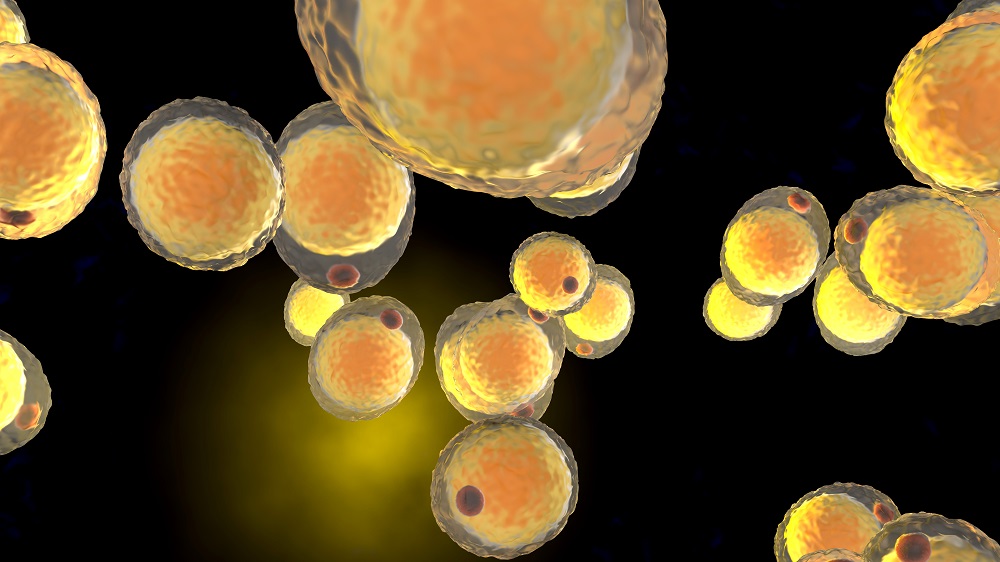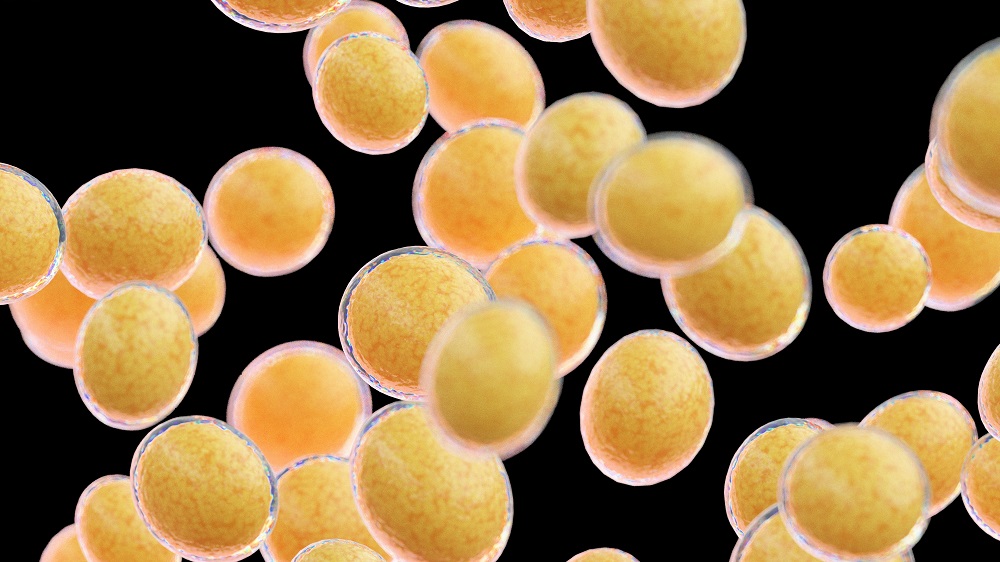
Scientists have discovered that, like brown fat, white fat has a mechanism that burns fuel to produce heat. This effect could potentially be used to create weight loss drugs [1].
Central heating
Cells use energy to power various cellular processes, with heat being a byproduct. However, we might need additional heat to survive. Brown adipocytes are a type of fat cell specializing in heat production. They are critically important in infants and small mammals, helping them to stay warm, but in adult humans, they are relatively scarce.
In obese people, they are even more scarce: brown adipocytes are few and far between, overshadowed by white adipose tissue, which is much worse at producing heat [2]. However, a new study from Cornell University, published in Nature Metabolism, describes a novel mechanism of heat generation in white adipocytes. Enhancing this new mechanism could be a potential new avenue for treating obesity.
Fat cells store energy primarily as triglycerides, molecules that consist of three fatty acid chains linked to a glycerol backbone. When the body needs energy, one of the ways to get it is via lipolysis in fat cells, which cleaves those fatty acids from the backbone and thus creating free fatty acids (FFA). Most of those are then transported outside the cell and into the bloodstream for distribution in tissues in need of energy.
Some FFAs stay inside the cells and undergo either beta-oxidation, an energy-producing process that uses FFAs as fuel, or reattachment to glycerol backbones (re-esterification). Unlike beta-oxidation, re-esterification is an energy-consuming process, requiring lots of ATP, the energy currency of the cell. Hence, theoretically, re-esterification should be directly correlated with cellular respiration, the cell’s default energy-producing process. However, as scientists have previously noticed, the opposite is true: re-esterification is inversely correlated with cellular respiration. This study set out to understand why this is the case.
A distinct uncoupling mechanism
To undergo either beta-oxidation or re-esterification, FFAs must be activated. By tinkering with various stages of these processes, the researchers established that the factor driving respiration was free, unactivated fatty acids themselves.
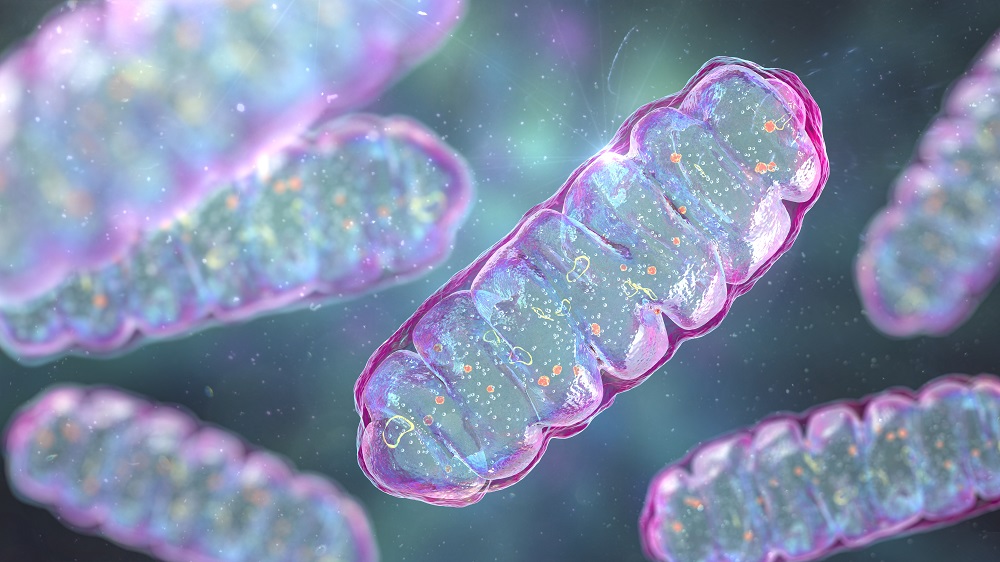
For mitochondria to work properly, they must push protons into the space between their inner and outer membranes; those protons coming back via ATP synthase is what creates ATP molecules, the difference in the proton “pressure” being the membrane potential. The scientists found that when lipolysis was stimulated, this mitochondrial membrane potential collapsed. Another set of experiments confirmed that this was due to the abundance of FFAs in the cell.
This unusual situation, when oxygen consumption by the cell goes up even as the membrane potential decreases, is called uncoupling. Cells were consuming oxygen vigorously even when ATP synthase was completely blocked, which is only possible if protons are leaking back through something other than their normal route of ATP synthase. Something was making these mitochondria’s inner membranes permeable to protons, decreasing membrane potential and causing the “engine” to run without producing the normal amount of ATP.
In brown adipocytes, this is exactly how thermogenesis works via the uncoupling protein UCP1, making mitochondria produce heat instead of ATP, sort of like idling the car’s engine to keep the heater working [3]. However, UCP1 is not known to be expressed in white adipocytes, which is what the researchers saw in their experiments as well. Therefore, the white adipocytes were using an alternative uncoupling mechanism.
The researchers struck gold when they focused on the protein AAC, which sits inside the inner membrane and acts as an ADP/ATP carrier. Blocking AAC completely blocked the uncoupling function, confirming that FFAs create a proton leak via that protein. Apparently, FFAs compete with ADP/ATP for AAC’s “attention.” AAC’s interaction with FFAs both causes the proton leak and distracts AAC from its “day job” supporting ATP production.

White fat takes over thermoregulation in obese mice
Moving to experiments in vivo, the researchers created a strain of mice with increased re-esterification and less intracellular FFAs as a result. Otherwise, the mice were normal, including regular levels of lipolysis, meaning that any differences in thermogenesis could not be explained by reduced fuel supply to other tissues like muscle or brown fat.
On normal diet and/or at room temperature, the mutant mice showed largely normal cold responses. Suspecting that brown adipocytes were still working well enough to ensure thermoregulation, the researchers put the mice on a high-fat diet and in thermoneutral (30°C) housing. Combined, these conditions led to the inactivation of brown adipocytes and expansion of white fat mass. As a result, the mutant mice gained more weight, had more fat mass, could not maintain core temperature during cold exposure, and died at significantly higher rates than controls.
After a couple of alternative explanations were ruled out, it became clear that while in control mice, white adipocytes took over thermoregulation via FFA-mediated uncoupling after the inactivation of brown adipocytes, the same mechanism did not work in mice with less intracellular FFA, making them unable to resist cold by producing heat. The researchers suggest that reversing this logic – i.e., increasing heat production by white adipocytes, such as by ramping up intracellular FFAs – might pave the road to new obesity treatments, which could work especially well alongside popular GLP1 receptor agonists.
“There is still a lot of research to do, but in principle this approach to treating obesity might be very effective and safe,” said the study’s senior author, Shannon Reilly, an assistant professor of metabolic health in medicine and a member of the Joan and Sanford I. Weill Center for Metabolic Health at Weill Cornell Medicine. “Current weight-loss medications work by reducing hunger but sometimes have unpleasant digestive side effects. This new approach complements these existing therapies and thus could potentially be used in conjunction with lower doses to minimize unwanted side effects.”
Literature
[1] Ahmadian, M., Aksu, A.M., Dhillon, P. et al. (2026). Fatty acids promote uncoupled respiration via ATP/ADP carriers in white adipocytes. Nat Metab.
[2] Becher, T., Palanisamy, S., Kramer, D. J., Eljalby, M., Marx, S. J., Wibmer, A. G., … & Cohen, P. (2021). Brown adipose tissue is associated with cardiometabolic health. Nature medicine, 27(1), 58-65.
[3] Cannon, B., & Nedergaard, J. (2004). Brown adipose tissue: function and physiological significance. Physiological reviews, 84(1), 277–359.