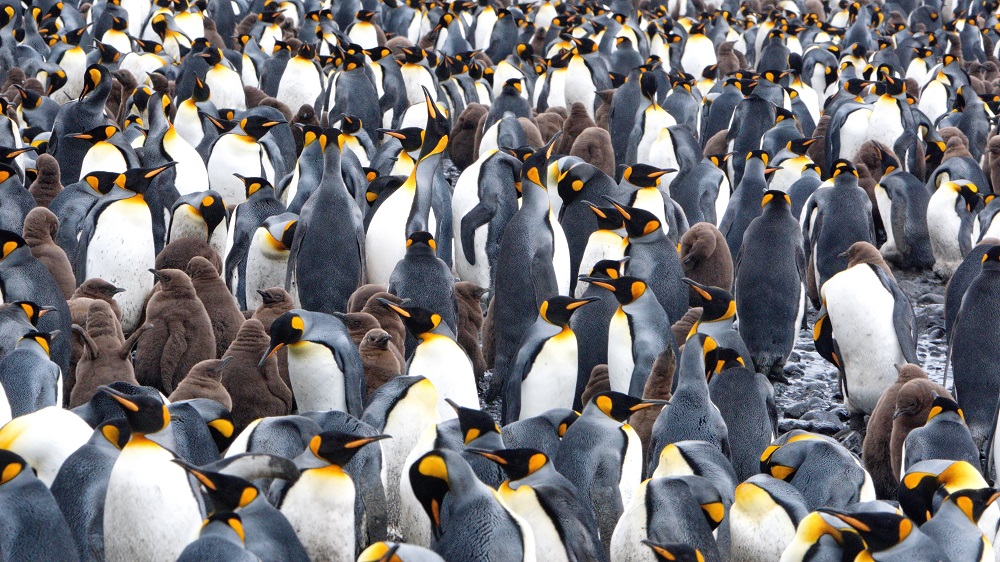
A recent study suggests that the transition of king penguins from the wild to a zoo environment, which resembles a sedentary, well-fed Western lifestyle, results in accelerated aging and changes in metabolic pathways [1].
A unique model system
A sedentary lifestyle and obesity are linked to accelerated aging in humans and, at the molecular level, negatively impact the hallmarks of aging [2, 3]. On the other hand, such interventions as increasing physical activity [4], caloric restriction [5], and manipulation of nutrient-sensing pathways [6] are reported to have a positive impact on the rate of aging. However, much of the data on this topic comes from mouse models, which have limitations, and whether these findings will translate to humans and provide lifelong improvements remains debated [7], creating the need for alternative model systems.
A team of researchers based in Europe decided to explore this research area using king penguins. King penguins, when living in the wild, show a unique behavior among model systems studied to date: voluntary fasting. Specifically, during their breeding cycle, king penguins undergo prolonged fasting periods (up to 8 weeks) that have been shown to involve physiological traits similar to those observed in human fasting [8]. These fasting periods are followed by periods of extreme physical activity.
While penguins are not the kind of animals routinely kept in labs, they are frequent inhabitants of zoos around the world, where researchers can study them. When penguins are moved from the wild to the zoo, the transition resembles a shift to a Western lifestyle in humans: their physical activity levels decline, and animals frequently become overweight. [9] This kind of lifestyle change creates a unique opportunity for experimentation, in which the wild environment, with high levels of physical activity and voluntary caloric restriction, serves as the control state, while the zoo environment, with continuous feeding and sedentary behavior resembling the Western lifestyle, is treated as the experimental manipulation. The researchers hypothesized that such a Western-style environment would accelerate aging in zoo-housed king penguins.
“We wanted to investigate whether turning these penguins into nonchalant, well-fed, and well-cared-for individuals would alter their aging trajectory. Since this lifestyle already occurs in zoos, the setup was ideal,” said Robin Cristofari from the University of Helsinki, first author of the study.
Faster aging but longer lives
To estimate penguins’ biological age, the researchers relied on a penguin genome-adapted methylation-based epigenetic clock, as is commonly done in other species and humans. The results showed that zoo-housed king penguins exhibit accelerated epigenetic aging compared with age-matched penguins living in the wild. The numerical value of the acceleration varied between different modeling approaches but was estimated to be between around 2.5 and 6.5 years. Such age acceleration is comparable (when adjusted for the penguin’s lifespan) to the differences seen between smokers and non-smokers in humans.
This accelerated epigenetic aging didn’t translate to faster death. The researchers reported that the median survival age was almost 21 years for zoo-housed penguins and 13.5 years for those in the wild. Those differences are caused by high mortality among young penguins in the wild and zoo animals being protected from predators and having an abundance of food and medical care that allows them to live longer.
“A 15-year-old penguin in the zoo has the body of a 20-year-old penguin in the wild. However, the interesting part is that zoo penguins also live longer, overall. They may be less physically fit, but with no natural predators or Antarctic storms to contend with and with access to veterinary care, they can survive long past the age at which they would typically die in the Southern Ocean,” explains co-researcher Céline Le Bohec, from the French CNRS. This data suggests that the Western lifestyle might increase lifespan but not healthspan, which is in line with observations in humans.
Metabolic changes
To understand age acceleration in the zoo environment, the researchers searched for differences in methylation patterns between the two groups, identifying nearly 300 genes clustered into 11 different molecular pathways. Those pathways were involved in cell growth and in linking nutrient sensing to aging and age acceleration, all supporting the hypothesis that a Western-like sedentary, well-fed lifestyle influences core metabolic processes in king penguins.
Further analysis of the specific genes identified in this study emphasizes their impact on metabolism. For example, a few identified genes are known to play a role in coping with excessive nutrient intake, while others were linked to heart function and physical activity.

The researchers report that their results suggest that zoo-housed penguins need to make significant changes in their gene expression and metabolism to compensate for shifts in diet, especially in lipid composition and food abundance, compared with their wild diet. Additional epigenetic changes are also caused by the substantial decrease in physical activity
Finding a balance
This study adds additional data supporting the detrimental role of a sedentary lifestyle combined with abundant food in age acceleration, a phenomenon that appears to be conserved across various animal species. What’s more, the conclusions drawn from these observations suggest that age acceleration results from the suppression of physical activity and periodic caloric restriction, rather than from being overweight, as the penguins in this study were not clinically obese.
The researchers plan to continue this research in the hope of identifying a lifestyle that can extend both lifespan and healthspan. “We are currently conducting a study in which we induce penguins to eat less and exercise more. It is important to find a moderate lifestyle in a world of abundance—for us humans as well,” concluded research curator Leyla Davis from Zoo Zurich.
Literature
[1] Cristofari, R., Davis, L. R., Bardon, G., Nitta Fernandes, F. A., Figueroa, M. E., Franzenburg, S., Gauthier-Clerc, M., Grande, F., Heidrich, R., Hukkanen, M., Le Maho, Y., Ollikainen, M., Paciello, E., Rampal, P., Stenseth, N. C., Trucchi, E., Zahn, S., Le Bohec, C., & Meyer, B. S. (2026). Lifestyle change accelerates epigenetic ageing in King penguins. Nature communications, 10.1038/s41467-026-70527-8. Advance online publication.
[2] de Rezende, L. F., Rey-López, J. P., Matsudo, V. K., & do Carmo Luiz, O. (2014). Sedentary behavior and health outcomes among older adults: a systematic review. BMC public health, 14, 333.
[3] Tam, B. T., Morais, J. A., & Santosa, S. (2020). Obesity and ageing: Two sides of the same coin. Obesity reviews : an official journal of the International Association for the Study of Obesity, 21(4), e12991.
[4] Ekelund, U., Steene-Johannessen, J., Brown, W. J., Fagerland, M. W., Owen, N., Powell, K. E., Bauman, A., Lee, I. M., Lancet Physical Activity Series 2 Executive Committe, & Lancet Sedentary Behaviour Working Group (2016). Does physical activity attenuate, or even eliminate, the detrimental association of sitting time with mortality? A harmonised meta-analysis of data from more than 1 million men and women. Lancet (London, England), 388(10051), 1302–1310.
[5] Maegawa, S., Lu, Y., Tahara, T., Lee, J. T., Madzo, J., Liang, S., Jelinek, J., Colman, R. J., & Issa, J. J. (2017). Caloric restriction delays age-related methylation drift. Nature communications, 8(1), 539.
[6] Madeo, F., Pietrocola, F., Eisenberg, T., & Kroemer, G. (2014). Caloric restriction mimetics: towards a molecular definition. Nature reviews. Drug discovery, 13(10), 727–740.
[7] Phelan, J. P., & Rose, M. R. (2005). Why dietary restriction substantially increases longevity in animal models but won’t in humans. Ageing research reviews, 4(3), 339–350.
[8] Groscolas, R., & Robin, J. P. (2001). Long-term fasting and re-feeding in penguins. Comparative biochemistry and physiology. Part A, Molecular & integrative physiology, 128(3), 645–655.
[9] Fens, A., & Clauss, M. (2024). Nutrition as an integral part of behavioural management of zoo animals. Journal of Zoo and Aquarium Research, 12(4), Epub ahead of print.