
The Blog

Building a Future Free of Age-Related Disease

Alopecia

Encouraging Hair Growth by Reducing Senescence

In Aging Cell, researchers have described how to improve the hair growth potential of stem cells and organoids by reducing cellular senescence.

The quest for a true stem cell hair treatment

There has been a substantial amount of previous work in restoring hair follicle growth by culturing dermal papilla cells (DPs), which are the mesenchymal stem cells (MSCs) responsible for hair growth within follicles [1]. However, utilizing these cells to treat patients has proved unexpectedly difficult: outside the context of an active hair follicle, these cells quickly forget what they’re supposed to do and their hair growing ability swiftly declines [2].

Furthermore, unlike with rodent cells, repeated passages of human DPs cause them to lose potency. While there have been multiple attempts to restore this through various methods, such as conditioned media [3] and implantation into an extracellular matrix [4], such approaches have only been documented to work on early-passage cells.

The researchers attribute some of this decreasing capability to a rise in cellular senescence, as senescent cells and their secreted compounds (SASP) have been listed as causes of dysfunction [5] and removing them has restored hair in a mouse model [6]. In a living animal, senescent cells are naturally cleared, such as by the immune system; however, this mechanism doesn’t exist in cell cultures.

Hair cells become senescent quickly in culture

In their first experiment, the researchers extracted and cultured DPs and dermal fibroblasts (DFs) from the same donor. While those cells don’t grow hair, they are well-studied in the context of senescence and share a common progenitor with DPs.

The DPs rapidly became more senescent than the DFs, even from the very first cellular passage, according to the well-known biomarker SA-β-Gal. The DPs also rapidly became senescent according to several other markers, including a loss of proliferation and an increase in p16 and p21.

The rapid predominance of senescent cells in DP culture also meant a sharp increase in SASP factors, including the inflammatory factors IL-6 and IL-8. Compounding the problem, cells that were exposed to these inflammatory factors were found to have their own productive abilities suppressed. An RNA analysis confirmed these findings, showing a marked rise in SASP-related signaling among these cultured cells.

A senolytic solution

Senolytics, drugs that remove and destroy senescent cells, may or may not be advisable for living organisms, as senescence is required in some situations. However, in cell cultures, none of those concerns apply.

At passage 3, the researchers administered dasatinib and quercetin, a well-studied senolytic combination, to a population of DPs. This approach was effective: the senescent cells were rapidly killed off. Interestingly, many of the remaining cells entered into a quiescent state, as measured by the biomarker p27; however, quiescent DPs can be woken up and encouraged to fulfill their function, while senescent DPs cannot. As expected, senolytic treatment also removed the influence of the SASP, significantly reducing such SASP factors as IL-6 and the downstream effects.

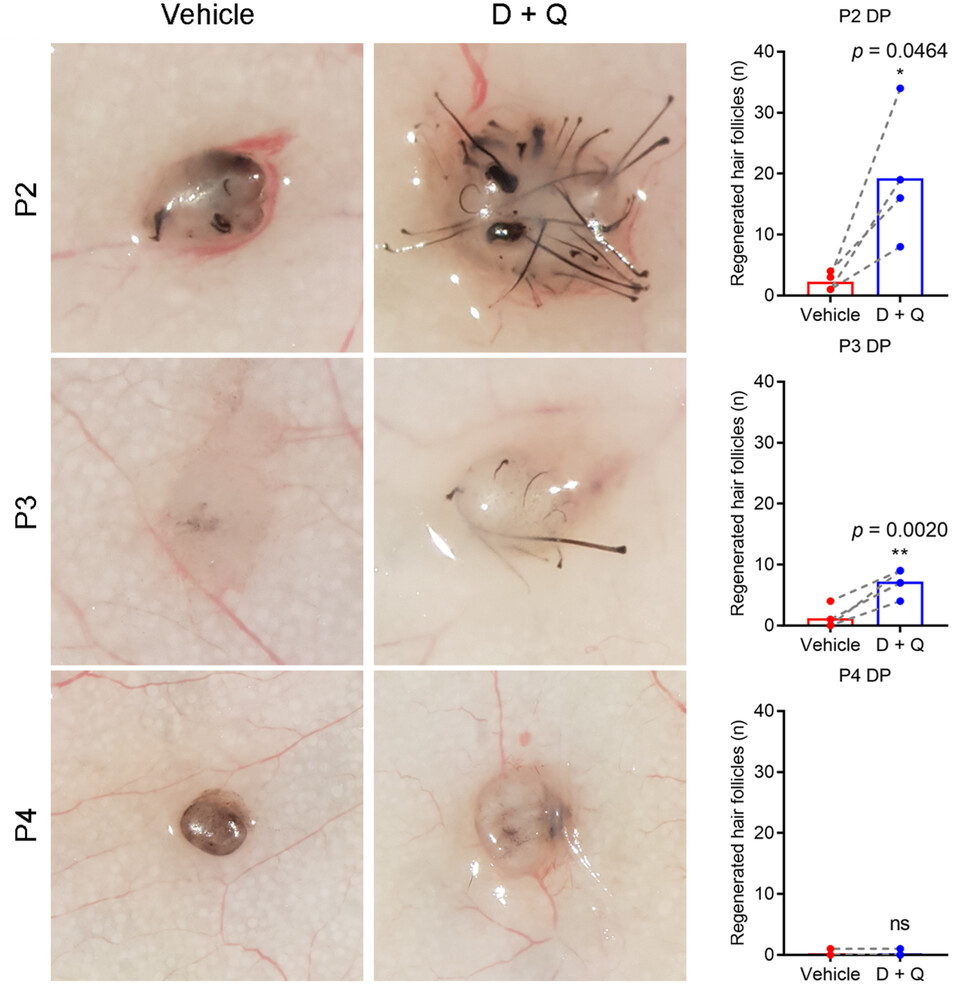
Intrigued, the researchers continued their work by first applying senolytics to DPs at passages 2, 3, and 4, and then using them to create 500 spheroids that each contained 2000 human DPs and a million mouse keratinocytes. They then implanted these spheroids into the backs of hairless mice. Compared to a non-senolytic control group, the senolytic-applied DPs were far more effective at growing hair. Unfortunately but expectedly, the DPs that were taken at passage 2 were more effective than similar cells taken at passages 3 and 4, demonstrating that while senolytics are effective, they are not a complete solution for later-passage DPs.
Hair growth senolytics

These results were recapitulated in an experiment involving cultured human skin. A million human DPs and two million human DFs were seeded in wells of collagen. The cells that were exposed to senolytics were found to grow keratin and hair follicle structures, but the control group that had not been exposed to senolytics did not.

While the researchers acknowledge that their work is incomplete and that they still do not have a readily available treatment for hair loss, they hold that senolytics are key in overcoming one of the major hurdles associated with this line of work. Further research will need to be done to create artificial human skin that can grow hair in the same way that the skin of living, healthy people can.

We would like to ask you a small favor. We are a non-profit foundation, and unlike some other organizations, we have no shareholders and no products to sell you. All our news and educational content is free for everyone to read, but it does mean that we rely on the help of people like you. Every contribution, no matter if it’s big or small, supports independent journalism and sustains our future.

Literature

[1] Leirós, G. J., Kusinsky, A. G., Drago, H., Bossi, S., Sturla, F., Castellanos, M. L., … & Balañá, M. E. (2014). Dermal papilla cells improve the wound healing process and generate hair bud-like structures in grafted skin substitutes using hair follicle stem cells. Stem cells translational medicine, 3(10), 1209-1219.

[2] Ohyama, M., Kobayashi, T., Sasaki, T., Shimizu, A., & Amagai, M. (2012). Restoration of the intrinsic properties of human dermal papilla in vitro. Journal of Cell Science, 125(17), 4114-4125.

[3] Abreu, C. M., Cerqueira, M. T., Pirraco, R. P., Gasperini, L., Reis, R. L., & Marques, A. P. (2021). Rescuing key native traits in cultured dermal papilla cells for human hair regeneration. Journal of Advanced Research, 30, 103-112.

[4] Liu, Z., Huang, J., Kang, D., Zhou, Y., Du, L., Qu, Q., … & Miao, Y. (2023). Microenvironmental reprogramming of human dermal papilla cells for hair follicle tissue engineering. Acta Biomaterialia, 165, 31-49.

[5] Shin, W., Rosin, N. L., Sparks, H., Sinha, S., Rahmani, W., Sharma, N., … & Biernaskie, J. (2020). Dysfunction of hair follicle mesenchymal progenitors contributes to age-associated hair loss. Developmental cell, 53(2), 185-198.

[6] Baar, M. P., Brandt, R. M., Putavet, D. A., Klein, J. D., Derks, K. W., Bourgeois, B. R., … & de Keizer, P. L. (2017). Targeted apoptosis of senescent cells restores tissue homeostasis in response to chemotoxicity and aging. Cell, 169(1), 132-147.
Jamie Justice XPRIZE

Why Research Teams Should Email XPRIZE Healthspan Now

With the deadline for submissions just around the corner, Jamie Justice, Executive Director of XPRIZE HealthSpan, explains to researchers still on the fence why they should contact her team now but also why missing the deadline is not the end of the world.

XPRIZE Foundation has been making history for 30 years with dozens of prizes in various fields, from space exploration to climate research. Symbolically, XPRIZE Healthspan, announced last year, is the biggest one yet, with a whopping $101 million in prize money that can go a long way in advancing the science of longevity.

We have previously discussed XPRIZE Healthspan with XPRIZE founder Peter Diamandis and with Hevolution Foundation CEO Dr. Mehmood Khan. However, when it comes to the nitty-gritty of this giant enterprise, Jamie is the one to talk to, which we did.

Where does XPRIZE Healthspan stand as of now?

We’re just over one year since our launch. We spent our first six months in what we call the public comment period, getting advice from investigators worldwide. Then, we posted our competition guidelines and opened for primary registration – the primary chance for teams to submit qualifying submissions to advance into the competition.

Primary registration closes on December 20th officially, but we have opportunities for teams to come in later. They may not be able to advance through our first judging, but there are still opportunities to get involved, whether as a competitor or through our partnership ecosystem.

Just to clarify: a team will still be able to participate if they submit after December 20th, correct?

They will. Teams submitting after December 20th can still be considered as competitors. However, they might miss our first judging round, after which the top 40 teams will receive $250,000 each to help them advance in the competition. That’s what the December 20th deadline is really for – Milestone One judging. If a team wants to be considered for this, they need to communicate with us by that deadline so that their application can be reviewed in time. But missing this deadline doesn’t preclude teams from entering the competition; they just might not be eligible for these initial monetary awards.

We’re actually going to allow discretionary late registrations all the way to 2027. We know developing the next great idea takes time, especially for those looking to translate into human clinical trials. There are barriers that people might not know if they’re ready to overcome. Maybe they have something newer in development, they’re still doing preclinical work, and they’re on the fence about competing.

We want to encourage such teams to submit now. You can still be judged, and even if you don’t make the top 40, you already have your foot in the door. At no point are we trying to gatekeep, to close people out. They just need to have an open conversation with us and submit a letter of intent to continue.

So, you are encouraging teams to reach out to you.

Yes, email us at healthspan@xprize.org – that’s our team address. Let us know if you might have a late submission. All discretionary late registrations require a conversation with us first, where we ask them to submit a letter explaining why they’ll be late. We’ll determine if there’s an opportunity to move forward. For us, it’s just a matter of timing – we’ll have to form ad hoc judging panels to ensure they can meet goals along the way.

This is a $101 million global incentivized competition. For the grand prize, teams have to show they’ve restored muscle, cognitive, and/or immune function in older adults. The therapeutic must be administered in one year or less. To win, they have to demonstrate that their therapeutic can improve function by 10, 15, or 20 years. These are personalized response thresholds that individuals in their trial must meet. And yes, I said trial – people have to use clinical trials for the finals, which start in 2026.

Right now, we’re asking teams to submit for Milestone One – bring us their idea, tell us who they are as a team, where their testing center might be, where they propose to do clinical trials or what research stage they’re at. They need to detail their therapeutic, their preclinical evidence, what they’ve already done, and ideas about how it might work. It’s a pen-and-paper submission.

The 40 semifinalists will receive funding to continue and get to attend our milestone award summit, coupled with an investor summit. That’s the real prize for making top 40 – the chance to pitch their idea and potentially receive additional funding from investors, funders, or foundations interested in this area.

We’re going to give feedback to all teams who submit. The judges will tell them if there was a gap that needed to be met: “Great application, you might consider bringing in X expertise” or “You might consider finding a clinical research organization.” This is especially valuable for teams that are on the bubble, maybe missing the top 40 but still having an opportunity to make the finals.

How many teams have already applied, and what is their geographic makeup?

We’re at a fascinating point near our deadline. Our goal was 500 teams. My initial goal was 300, but Peter Diamandis said “no, 500,” and we bartered back and forth. Now, we have 510 teams who have at least registered their interest in competing.

Not all will submit qualifying submissions – some may start the process and realize they’re not ready or withdraw. We hope they’ll at least submit something for consideration. It would be sad for those who start with us to not make this final step.

These 510 teams come from 54 countries – we’re truly global. Our top five countries are United States, Canada, China, India, Japan, and United Kingdom (tied). Beyond that, we have strong representation from South Korea, France, Australia, South Africa, Switzerland, Brazil, Denmark, Spain, Israel, Turkey – those are our top 15. This global representation across continents reflects the global interest in aging and longevity research.

XPrize Teams

What is the distribution in terms of academia versus for-profits?

Right now, about 50% of our teams are for-profit. We’re approaching 18-20% academic teams, and that number keeps increasing as we get closer to the submission deadline. We have other nonprofit research organizations and numerous student-led teams – from middle school and high school to undergraduates and graduate students leading teams together. We also have biohacker groups that don’t quite fit any category.

Do you require teams to be legal entities?

We don’t exactly require this, but within our competition guidelines, you need some sort of established entity we can write a check to if you win. How that’s structured on the team’s side, we don’t determine. Some teams are collaborations between legal entities based on memorandums of agreement. Some are actual businesses. Others are figuring out creative ways to pull it together. Some are individuals who’ll name one person as their lead.

Does the prize structure advantage certain types of teams?

It does. We’re asking teams to develop therapeutics, which requires intellectual and infrastructure background to do research. Whether they’re a company, academic group, or small nonprofit, they need facilities. Part of our questionnaire asks if they can conduct clinical trials, if they have research and clinical space. This might make it more difficult for biohacker teams without centralized locations or clinics – not impossible, just challenging.

Interestingly, while academics usually make up 20-30% of registrants, as we know from previous XPRIZEs, they’re actually more likely to make it to the finals. They have certain advantages – support structures, core facilities, or business units built into their institutions, plus existing grant mechanisms they can leverage.

Still, many of our winners are companies. Companies have the advantage of being more nimble – it’s easier for them to pivot and maybe take something from their pipeline that fits. Some academic groups may not be so positioned.

What we’re seeing is a great opportunity for academic and industry teams to merge. Such partnership teams would probably have a distinct advantage – combining the fleet-footed principles from commercial space with academic resources and scientific expertise across both sectors could be a winning combination.

Can you give any advice to the competitors?

I think I did – contact us! If you’re on the fence, try it. Do it. This will be one of those competitions that if you don’t try, you won’t know. If you’re thinking, “Oh my gosh, this qualifying submission is 12 pages” – make it shorter if you don’t have the time but put something together and try.

We have templates online, guidance documents, our email address, a Slack channel we’re monitoring almost 24/7 right now. Not many on my team are sleeping well these days, and we don’t plan to through December 20th. We’re really here for our teams. That’s the biggest advice I can give anyone – just try it. Don’t miss it by sitting on the fence wondering if your idea is good enough.

Can you expand on your endpoints? Making it about restoring function was an interesting decision.

We had to pick endpoints – muscle, cognitive, and immune – working with an endpoints committee to define measures that are simple, understandable, feasible to measure in trials, and show great potential. We established the criteria with our working group and advisory boards (this isn’t published yet, but there will be a scientific paper).

Those criteria consider several factors for each measure: face validity (does a measure of muscle power relate to muscle function?); relevance to biological aging (if the system is disrupted in animal models, is it fundamentally linked to biology?); association with chronological age across multiple populations; link to mortality risk, disease risk, and disability; longitudinal change over time; and responsiveness to intervention.

The hardest criterion for anyone to meet is showing that if it changes with intervention, is it a mediator of change in those events? No one has that because we don’t have enough clinical trials. For measures that haven’t met all criteria, like immune function, we had to decide: do we kick that measure out, or do we use the prize competition process as the means to actually develop the measures?

We’re filling in gaps along the way. What impact points do we need? What datasets are we missing? What consensus factors does the field need? We can use the prize to build momentum and pull people along – refining endpoints, getting measures, determining criteria, developing regulatory frameworks.

Our approach to trial design is particularly interesting. Traditionally, trials compare group averages – treatment group versus control group. That’s great for trials, and we love randomization, but at early stages, it can be challenging. We don’t take therapeutics based on the mean. Yes, maybe this group average is different than that group average, but is it meaningful?

What you’re saying is that the prize will advance the field regardless of the results, for instance, by improving our understanding of how to measure aging.

Yes, the prize gives the longevity field a chance to define what’s meaningful. What do we as scientists, experts, and drug developers think is important? The magnitude of effects we’re choosing – 10 years, 20 years – these are just numbers until we build references behind them. How do we do that?

What is meaningful for a clinician when treating an individual? Clinicians aren’t prescribing to the average, they’re prescribing to someone specific. After that person started the intervention, we need to look at individualized response over time. Did this person improve relative to themselves?

That’s not necessarily how we think in early stages of translation, but it’s how we need to think about applying these therapeutics. We have a chance with this prize to develop those references and consider what matters to individuals, clinicians, stakeholders, and companies that might acquire or de-risk larger trials.

For Milestones one and two, we left a lot up to our teams, but for finals, some things are fixed. We’ll have a data coordinating center, and we feel strongly about the personalized response threshold approach. This requires a particular structure – teams need multiple baseline points before randomization to either drug or control. They can do whatever they want during their intervention period, but we need multiple follow-up points.

Those multiple baseline points before randomization are crucial because we need to know how variable people are in their day-to-day. We need a solid baseline because that person becomes their own control group. When setting thresholds, we’re looking at how they compare to themselves, not to somebody else.

Some parts are absolutely a work in progress – like the biomarkers for immune function. I’ve been on a warpath for a year about this and will continue. By the time we open for finals, I want a biomarkers bonus prize.

A bonus prize is an interesting idea, especially for developing biomarkers of aging, which is a pressing need in our field. This brings me to the question: is the prize open to additional sponsors?

Absolutely. We hope to announce soon an additional sponsor helping with operations. I’d love to have an additional sponsor help put together a biomarker bonus prize. It doesn’t need to be $100 million. It just needs to be enough to get people to chase it. Think of how many people we have to sign up for one-year trials. A biomarker prize would be asking for much less.

We also have opportunities for sponsors to help with marketing, events, documentaries. One big thing XPRIZE does is democratize science. We want public engagement. We’re looking for opportunities for events and outreach, especially to groups that don’t typically compete in prizes like this – student groups or teams from lower or middle-income countries that might not have the resources of larger universities and countries in the West.

There are many sponsorship opportunities, if not through XPRIZE, then to individual teams and groups doing the work. If anybody’s interested in making those contributions, we’d be happy to help make connections and get people engaged. Teams need it. The field needs it.

You seem fired up about this project. What does it mean to you personally?

I am hugely excited about this. I was about to turn in my promotion materials when I got this call from XPRIZE to lead the prize that aligned with my scientific work. It was the biggest bet of my life.

It seemed like a huge risk, relying on the global community to come up and support it. We’re decentralizing not just any science, but the science of longevity. It’s a wild concept – crowdsourcing the greatest innovations that we think will change how we live and age.

To go through this process over the last year and have huge public reception, to have 500 teams sign up, to get sponsors to sign on and have partners like lifespan.io joining us – it’s actually working. We’re just at the start line, but we have people who’ve shown up with us. It’s remarkable.

I was on a call this afternoon with Dr. Lauren Pierpoint, who’s a biostatistician and epidemiologist. She similarly took a bet on XPRIZE, leaving her career. We were going through team submissions and metadata, and she just started giggling and said, “Jamie, it’s working.” We’re just at the start – there’s so much left to do in the next six years – but that we could at least get to this stage speaks volumes.

We received some information after this interview was completed:

XPRIZE Healthspan closes primary registration on Friday, 20 December 2024, but we are extending the deadline for Qualifying Submission upload until 31 December 2024.

This means teams need to go enter their team and contact information on our registration website by 20 December (https://pop.xprize.org/prizes/healthspan/overview) . Teams with an active registration profile will be able to access the portal and complete their ~12-pg Qualifying Submission until the platform closes at 7pm PT on 12/31/24. But teams who wait are at their own risk as our offices are not staffed over the Holidays; there is no guarantee of technical or scientific support for Qualifying Submissions after 20 December.

We would like to ask you a small favor. We are a non-profit foundation, and unlike some other organizations, we have no shareholders and no products to sell you. All our news and educational content is free for everyone to read, but it does mean that we rely on the help of people like you. Every contribution, no matter if it’s big or small, supports independent journalism and sustains our future.
Long Game

LongGame Venture Capital Fund Officially Launched

Crypto investor and founder Will Harborne will lead a new enterprise aimed at funding and supporting groundbreaking longevity technologies.

From crypto to longevity

The burgeoning field of longevity biotech is about to have a new player. Like many recent enterprises, such as Brian Armstrong’s NewLimit, this one is driven by someone coming from the crypto field.

A team led by Will Harborne, a leading crypto investor and founder known for his work with Bitfinex, rhino.fi, and ZKV, has announced today the launch of LongGame, a new venture capital fund designed to invest in groundbreaking longevity biotech companies. The fund is actively fundraising, with the goal set at $40 million.

At a time when many venture capital funds are wary about “high risk, high reward” technologies that may take years and decades to mature, LongGame is going all in, as evident already from its name. The fund proudly touts its “radical focus” and promises that all its investments will “target therapies with the potential to increase human lifespan by 10+ years and ideally significantly more.”

The philosophy and the team

Despite this spirit of disruptive boldness, LongGame’s announced investment priorities are not necessarily revolutionary: stem cell therapies, gene editing, and senolytics. While the first two have a lot of untapped potential, many researchers think that the impact of senolytics on lifespan is more likely to be limited. It remains to be seen whether LongGame will venture into other radical territories such as organ and tissue replacement.

The fund also plans to leverage its crypto roots by “exploring potential crossovers between biotech and crypto in the newly emerging DeSci space.” Decentralized science (DeSci) is indeed an exciting new paradigm aimed at streamlining and democratizing research and development while also fixing some obvious flaws in the current system of incentives.

LongGame boasts an impressive team. Chloe Northcott, formerly at Geometry, will serve as Chief Operating Officer, while Dr. Manish Chamoli, hailing from the famed Buck Institute for Research on Aging, will assume the role of Chief Scientific Officer. Sebastian Brunemeier, General Partner at Healthspan Capital, will join as a special advisor. “The team at LongGame are truly mission-driven and laser-focused on Long-Bio, entering the sector at a time when the field is at a major inflection point,” he told lifespan.io.

“Longevity is the next frontier of innovation, and just as we’ve seen crypto disrupt traditional finance, we believe that longevity biotech will do the same for health,” said Harborne, Founder and Managing Partner of LongGame. “Our goal is to fund therapies that do more than just extend life; we’re looking for solutions that radically expand the healthy human lifespan—by 30 years or more. We’re tackling the root causes of aging, not just the symptoms.”

Leading by example

Will leads by personal example: inspired by longevity pioneers like Bryan Johnson and his Blueprint program, he has transformed his own life in pursuit of life extension. He follows a precision health regimen that includes a supplement stack, exercise, and other practices to optimize physical and mental performance as well as a lot of testing beyond routine bloodwork. Will realizes, however, that lifestyle changes can only take him so far, and to go beyond this, major advancements in our understanding and manipulation of aging biology are required.

Will says that his commitment to longevity is not just a personal journey, but a scientific exploration into the future of human health. He also cares about future longevity therapies being widely available: “We want to ensure that these life-extending therapies are accessible to the masses, not just the wealthy. Longevity shouldn’t be just about helping the wealthy live longer but about helping the whole of society have significantly longer and healthier lives.”

We asked Will a few more questions in an exclusive blitz interview:

What is the new fund’s “secret formula” for success?

Secret formula is to combine our experience as founders in industries which are as highly uncertain as longevity biotech or potentially even more so (like crypto), with super high-quality scientific due diligence and a focus on commercialisability.

Many venture funds are cautious about the long-term and uncertain nature of investing in longevity biotech. However, LongGame seems to embrace it, even in its name. Are you really in this for the long haul?

We are committed to the long haul because solving aging is not a quick endeavor. Our LPs are motivated and fully aligned with this mission as well as with the potential for significant returns. This first fund serves as a precursor to a larger follow-up fund, where we aim to invest at later stages. However, our immediate priority is to demonstrate that early-stage longevity biotech can deliver returns that justify the inherent uncertainty and risk.

While investing in this space is undoubtedly challenging, it also presents immense opportunity. Many companies struggle to raise capital due to the long-term and uncertain nature of the field, with all longevity biotech ventures often painted with the same broad brush. However, not all companies are equal in their paths to commercialization. We see a unique opportunity to identify and support those with stronger short-term commercial prospects, helping them navigate uncertainty more efficiently.

What are your predictions for the near future of longevity biotech, particularly in light of recent setbacks like BioAge discontinuing its Phase II trial? Are we entering “the valley of death”?

We certainly don’t see this as the valley of death, and setbacks in all areas of biotech are common, particularly at clinical trials. Although this has not yet filtered through to clinical trial outcomes due to the long time frames involved, we see the next 10 years as a major engineering unlock (following research breakthroughs). Particularly when combined with progress in all areas of AI, and overlap to biotech, we see the potential for a longevity biotech golden era ahead, with successes leading to a positive feedback loop.

How do you intend to measure life extension outcomes (e.g., +10 years, +30 years)?

That’s very hard to do, and until we get the first approved aging interventions to market, any numbers will be predictions and likely wrong. Eventually, statistical evidence will emerge, and we are looking for life extension in healthy humans, not in obese or inactive populations.

We would like to ask you a small favor. We are a non-profit foundation, and unlike some other organizations, we have no shareholders and no products to sell you. All our news and educational content is free for everyone to read, but it does mean that we rely on the help of people like you. Every contribution, no matter if it’s big or small, supports independent journalism and sustains our future.
Cynomolgus monkey

Extending Monkeys’ Reproductive Span With Stem Cells

An investigation into transplanting human embryonic stem cells (hESC)-derived MSC-like cells (M cells) into the ovaries of cynomolgus monkeys suggests an extension of female reproductive span accompanied by a reduction in senescence-associated processes, such as inflammation, fibrosis, oxidative damage, and apoptosis [1].

Increasing healthspan by delaying menopause

Aging of the female reproductive system precedes aging of other systems, resulting in women living one-third of their lives after menopause [2]. Menopause results not only in the cessation of reproduction but is also associated with health problems such as osteoporosis [3], cardiovascular problems [4], and neurodegenerative diseases [5]. Therefore, delaying menopause could allow women to live longer, disease-free lives, and so the authors chose stem cell transplantation as a possible therapeutic approach to delay ovarian aging and increase the reproductive span.

Perimenopausal Chinese women’s ovarian reserve

Female reproductive aging is tightly linked to ovarian reserve, which is measured by the number of primordial follicles. The ovarian follicle is a cellular structure that releases an egg that can be fertilized. The follicle’s oocyte is surrounded by granulosa cells (GCs) and theca cells (TCs).

A female’s ovarian reserve is established while still in her mother’s womb. Once a woman enters puberty, every menstrual cycle draws from the reserve of primordial follicles. This process slowly diminished the ovarian reserve, leading to menopause.

Multiple studies have analyzed ovarian reserve decline. However, none has analyzed the ovarian reserve of Asian women. Since there is variability among different demographics regarding the age at menopause, there are also likely to be differences in ovarian reserve decline among different demographic groups. To address that, those researchers analyzed the ovarian reserve in Chinese females.

The researchers collected 28 ovaries from 26 Chinese women between 35 and 52 years old and counted the follicles in the stained, thin ovarian sections.

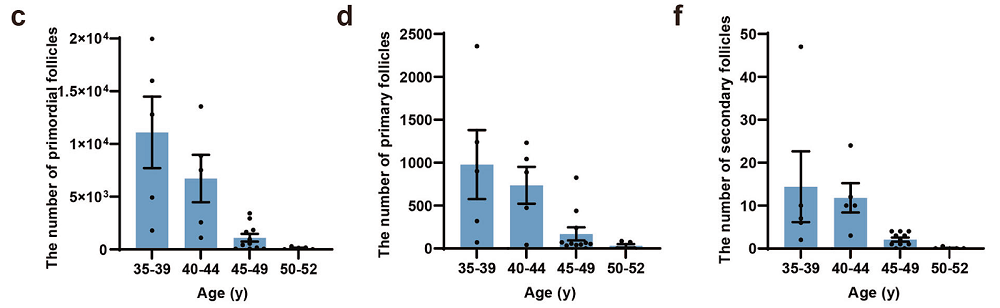
In the youngest group of females, aged 35-39, the average number of primordial follicles per ovary was 11,098. This number decreased with age. In females aged 40-44, it was 6,728; in the 45-49 group, it was 1,019, and there were only 151 in the oldest group aged 50-52. On the other side, the diameters of oocytes and oocyte nuclei of primordial follicles were similar between females of different ages.

Cynomolgus ovaries 1

The authors also observed the primordial follicles to develop into primary and secondary follicles in perimenopausal women. However, the number of both decreased with age. They conclude that the primordial follicles in perimenopausal women could still develop into growing follicles.

Alleviating ovarian aging with stem cells

Mesenchymal stem cell (MSC)-based therapy has shown potential in reversing ovarian aging and recovering fertility in animal models and women suffering from premature ovarian insufficiency [6-9]. However, this approach has some limitations.

hESC-derived M cells resemble MSCs but can overcome some of MSCs’ limitations, such as manufacturing at scale. Research has also discovered that they also have more potent immunomodulatory and anti-fibrotic functions [10].

With the aim of testing “the safety and efficacy of M-cell transplantation in ameliorating human physiological ovarian aging,” the researchers have chosen naturally aging cynomolgus monkeys as their model systems, since ovarian aging shares plenty of similarities between monkeys and humans.

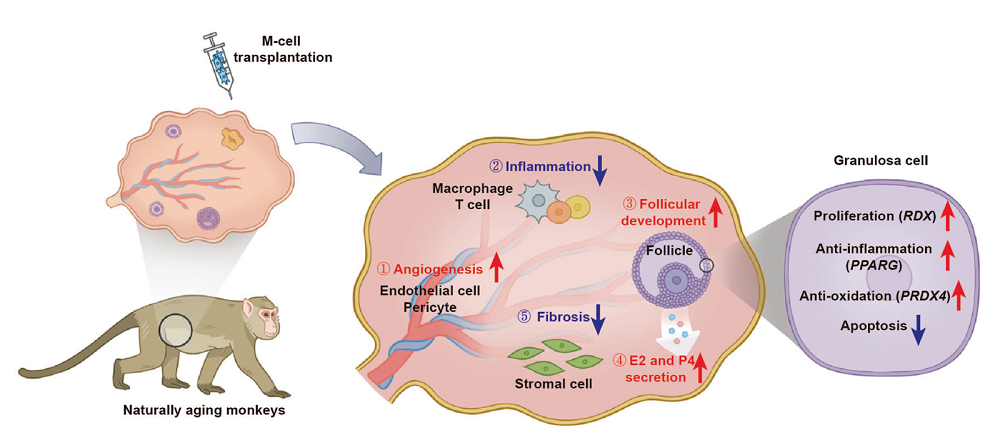
The authors selected ten perimenopausal monkeys and divided them into two groups: three as controls and seven in the treatment group. They injected the monkeys’ ovaries with M cells twice, one month apart, and followed up for eight months. The results suggested the safety of the treatment, as no acute inflammation or malignant diseases were observed.

A comparison of treated and untreated monkeys showed some positive impacts of the treatment. The researchers observed significantly larger ovarian diameters and thicker endometria in the treated group. Sex hormone levels were also positively impacted – estradiol levels were higher than control in 6 and 8 months post-treatment check-ups and progesterone remained at higher levels in treated monkeys, while in the control group, progesterone levels decreased during the follow-up period.

The researchers also tested the impact of M-cell treatment on follicle development. Assessment of the number of follicles showed increased numbers of growing follicles in the treated group compared to the control group, suggesting increased fertility potential following the treatment.

The treatment also alleviated ovarian aging, as the examination of ovaries showed decreased fibrosis, higher numbers of proliferative GC cells, which are essential for follicle development, and reduced DNA damage markers in GC cells in the treated group compared to the control.

Extending reproductive span

While the changes in molecular processes and hormonal levels are important for testing ovarian aging, the ultimate test of whether the treatment works is whether the monkeys can conceive a child.

In the initial test, the researchers injected monkeys with recombinant hormones to stimulate follicle growth and egg production. Two monkeys from the control group that were injected with hormones didn’t yield oocytes. Four monkeys from the treatment group injected with hormones yielded between 1 and 33 oocytes. Two monkeys produced mature oocytes that were collected for intracytoplasmic sperm injection (ICSI) and successfully fertilized. Out of those, two fertilized eggs developed to the blastocyst stage.

Monkeys were also allowed to breed for two months to test the possibility of natural conception. One treated monkey got pregnant and delivered a healthy, full-term baby. The baby is around three years old and still healthy, similar to the babies delivered by younger monkeys.

Molecular mechanism

The molecular mechanism behind the recovery of ovarian function following M-cell transplantation was also studied. The researchers collected ovaries from two control and three treated monkeys and measured their gene expression. They also employed a wide array of experimental tools, including cell culture-based assays, and gene inactivation experiments that allowed them to find the molecular processes that play a role in the impact of M cells on ovarian aging.

Their results suggest that M-cell therapy led to a decrease in inflammation, fibrosis, oxidative damage, and apoptosis. It also promoted follicle development by increasing cell proliferation, angiogenesis, and hormone response levels in perimenopausal ovaries.

The researchers concluded that their results show the feasibility of using M-cell transplantation to alleviate ovarian aging and  the possibility of extending reproductive lifespan, but more research is necessary to establish safety and efficacy in humans.

Cynomolgus ovaries 2
We would like to ask you a small favor. We are a non-profit foundation, and unlike some other organizations, we have no shareholders and no products to sell you. All our news and educational content is free for everyone to read, but it does mean that we rely on the help of people like you. Every contribution, no matter if it’s big or small, supports independent journalism and sustains our future.

Literature

[1] Yan, L., Tu, W., Zhao, X., Wan, H., Wu, J., Zhao, Y., Wu, J., Sun, Y., Zhu, L., Qin, Y., Hu, L., Yang, H., Ke, Q., Zhang, W., Luo, W., Xiao, Z., Chen, X., Wu, Q., He, B., Teng, M., … Wang, H. (2024). Stem cell transplantation extends the reproductive life span of naturally aging cynomolgus monkeys. Cell discovery, 10(1), 111.

[2] Lobo, R. A., & Gompel, A. (2022). Management of menopause: a view towards prevention. The lancet. Diabetes & endocrinology, 10(6), 457–470.

[3] Nakamura, T., Imai, Y., Matsumoto, T., Sato, S., Takeuchi, K., Igarashi, K., Harada, Y., Azuma, Y., Krust, A., Yamamoto, Y., Nishina, H., Takeda, S., Takayanagi, H., Metzger, D., Kanno, J., Takaoka, K., Martin, T. J., Chambon, P., & Kato, S. (2007). Estrogen prevents bone loss via estrogen receptor alpha and induction of Fas ligand in osteoclasts. Cell, 130(5), 811–823.

[4] Zhu, D., Chung, H. F., Dobson, A. J., Pandeya, N., Giles, G. G., Bruinsma, F., Brunner, E. J., Kuh, D., Hardy, R., Avis, N. E., Gold, E. B., Derby, C. A., Matthews, K. A., Cade, J. E., Greenwood, D. C., Demakakos, P., Brown, D. E., Sievert, L. L., Anderson, D., Hayashi, K., … Mishra, G. D. (2019). Age at natural menopause and risk of incident cardiovascular disease: a pooled analysis of individual patient data. The Lancet. Public health, 4(11), e553–e564.

[5] Xiong, J., Kang, S. S., Wang, Z., Liu, X., Kuo, T. C., Korkmaz, F., Padilla, A., Miyashita, S., Chan, P., Zhang, Z., Katsel, P., Burgess, J., Gumerova, A., Ievleva, K., Sant, D., Yu, S. P., Muradova, V., Frolinger, T., Lizneva, D., Iqbal, J., … Ye, K. (2022). FSH blockade improves cognition in mice with Alzheimer’s disease. Nature, 603(7901), 470–476.

[6] Zhao, Y., Ma, J., Yi, P., Wu, J., Zhao, F., Tu, W., Liu, W., Li, T., Deng, Y., Hao, J., Wang, H., & Yan, L. (2020). Human umbilical cord mesenchymal stem cells restore the ovarian metabolome and rescue premature ovarian insufficiency in mice. Stem cell research & therapy, 11(1), 466.

[7] Yan, L., Wu, Y., Li, L., Wu, J., Zhao, F., Gao, Z., Liu, W., Li, T., Fan, Y., Hao, J., Liu, J., & Wang, H. (2020). Clinical analysis of human umbilical cord mesenchymal stem cell allotransplantation in patients with premature ovarian insufficiency. Cell proliferation, 53(12), e12938.

[8] Umer, A., Khan, N., Greene, D. L., Habiba, U. E., Shamim, S., & Khayam, A. U. (2023). The Therapeutic Potential of Human Umbilical Cord Derived Mesenchymal Stem Cells for the Treatment of Premature Ovarian Failure. Stem cell reviews and reports, 19(3), 651–666.

[9] Tian, C., He, J., An, Y., Yang, Z., Yan, D., Pan, H., Lv, G., Li, Y., Wang, Y., Yang, Y., Zhu, G., He, Z., Zhu, X., & Pan, X. (2021). Bone marrow mesenchymal stem cells derived from juvenile macaques reversed ovarian ageing in elderly macaques. Stem cell research & therapy, 12(1), 460.

[10] Wu, J., Song, D., Li, Z., Guo, B., Xiao, Y., Liu, W., Liang, L., Feng, C., Gao, T., Chen, Y., Li, Y., Wang, Z., Wen, J., Yang, S., Liu, P., Wang, L., Wang, Y., Peng, L., Stacey, G. N., Hu, Z., … Hao, J. (2020). Immunity-and-matrix-regulatory cells derived from human embryonic stem cells safely and effectively treat mouse lung injury and fibrosis. Cell research, 30(9), 794–809.

Bladder

Senescent Cells Protect the Bladder

In Aging Cell, a research team has explained why barrier cells in the human bladder are largely senescent and what might lead them to become cancerous.

Targeting the right cells

It is well-known that people develop urinary problems with advanced age, including increasing frequency and incontinence [1]. However, previous efforts to treat this problem have largely focused on signaling pathways in the smooth muscle in the region rather than the bladder itself, and this has proven to be largely ineffective, with patients often discontinuing prescribed medication [2].

The researchers of this paper note that bladder control is a multifaceted issue, with the brain playing a role [3] along with a decrease in feeling in the area [4] and an increase in fibrosis [5]. This led the researchers to attempt a geroscience-related approach, determining if attempting to treat aging in a broader way might alleviate the issue, focusing specifically on senescent cells in the bladder as a potential therapeutic target to be treated with senolytics.

What they found, however, defied their expectations.

Where senescent cells are necessary

These researchers began their study by determining how senescent cells in the bladders of mice are affected by aging over their lifespans. Interestingly, the researchers only found that, in this area, old female mice had increases in the inflammatory molecules secreted by senescent cells; male mice did not have a statistically significant change.

While the researchers looked at individual molecules in order to establish a pattern, this line of exploration was largely inconclusive, with expected correlations not being established. They used the well-established senescence-associated biomarker SA-β-gal to find these cells, discovering that the only appreciable population was in the surface umbrella cells (UCs), barrier cells that prevent leakage between the bladder and the surrounding tissue.

Unlike most other cells, UCs are normally polyploid: they have multiple copies of chromosomes [6]. These senescent cells were found even in two-month mice, and they increased as the mice matured but did not increase into older ages. Other biomarkers, such as telomere-associated foci (TAF) and γH2AX, which represents damaged DNA, were highly represented in the UC population.

However, there were some crucial differences with aging. The senescent cell marker p16 was not found in this tissue area in middle-aged mice but was found in 10% of the relevant cells of older mice. Genes that prevent death by apoptosis that were expressed in middle-aged mice were less expressed in older mice, while the bladder cells of older mice seemed to be undergoing much more stress.

Being polyploid is likely to mean that UCs are more resistant to stresses and more able to respond to challenges [7], and one paper demonstrated that this is what makes it possible to fulfill their function [8]. However, as polyploidy also makes it much more likely that cells will have problems with missing or extra chromosomes (aneuploidy), there are evolved safeguards against their proliferation, and so previous work has also found that polyploidy is a cause of senescence [9]. These researchers were able to confirm that work, finding that the relevant cell cycle regulator was significantly upregulated in UCs.

Well-known senolytics are ineffective here, and it’s good that they are

While removing senescent cells in this case would not be likely to be beneficial, the researchers tested the well-known combination of dasatinib and quercetin in older mice. The mice’s UC cells were completely unaffected by this treatment: there were no differences in senescent cell population, TAF, nor p16. While there were some changes in gene expression in the whole bladder, the treatment did not offer any appreciable benefits.

Feeding the mice a high-fat diet, which increases systemic inflammation and senescent cell burden, had a small effect on maximum bladder pressure but did not affect other markers, such as the amount voided into corners: while such a diet clearly has some negative effects, it does not recapitulate natural aging. Here, too, senolytics were not found to have any effect.

Injecting the mice with senescent cells had similar effects on maximum pressure. Interesting, injecting mice with proliferating ear fibroblasts seemed to cause the mice to void more in corners.

The researchers note that these senescent cells are clearly necessary for proper function of the bladder, suggesting that they should be treated rather than destroyed, such as by improving their mitochondrial function or reducing their oxidative stress. They also believe that the polyploidy of these cells may be responsible for bladder cancer, as the cell cycle regulator that keeps them senescent is not perfect, and polyploid cells are much more prone to becoming cancerous. The researchers point to this as being part of antagonistic pleiotropy: a benefit earlier in life becomes a danger later on. Time will tell whether this knowledge can be used to develop treatments for bladder problems, including cancer.

We would like to ask you a small favor. We are a non-profit foundation, and unlike some other organizations, we have no shareholders and no products to sell you. All our news and educational content is free for everyone to read, but it does mean that we rely on the help of people like you. Every contribution, no matter if it’s big or small, supports independent journalism and sustains our future.

Literature

[1] Nordling, J. (2002). The aging bladder—a significant but underestimated role in the development of lower urinary tract symptoms. Experimental gerontology, 37(8-9), 991-999.

[2] Benner, J. S., Nichol, M. B., Rovner, E. S., Jumadilova, Z., Alvir, J., Hussein, M., … & Brubaker, L. (2010). Patient‐reported reasons for discontinuing overactive bladder medication. BJU international, 105(9), 1276-1282.

[3] Zhao, P., Zhang, G., Shen, Y., Wang, Y., Shi, L., Wang, Z., … & Sun, L. (2023). Urinary dysfunction in patients with vascular cognitive impairment. Frontiers in Aging Neuroscience, 14, 1017449.

[4] Pfisterer, M. H. D., Griffiths, D. J., Schaefer, PhD, W., & Resnick, N. M. (2006). The effect of age on lower urinary tract function: a study in women. Journal of the American Geriatrics Society, 54(3), 405-412.

[5] Kullmann, F. A., Birder, L. A., & Andersson, K. E. (2015). Translational research and functional changes in voiding function in older adults. Clinics in geriatric medicine, 31(4), 535.

[6] Wang, J., Batourina, E., Schneider, K., Souza, S., Swayne, T., Liu, C., … & Mendelsohn, C. L. (2018). Polyploid superficial cells that maintain the urothelial barrier are produced via incomplete cytokinesis and endoreplication. Cell reports, 25(2), 464-477.

[7] Bailey, E. C., Kobielski, S., Park, J., & Losick, V. P. (2021). Polyploidy in tissue repair and regeneration. Cold Spring Harbor Perspectives in Biology, 13(10), a040881.

[8] Wang, J., Batourina, E., Schneider, K., Souza, S., Swayne, T., Liu, C., … & Mendelsohn, C. L. (2018). Polyploid superficial cells that maintain the urothelial barrier are produced via incomplete cytokinesis and endoreplication. Cell reports, 25(2), 464-477.

[9] Panopoulos, A., Pacios-Bras, C., Choi, J., Yenjerla, M., Sussman, M. A., Fotedar, R., & Margolis, R. L. (2014). Failure of cell cleavage induces senescence in tetraploid primary cells. Molecular biology of the cell, 25(20), 3105-3118.

Longevity Hackers

Longevity Hackers: A Documentary Debuts on How to Stop Aging

Longevity Hackers, an in-depth look at how to slow the human pace of aging, debuts on Apple TV and Amazon beginning December 4, 2024. Produced by Ruben Figueres, directed by Michal Siewierski, and narrated by Academy Award nominee, Edward Norton, the film revolutionizes outdated cultural conceptions and beliefs about aging and offers a behind-the-scenes look at the breakthrough science and biohacking secrets that are adding not just years but healthy, fulfilled years to our lifespan.

“This is probably the most important topic of our generation,” says featured voice Steve Aoki.

Historically, the pairing of aging and disease has been regarded as an inevitability. Today, as the American life expectancy wanes, we enter a new era. Major advancements in longevity research and technology have enabled humans to significantly slow the biological pace of aging by addressing its root causes. By solving for the degenerative changes that come with aging, and removing them from the aging process, most diseases would be eliminated.

Michal Siewierski cites Artificial Intelligence as a major factor: “The irruption of AI technology in the medical field will increase exponentially the speed of the advances. Things that seemed like science fiction a few years ago, are becoming a reality now.”

Hear from Tony Robbins, Mark Cuban, Steve Aoki, Peter Diamandis, Dr. Morgan Levine, Tony Hawk, Chris Bumstead, John Salley, Wim Hof, Chris Mirabile, and other notable voices in the longevity and biohacking community as they share powerful insights and personal regimens to optimize health and add years to your life.

The global longevity market is estimated to reach $610B by 2025 and investment in personal health and wellness remains a top priority. Longevity Hackers demystifies the root causes of aging across exercise, nutrition, recovery, stress management, mental health, and more. Viewers learn about the relationship between sleep and metabolic systems, the dramatic impact joy and purpose in life have on health, and how to track your longevity via biological age testing.

“Biological age is becoming the premier biomarker of our health,” said Chris Mirabile, biohacker and biotech CEO of NOVOS. “The best way to keep track of your lifestyle being conducive to longevity is with a biological age clock, specifically one that’s been proven to be both accurate and precise.”

Aging will look starkly different for current and future generations. Science has shown that only 10% to 20% of lifespan is based on genetics, while lifestyle choices determine the rest. This film will empower humans to take their lives into their own hands by equipping them with the knowledge to do so.

“No matter where you are from, or what your beliefs are, we can all agree that life is a gift that should be cherished,” said Edward Norton. “The people working in the longevity and life extension fields want to extend that gift to humanity.”

‘The Longevity space is growing rapidly. Aging affects every person, regardless of race, religion, political orientation, or any other factors. The fight against aging is something that could unite humanity for a common goal,” said producer Ruben Figueres.

We would like to ask you a small favor. We are a non-profit foundation, and unlike some other organizations, we have no shareholders and no products to sell you. All our news and educational content is free for everyone to read, but it does mean that we rely on the help of people like you. Every contribution, no matter if it’s big or small, supports independent journalism and sustains our future.
Vitalism

Announcing Vitalist Bay, a Pop-Up City in the Bay Area

A unique project is set to go live next spring in the Bay Area. Organized by the Vitalism Foundation, it promises to be one of the largest longevity-related events ever.

They’re popping up!

Since the pop-up city of Zuzalu took the longevity community by storm in early 2023, its innovative concept has inspired a wave of adaptations around the globe. These include Vitalia on the island of Roatan, Honduras; ZuVillage in Georgia (the country, not the state); and Zelar City in Berlin, each offering its own spin on the original formula.

A pop-up city gathers like-minded people, blending co-living with a packed schedule of activities such as conferences, workshops, and hackathons. When the project is longevity-focused, the daily routine revolves around health and wellness, including healthy meals, cold plunges, yoga classes, detailed blood tests, and on-site treatments.

Vitalism

Pop-up cities give participants an inspiring glimpse into a future where people aren’t bound by national borders but instead unite around shared values and interests. This ambitious concept, known as “network states,” was coined by entrepreneur Balaji Srinivasan. Some projects, like Vitalia, have already taken the next step by establishing a continuous presence with a small, permanent community rather than disbanding after a few months.

Betting big on the Bay Area

Most pop-up cities have been set in remote or underdeveloped locations, due to factors like lower costs and relaxed regulations. Building such a project in a bustling, expensive metropolis is a serious challenge – one that Vitalist Bay is stepping up to meet.

Vitalist Bay, a future pop-up city set to operate in Berkeley, California, during April and May of 2025, is being organized by the Vitalism Foundation, a major non-profit in the longevity space. In a press release, the organizers described the initiative as “humanity’s boldest effort to extend healthy lifespan and solve aging” and “the Bay Area’s first longevity zone.”

Like a proper longevity-oriented pop-up city should, Vitalist Bay will offer its inhabitants and visitors perks like a gym, a sauna, a large co-working space, advanced diagnostics such as DEXA scans and VO2max tests, and, generally, a “pro-health social environment.” ‘Bayers’ will also be able to participate in a community clinical trial.

The program

Vitalist Bay boasts an exceptionally comprehensive program covering a variety of interconnected topics, including longevity science, decentralized science and network states, biostasis and cryopreservation, AI in biology, and investment in longevity biotech. Notably, an entire week will focus on healthcare policy, philosophy, and ethics – an encouraging sign of growing interest in longevity advocacy, a vital part of the movement.

“Aging and longevity have such wide scope – from policy and regulations to science and technology, investing in startups, and even crypto with decentralized science. Unfortunately, the interaction between these different areas has been quite limited,” Adam Gries, Vitalism’s co-founder, said to lifespan.io. “Vitalist Bay is longevity’s new capital, which is a triple entendre – human capital, financial capital, and physical capital – because we feel longevity has been missing a focal point that converges its different aspects.”

The locals and the visitors

Despite the Bay Area’s notoriously high cost of living, Vitalist Bay will offer reasonably priced accommodations for several dozen permanent residents. “The event will be centered around the Lighthaven campus, where the rationalist community is based,” said Nathan Cheng, co-founder of Vitalism and the Longevity Biotech Fellowship. “We’ll bring in hundreds, if not thousands, of longevity experts across different domains with the common focus of solving the problem of aging.”

The primary emphasis, however, will be on visitors. “Vitalia and Zuzalu were designed as pop-up cities with residents as the dominant group,” Adam noted. “Our longevity zone is different – the dominant group will be visitors coming for shorter periods. With a venue that can host a thousand people but only 70 residents, we’re expecting thousands of attendees to participate in our conferences.”

Elaborating on why Vitalist Bay differs from its predecessors, Adam added, “Being in the Bay Area is crucial. Long-term pop-up cities in remote locations with limited infrastructure, research ecosystems, or innovation history are inherently restrictive. Think about the 10,000 or more angel investors in the Bay Area; how many would travel to Vitalia? Maybe the hardcore enthusiasts, but not those who are merely curious or geographically tied. With a local event, we can spark engagement beyond the dedicated longevity community.”

What’s next?

“Among the outputs we’re aiming for,” Nathan said, “are policy and ethics statements from philosopher groups, think tanks with recommendations for research funding priorities, and local community partnerships that emphasize the pro-social aspects of longevity. We also want to engage with the local art scene and, more broadly, build projects that bridge different parts of the longevity ecosystem. Of course, we’ll try to get more capital into companies and initiatives, both for-profit and nonprofit.”

Another ambitious goal is to create a longer-term physical presence in the Bay Area. “For that,” Nathan explained, “we’re partnering with Berlin House, which owns a 16-story tower in San Francisco. We’ll be governing one floor dedicated to longevity in partnership with VitaDAO and Foresight Institute. This could become our longer-term venue after the two-month event.”

We would like to ask you a small favor. We are a non-profit foundation, and unlike some other organizations, we have no shareholders and no products to sell you. All our news and educational content is free for everyone to read, but it does mean that we rely on the help of people like you. Every contribution, no matter if it’s big or small, supports independent journalism and sustains our future.
BioAge Labs

BioAge Labs Ends STRIDES Phase 2 Clinical Trial

RICHMOND, Calif., Dec. 06, 2024 (GLOBE NEWSWIRE) — BioAge Labs (Nasdaq: BIOA) (“BioAge”, “the Company”), a clinical-stage biopharmaceutical company developing therapeutic product candidates for metabolic diseases by targeting the biology of human aging, today announced that the Company has made the decision to discontinue the ongoing STRIDES Phase 2 study of its investigational drug candidate azelaprag as monotherapy and in combination with tirzepatide after liver transaminitis without clinically significant symptoms was observed in some subjects receiving azelaprag. No transaminase elevations were observed in the tirzepatide only treatment group.

“Patient safety is our top priority in the conduct of our clinical studies,” said Kristen Fortney, PhD, CEO and co-founder of BioAge. “We made the difficult decision to discontinue the STRIDES Phase 2 study of azelaprag because it became clear that the emerging safety profile of the current doses tested is not consistent with our goal of a best-in-class oral obesity therapy. While this outcome is a significant disappointment, we remain encouraged by azelaprag’s promising preclinical and Ph1b efficacy profile. We remain committed to our focus on developing therapies for metabolic aging. In parallel to assessing the next steps for the azelaprag program, we will continue to advance our NLRP3 inhibitor program as well as additional research programs with novel mechanisms emerging from our platform.”

STRIDES is a randomized, double-blind, placebo-controlled Phase 2 clinical trial of azelaprag as monotherapy and in combination with tirzepatide that planned to enroll approximately 220 individuals with obesity aged 55 years and older (link). The trial was designed to evaluate the efficacy as measured by body weight reduction and other outcomes, safety, and tolerability of two oral doses of azelaprag (300 mg, once or twice daily) in combination with tirzepatide (5 mg subcutaneous injection once weekly). An azelaprag monotherapy arm was included to provide additional safety information.

Of 204 subjects enrolled in STRIDES as of today, 11 subjects in the azelaprag treatment groups were observed to have transaminase elevations with no clinically significant symptoms. Dosing of all subjects will be discontinued, and no additional subjects will be enrolled. Clinical follow-up of enrolled subjects will continue off drug. The Company intends to further analyze available STRIDES clinical data from all enrolled subjects. The Company has notified all study investigators and regulatory authorities including the U.S. Food and Drug Administration (FDA) of the Company’s decision to discontinue enrollment.   The Company intends to share updated plans for azelaprag in Q1 2025.

BioAge continues to advance its pipeline of therapeutic candidates targeting the biology of aging to treat metabolic diseases. The Company’s novel class of brain-penetrant NLRP3 inhibitors, which have demonstrated high potency and a novel binding site, are progressing toward IND submission, anticipated in the second half of 2025. The NLRP3 inhibitor program targets neuroinflammation, which is linked to both metabolic and neurodegenerative diseases. In addition, BioAge is advancing multiple targets derived from its proprietary discovery platform, which analyzes molecular data spanning over 50 years of human aging trajectories.

About BioAge Labs, Inc. BioAge is a clinical-stage biopharmaceutical company developing therapeutic product candidates for metabolic diseases, such as obesity, by targeting the biology of human aging. BioAge’s lead product candidate, azelaprag, is an orally available small molecule agonist of APJ that was observed to promote metabolism and prevent muscle atrophy on bed rest in a Phase 1b clinical trial. BioAge is also developing orally available small molecule brain penetrant NLRP3 inhibitors for the treatment of diseases driven by neuroinflammation. BioAge’s preclinical programs, based on novel insights from the company’s discovery platform built on human longevity data, address key pathways in metabolic aging.

Forward-looking statements This press release contains “forward-looking statements” within the meaning of, and made pursuant to the safe harbor provisions of, the Private Securities Litigation Reform Act of 1995. All statements contained in this press release that do not relate to matters of historical fact should be considered forward-looking statements, including, but not limited to, statements regarding our plans to develop and commercialize our product candidates, our business strategy, results of our ongoing or planned clinical trials, the timing of any future updates to our programs and the clinical utility of our product candidates. These forward-looking statements may be accompanied by such words as “aim,” “anticipate,” “believe,” “could,” “estimate,” “expect,” “forecast,” “goal,” “intend,” “may,” “might,” “plan,” “potential,” “possible,” “will,” “would,” and other words and terms of similar meaning. These statements involve risks and uncertainties that could cause actual results to differ materially from those reflected in such statements, including: our ability to develop, obtain regulatory approval for and commercialize our product candidates; the timing and results of preclinical studies and clinical trials; the risk that positive results in a preclinical study or clinical trial may not be replicated in subsequent trials or success in early stage clinical trials may not be predictive of results in later stage clinical trials; risks associated with clinical trials, including our ability to adequately manage clinical activities, unexpected concerns that may arise from additional data or analysis obtained during clinical trials, regulatory authorities may require additional information or further studies, or may fail to approve or may delay approval of our drug candidates; the occurrence of adverse safety events; failure to protect and enforce our intellectual property, and other proprietary rights; failure to successfully execute or realize the anticipated benefits of our strategic and growth initiatives; risks relating to technology failures or breaches; our dependence on collaborators and other third parties for the development of product candidates and other aspects of our business, which are outside of our full control; risks associated with current and potential delays, work stoppages, or supply chain disruptions; risks associated with current and potential future healthcare reforms; risks relating to attracting and retaining key personnel; failure to comply with legal and regulatory requirements; risks relating to access to capital and credit markets; and the other risks and uncertainties that are detailed under the heading “Risk Factors” included in BioAge’s Form 10-Q filed with the U.S. Securities and Exchange Commission (SEC) on November 7, 2024, and other filings with the SEC filed from time to time. BioAge undertakes no obligation to publicly update any forward-looking statement, whether written or oral, that may be made from time to time, whether as a result of new information, future developments or otherwise.

Contacts PR: Chris Patil, media@bioagelabs.com IR: Elena Liapounova, ir@bioagelabs.com Partnering: partnering@bioagelabs.com Web: https://bioagelabs.com

Gene editing

Nuclear Expression of a Mitochondrial Gene in Mice

Scientists from the Longevity Research Institute (LRI), which was formed by the merger of SENS Research Foundation and lifespan.io, have achieved expression of an essential mitochondrial gene in the nucleus and proper functioning of the protein. This could pave the way for curing diseases caused by mitochondrial mutations [1].

The fragile mitochondrial DNA

The prevailing scientific consensus is that mitochondria were once independent microorganisms that entered a symbiotic relationship with larger cells. This duo gave rise to eukaryotic cells: the building blocks of all multicellular life. Without that fateful “marriage,” complex life would not exist, as mitochondria provide cells with essential energy via oxidative phosphorylation.

Over the millennia, mitochondria have retained their own DNA. However, this mitochondrial DNA (mtDNA) has several vulnerabilities: it lacks the protective proteins that nuclear DNA is wrapped around (histones), has fewer repair mechanisms compared to nuclear DNA, and exists in a harsh environment of oxidative stress generated by its own metabolic activity.

The fragility of mtDNA might have contributed to the relocation of most of its genes to nuclear DNA. Proteins encoded by those genes are synthesized in the cytosol and transported across the cell into mitochondria via a highly regulated process. However, 13 essential proteins involved in oxidative phosphorylation remain encoded by mtDNA and still suffer from the same vulnerabilities. This makes mtDNA prone to mutations, particularly as we age.

Mutations in mtDNA contribute to a range of diseases, such as Leber hereditary optic neuropathy (LHON), and are linked to a wide range of age-related pathologies, including sarcopenia and Alzheimer’s disease [2]. Addressing problems caused by mtDNA mutations is a major challenge in biomedical research. However, in this study, LRI researchers have achieved a significant breakthrough by successfully relocating a mitochondrial gene to the nucleus in vivo.

Overcoming the challenges

Previously, the same team had achieved promising results in vitro [3], but finding a suitable animal model proved difficult: mtDNA genes are so essential that mutations in them usually render mice non-viable. However, a particular strand of mice exists that harbors a relatively benign mutation in ATP8, a gene encoding a subunit of the ATP synthase complex, which causes only a mildly pathologic phenotype. Alongside those mutants, wild-type mice were used as controls.

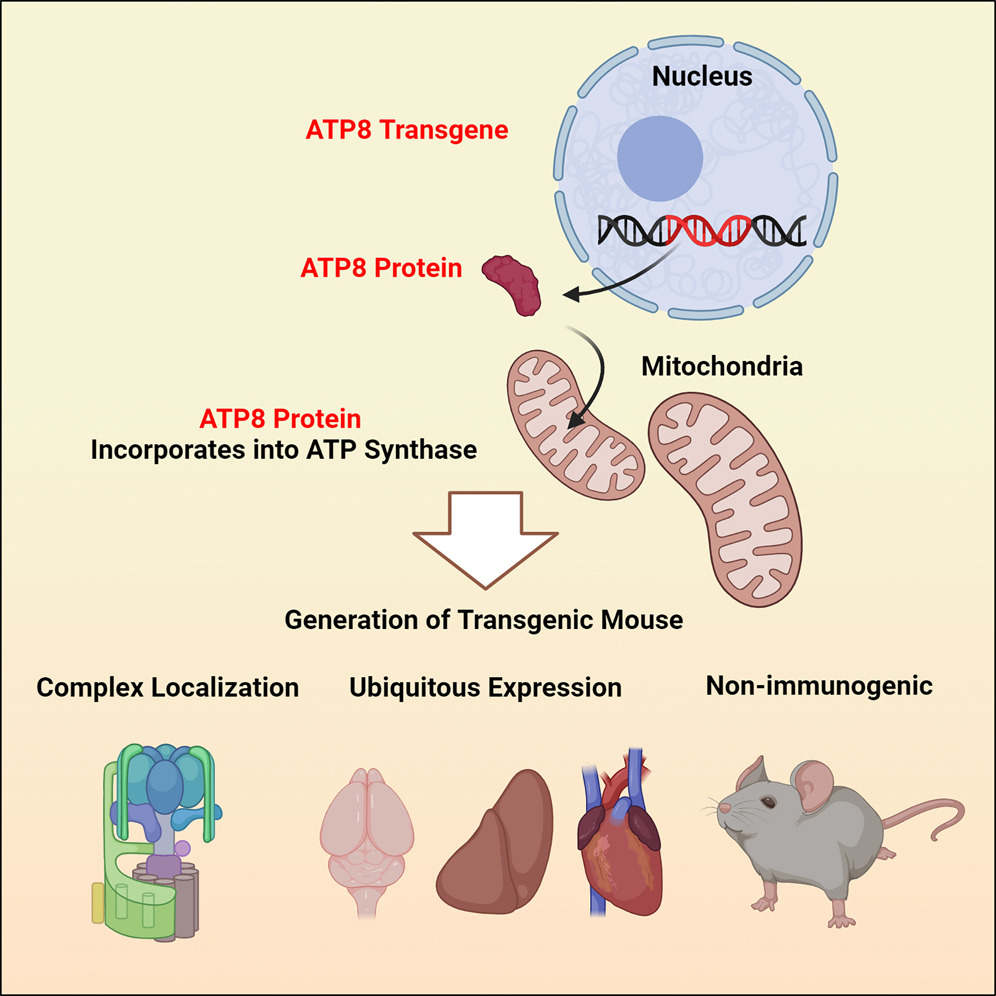
The team synthesized a nuclear-compatible version of ATP8 and inserted it into the ROSA26 locus, a well-characterized “safe harbor” site in the mouse genome. This locus is widely used in genetic engineering because it allows stable organism-wide expression of inserted genes without interfering with other essential genomic functions.

The researchers had to overcome significant technical challenges to achieve nuclear expression of a gene that is normally expressed in mitochondria (allotopic expression) and to make the protein transferrable to mitochondria. For instance, they found that efficient allotopic expression requires codon optimization: altering the DNA sequence of a gene using codons that are more efficiently translated by ribosomes.

Efficient, persistent, non-immunogenic

Eventually, their efforts paid off: allotopic ATP8 was able to compete with mitochondrial ATP8 even in wild-type mice and outperformed the mutant ATP8. The allotopic gene was expressed in all the tissues that the researchers tested, and the protein successfully integrated into the mitochondrial machinery.

“The key question was ‘How well can an allotopic protein compete with pre-existing protein?’” said Dr. Amutha Boominathan, Assistant Professor and Principal Investigator at LRI and the study’s leading author. “One fundamental concept in the field is that mitochondrial DNA exists because proteins need to be synthesized on demand for easier incorporation into their respective complexes.”

“For allotopic expression to succeed,” she explained, “you must demonstrate that protein coming from the nuclear side can be incorporated with similar efficiency. In wild-type mice, we see equal efficiency between endogenous and exogenous proteins. In our mutant model, we see increasing incorporation over time, suggesting the nuclear protein actually outcompetes the mutated one from a stability perspective.”

Importantly, the allotopic gene functioned well in the genetically modified mice’s offspring for at least four generations, with no adverse effects on fertility. While mtDNA can sometimes trigger an immune reaction when released into the cytoplasm, this gene was also well-tolerated by the immune system, as confirmed by cytokine array analysis.

Nuclear mtDNA

A blueprint for the future

In the paper, the researchers note that their successful proof of concept does not necessarily apply to all mtDNA genes, and many challenges lie ahead. However, Boominathan is optimistic: “This provides a platform for testing other genes. With appropriate engineering we can overcome all the challenges. We’ve proven it for one protein and have promising data for others. What we’ve demonstrated here is the feasibility of expressing mitochondrial genes in a whole-body context. The inheritance patterns and lack of immune response are particularly encouraging for therapeutic applications.”

There are over 250 mitochondrial DNA diseases that could potentially benefit from this approach, according to Boominathan. “If we can achieve allotopic expression for all 13 genes,” she said, “we’d have a pathway to treat many of these rare diseases.”

The aging connection

LHON, one of the diseases that the researchers are after, “is actually an aging disorder,” Boominathan explained. “While the mutation is inherited, it specifically affects males over 40. These mutations amplify with age, particularly in tissues with high oxidative phosphorylation demands, like retinal ganglion cells. Symptoms only appear when the mutation load reaches a certain threshold.”

This is particularly relevant to post-mitotic cells that form the brain, skeletal muscle, and cardiac tissue since those cells cannot dilute mutations through cell division. “While internal recycling mechanisms like mitophagy exist, they decline with age,” said Boominathan. “If you inherit a mutation or acquire one early in life, it amplifies over time as mitophagy decreases, and these mutations often have an advantage that helps them take over.”

A three-pronged approach

“This work represents the culmination of more than a decade’s worth of effort to provide a genetic backup system for mitochondrial DNA in mammals, for which inherited mutations cause disease in nearly 1 in 200 people,” said Dr. E. Lillian Fishman, Director of Research and Education at LRI, about the study. “I am proud of Dr. Boominathan and her team’s persistence to rise to meet this technically challenging proof-of-concept that paves the way for the treatment of debilitating mitochondrial diseases like Leigh’s syndrome and progressive diseases of aging.”

This study was done as part of MitoSENS, a wider LRI project that includes a three-pronged approach to mitochondrial dysfunction. In addition to allotopic mtDNA expression, the researchers pursue boosting mitophagy with small molecules and de novo synthesis of healthy mtDNA for transfer into exogenous mitochondria, followed by introduction into cells.

We would like to ask you a small favor. We are a non-profit foundation, and unlike some other organizations, we have no shareholders and no products to sell you. All our news and educational content is free for everyone to read, but it does mean that we rely on the help of people like you. Every contribution, no matter if it’s big or small, supports independent journalism and sustains our future.

Literature

[1] Begelman, D. V., Dixit, B., Truong, C., King, C. D., Watson, M. A., Schilling, B., … & Boominathan, A. (2024). Exogenous Expression of ATP8, a Mitochondrial Encoded Protein, From the Nucleus In Vivo. Molecular Therapy Methods & Clinical Development.

[2] Zhunina, O. A., Yabbarov, N. G., Grechko, A. V., Yet, S. F., Sobenin, I. A., & Orekhov, A. N. (2020). Neurodegenerative diseases associated with mitochondrial DNA mutations. Current Pharmaceutical Design, 26(1), 103-109.

[3] Boominathan, A., Vanhoozer, S., Basisty, N., Powers, K., Crampton, A. L., Wang, X., … & O’Connor, M. S. (2016). Stable nuclear expression of ATP8 and ATP6 genes rescues a mtDNA Complex V null mutant. Nucleic acids research, 44(19), 9342-9357.

Skeletal muscle

Fragmented Mitochondria Linked to Muscle Weakness

In a study published in Aging Cell, researchers have outlined a relationship between mitochondrial fragmentation in skeletal muscle and the loss of strength with age.

Broken power plants

As its authors point out, this is far from the first study to link mitochondrial dysfunction and aging in muscle [1], nor is it the first to connect exercise habits, aging, mitochondria, and the loss of physical function [2].

There has also been significant prior work showing how the mitochondria in muscle tissue behave. Mitochondria in muscle are not equal in their behaviors: the mitochondria closest to the blood-filled capillaries (subsarcolemmal mitochondria) bring energy to more centrally located ones (intermyofibrillar mitochondria) through an intracellular network [3]. Fragmentation of this network destroys this energy transfer but may also offer protection against damage being transferred as well [4].

Too much fragmentation and fission, however, causes muscle wasting in mice [5]; the opposite, mitochondrial fusion, causes muscles to grow in these animals [6]. The researchers’ previous work on healthy volunteers demonstrated that fragmentation begins to occur at day 6 of bed rest, while functional impairments were found to occur on day 55 [7]. However, that work did not prove one way or another whether mitochondrial fragmentation is a useful biomarker or warning sign for age-related muscle decline.

Decline begins before retirement

Wanting to avoid physical inactivity as a confounder and suspecting that this process may not be the same as actual sarcopenia, the researchers recruited a dozen young (average age 27) and ten middle-aged (average age 55) volunteers rather than significantly older people. The older group was slightly more overweight than the younger group.

Unsurprisingly, the younger people’s muscles used more oxygen to generate more power than the older people’s, according to multiple metrics of respiration and energy use. This was not linked to blood flow; instead, it was linked to how the muscles pull oxygen from the blood.

The researchers then examined the mitochondria more closely in biopsied muscle tissue. The total density of the intermyofibrillar mitochondria was the same between younger and older people; however, the older people had more, smaller mitochondria. While their shapes did not differ, markers of mitochondrial fragmentation were greater in this area in the older group.

In the subsarcolemmal area, however, the older people had approximately as many mitochondria as the younger people, which led to a reduction of density with age as these mitochondria were also smaller. Here, too, they were found to be significantly more fragmented. This fragmentation in both areas was associated with the accumulation of fat (lipid) droplets.

Looking ever closer

There were also differences involving the tiny folds inside mitochondria (cristae). Younger people’s mitochondria had regular and dense cristae, while those of older people were less regular, with some areas having no cristae at all. This, the researchers hold, represents “age-associated deterioration at the level of the individual mitochondrion.” Interestingly, however, further data suggests that the increased number of smaller mitochondria may have made up for this, restoring some of the lost function.

The authors then pivoted to the key thrust of their research: the connection between fragmentation and loss of capacity. Fragmentation in the intermyofibrillar mitochondria and a reduction in the cristae was found to be responsible for nearly all of the changes in the well-known metric of VO2max. Unsurprisingly, the density of the subsarcolemmal mitochondria was found to be associated with the muscles’ ability to extract oxygen from blood.

The researchers believe that their findings explain the basic reasons why people lose strength with age, even in the absence of defined sarcopenia. They also warn that this mitochondrial dysfunction only gets worse with aging. Furthermore, they hold that their findings “reflect an early ageing phenotype, making the mitochondrial changes observed herein strong candidates for intervention studies aiming to slow the progression of the effects of ageing on physical function.”

As exercise is associated with mitochondrial fusion [8] and one study had suggested that six months of endurance training can compensate for 30 years of aging [9], the authors suggest that further research on exercise in older people should be done with a close examination into mitochondrial changes.

We would like to ask you a small favor. We are a non-profit foundation, and unlike some other organizations, we have no shareholders and no products to sell you. All our news and educational content is free for everyone to read, but it does mean that we rely on the help of people like you. Every contribution, no matter if it’s big or small, supports independent journalism and sustains our future.

Literature

[1] Gouspillou, G., Bourdel‐Marchasson, I., Rouland, R., Calmettes, G., Biran, M., Deschodt‐Arsac, V., … & Diolez, P. (2014). Mitochondrial energetics is impaired in vivo in aged skeletal muscle. Aging cell, 13(1), 39-48.

[2] Grevendonk, L., Connell, N. J., McCrum, C., Fealy, C. E., Bilet, L., Bruls, Y. M., … & Hoeks, J. (2021). Impact of aging and exercise on skeletal muscle mitochondrial capacity, energy metabolism, and physical function. Nature communications, 12(1), 4773.

[3] Glancy, B., Hartnell, L. M., Malide, D., Yu, Z. X., Combs, C. A., Connelly, P. S., … & Balaban, R. S. (2015). Mitochondrial reticulum for cellular energy distribution in muscle. Nature, 523(7562), 617-620.

[4] Glancy, B., Hartnell, L. M., Combs, C. A., Femnou, A., Sun, J., Murphy, E., … & Balaban, R. S. (2017). Power grid protection of the muscle mitochondrial reticulum. Cell reports, 19(3), 487-496.

[5] Romanello, V., Guadagnin, E., Gomes, L., Roder, I., Sandri, C., Petersen, Y., … & Sandri, M. (2010). Mitochondrial fission and remodelling contributes to muscle atrophy. The EMBO journal, 29(10), 1774-1785.

[6] Cefis, M., Dargegen, M., Marcangeli, V., Taherkhani, S., Dulac, M., Leduc‐Gaudet, J. P., … & Gouspillou, G. (2024). MFN2 overexpression in skeletal muscles of young and old mice causes a mild hypertrophy without altering mitochondrial respiration and H2O2 emission. Acta Physiologica, 240(5), e14119.

[7] Eggelbusch, M., Charlton, B. T., Bosutti, A., Ganse, B., Giakoumaki, I., Grootemaat, A. E., … & Wüst, R. C. (2024). The impact of bed rest on human skeletal muscle metabolism. Cell Reports Medicine, 5(1).

[8] Huertas, J. R., Ruiz‐Ojeda, F. J., Plaza‐Díaz, J., Nordsborg, N. B., Martín‐Albo, J., Rueda‐Robles, A., & Casuso, R. A. (2019). Human muscular mitochondrial fusion in athletes during exercise. The FASEB Journal, 33(11), 12087-12098.

[9] McGuire, D. K., Levine, B. D., Williamson, J. W., Snell, P. G., Blomqvist, C. G., Saltin, B., & Mitchell, J. H. (2001). A 30-year follow-up of the Dallas Bed Rest and Training Study: II. Effect of age on cardiovascular adaptation to exercise training. Circulation, 104(12), 1358-1366.

Robot doctor

AI Outperforms AI-Assisted Doctors in Diagnostic Reasoning

In a new study, ChatGPT 4.0 achieved significantly better diagnostic scores when evaluating complex cases than either unassisted human physicians or physicians who consulted the chatbot [1].

Bad news for human doctors?

For millions of people, chatbots powered by large language models (LLMs) have quickly become an indispensable source of information on everything from finances to relationships. These digital aids often come across as more knowledgeable, polite, patient, and compassionate than human experts.

It has been questioned, however, if it is really a smart idea to turn to a robot for medical advice. In what could be a troubling sign for general practitioners, chatbots have shown they can outperform humans in this area too. A study from May of last year found that the earlier version of ChatGPT, 3.5, handily outclassed human health professionals in answering patients’ questions. Responses from both the bot and verified physicians were graded by a panel of health experts, and the gap was striking: for instance, 27% of human answers were deemed “unacceptable” compared to just 2.6% of machine-generated ones.

That study had relied on doctor responses pulled from Reddit, but a more recent study went further. Earlier this year, researchers at Google developed a dedicated model called Articulated Medical Intelligence Explorer (AMIE) and tested it against human primary care practitioners. Wide-ranging health scenarios were distributed at random, with actors playing the roles of patients who discussed their cases with either the chatbot or a human physician without knowing who was who. According to expert evaluators, AMIE outperformed its human counterparts in 24 of 26 categories, including empathy.

“Meet my assistant, ChatGPT”

In a new study published in JAMA Network Open, Stanford researchers stripped AI of its perceived edge in empathy and bedside manner. They eliminated the patient interaction element entirely, tasking either ChatGPT 4.0 or 50 human physicians (26 attendings and 24 residents) with diagnosing six carefully selected cases. These cases had never been published before, ensuring that the LLM could not have encountered them during training.

Here’s the twist: half of the doctors were allowed to consult ChatGPT. The aim was to gauge whether physicians would embrace AI as an assistant and whether doing so would improve their diagnostic reasoning. All participants could also use conventional resources like medical manuals.

The primary outcome was a composite diagnostic reasoning score developed by the researchers, which measured accuracy in differential diagnosis, the appropriateness of supporting and opposing factors, and next diagnostic steps. Secondary outcomes included time spent per case and final diagnosis accuracy.

In the end of the day, the LLM dominated yet again, with a median score of 92% per case: 14 points higher than the non-LLM-assisted human group. It also achieved 1.4 times greater accuracy in the final diagnosis. Interestingly, the group of physicians consulting the chatbot didn’t fare much better than their non-assisted peers, scoring 76% versus 74%.

Why didn’t consultation work?

The researchers had anticipated that consulting the LLM would give physicians a marked advantage, but that wasn’t the case. “Our study shows that ChatGPT has potential as a powerful tool in medical diagnostics, so we were surprised to see its availability to physicians did not significantly improve clinical reasoning,” said study co-lead author Ethan Goh, a postdoctoral scholar in Stanford’s School of Medicine and research fellow at Stanford’s Clinical Excellence Research Center.

Why the lackluster collaboration? The authors suggest a few reasons. First, participants weren’t simply asked to provide a diagnosis. Instead, they had to demonstrate diagnostic reasoning by suggesting three possible diagnoses and explaining how they reached their final choice. The chatbot excelled at this aspect, while humans sometimes struggled to articulate their thought processes. This echoes longstanding challenges in modeling human diagnostic reasoning in computer systems before the advent of LLMs.

“What’s likely happening is that once a human feels confident about a diagnosis, they don’t ‘waste time or space’ on explaining their reasoning,” said Jonathan H. Chen, Stanford assistant professor at the School of Medicine and the paper’s senior author. “There’s also a real phenomenon where human experts can’t always articulate exactly why they made the right call.”

Another hurdle was that physicians often dismissed valid suggestions from their AI co-pilot, a sign that overcoming the natural sense of superiority toward machines may take time.

Finally, the researchers noted that the chatbot’s performance hinges on the quality of the prompts it receives. The research team crafted sophisticated prompts to get the most out of ChatGPT, while human participants often used it more like a search engine, asking short, direct questions instead of providing full case details. “The findings suggest there are opportunities for further improvement in physician-AI collaboration in clinical practice and health care more broadly,” Goh said.

One intriguing secondary finding was that doctor-LLM pairs completed cases slightly faster than doctors working solo. While, according to the paper, the difference of slightly more than a minute was negligible, Goh argues that even a small efficiency gains could help make doctors’ lives more efficient. “Those time savings alone could justify the use of large language models and could translate into less burnout for doctors in the long run,” he said. However, more rigorous studies are needed to fully understand this potential benefit.

AI will not replace doctors (until it will)

The authors of studies like this one have been careful to emphasize that AI is not a true substitute for a human health practitioner. “AI is not replacing doctors,” Goh reassures. “Only your doctor will prescribe medications, perform operations, or administer any other interventions.”

Still, it may only be a matter of time before AI demonstrates superiority over human physicians in nearly every aspect of care. Furthermore, vast regions of the world currently face limited access to healthcare, leaving many people without the option of consulting a human doctor at all. In such contexts, AI could fill a critical gap. Just as some countries skipped the landline phase entirely and adopted mobile phones, they might also be the first to transition to predominantly AI-driven healthcare, facing fewer entrenched bureaucratic barriers.

Building on this study, Stanford University, Beth Israel Deaconess Medical Center, the University of Virginia, and the University of Minnesota have joined forces to create AI Research and Science Evaluation (ARiSE), a network dedicated to evaluating generative AI outputs in healthcare.

We would like to ask you a small favor. We are a non-profit foundation, and unlike some other organizations, we have no shareholders and no products to sell you. All our news and educational content is free for everyone to read, but it does mean that we rely on the help of people like you. Every contribution, no matter if it’s big or small, supports independent journalism and sustains our future.

Literature

[1] Goh, E., Gallo, R., Hom, J., Strong, E., Weng, Y., Kerman, H., … & Chen, J. H. (2024). Large language model influence on diagnostic reasoning: a randomized clinical trial. JAMA Network Open, 7(10), e2440969-e2440969.

Computer healthcare analysis

Can AI Predict Your Death?

Once confined to the realms of science fiction or relatively crude internet death calculators, AI-driven predictions about longevity are inching closer to reality. Questions about the accuracy and value of these forecasts remain.

In recent years, researchers and companies around the globe have been pursuing answers to the ultimate question: How long have we got left? These models leverage cutting-edge tools, such as artificial intelligence and machine learning, drawing on a variety of parameters to deliver statistically grounded insights.

Conceptually, they function like established diagnostic tools such as QRisk for heart disease or CHA₂DS₂-VASc Score for stroke risk. Yet, the debate remains: are these predictions meaningful advancements or little more than modern-day fortune-telling?

The tech behind lifespan prediction

With the advent of artificial intelligence, increasing numbers of tools are emerging on the market. At the same time, biotech companies, such as Altos Labs and BioAge Labs, among others, are engaging such technologies to develop state-of-the-art therapeutics.

AI isn’t a one-stop fix for all challenges. The reality is that it’s a technological tool, albeit with immense potential, that utilizes sophisticated algorithms to get results, much like any other modern technology.

The same approach applies to lifespan prediction technologies built on AI. They engage a suite of technologies, such as:

  • Neural networks. These mimic the brain’s architecture, similarly to neurons making connections, and help uncover complex patterns in health and lifestyle data.
  • Machine learning algorithms. These analyze high-dimensional datasets, including genomic sequences, wearable device outputs and lifestyle choices, to establish relationships that could impact aging.
  • Random forests and decision trees. These can help to identify the critical biomarkers or lifestyle factors that influence the human lifespan.

The power of big data

Perhaps one of the major advantages of AI over traditional solutions hinges on its capabilities in analyzing extensive data sets. These can include:

  • Lifestyle metrics. By tabulating diet, exercise, sleep patterns, and other defined factors, it becomes possible to establish their roles in both healthspan and lifespan.
  • Medical history. This data can offer insights into chronic illnesses, prior interventions, and potential risk factors for the future.
  • Genomic data. Identifying hereditary risk factors and aging-related genes can establish possible risk levels.
  • Real-time biometrics. Data gathered from wearable technology, such as heart rate and oxygen levels, can provide insights to overall health longitudinally.

By combining these together, a bigger picture can be established that analyzes the probability of a patient developing a disease or condition or experiencing a negative health outcome within a specific period.

The relationship of risk and lifespan

Predicting the risks of specific diseases is not the same as predicting lifespan, and there may be ethical, moral, and legal concerns. To predict lifespan itself, companies working in this sector often choose to focus on specific metrics: biomarkers of aging.

  • Epigenetic clocks. These are used to evaluate DNA methylation patterns in order to estimate biological age. Tools such as GrimAge and DeepAge are already using this technology.
  • Blood and wearable biomarkers. These can be used to detect changes in inflammation or metabolism. Tthey offer real-time insights into health trajectories and risk factors.
  • Lifestyle biomarkers. These integrate diet, stress, and physical activity in order to allow an AI to suggest actionable interventions that could potentially improve lifespan.

Companies exploring lifespan prediction

Despite the challenges, scientific and human curiosity drive companies to seek answers to those all-important questions. Currently, multiple companies are focused on lifespan and on measuring specific risk factors.

Life2vec: This company offers a transformer-based AI model that analyzes life trajectories, predicting events such as death and health outcomes. It draws upon comprehensive datasets from six million individuals to make its predictions. These include socioeconomic, health, and behavioral data for granular predictions. According to the company’s stats, its accuracy rate is between 70% to 90%; however, it remains unclear how this is calculated.

AI-ECG Risk Estimation (Aire): Aire draws upon electrocardiograms (ECGs) to predict mortality risk. It does so by identifying subtle changes in the heart’s function and potential abnormalities. Estimates from the NHS show its accuracy at 78%.

Impacts to accuracy

As this is a new technology, questions arise relating to its accuracy. For example, Life2vec is a transformer-based system that integrates vast datasets to predict mortality risk with a level of granularity. However, challenges remain:

  • Fundamental limitations. Pinpointing death remains an almost unattainable goal. It’s almost impossible to approximate perfect accuracy even with a personalized risk assessment.
  • Data bias. AI models are often trained on data sets that lack diversity, which limits their accuracy and can make them biased in certain populations. It’s likely that such models require the same sorts of adjustments as BMI calculators.
  • Complexity of aging. This is a developing field, and models will struggle to account for all factors and assign the correct weights to them. In addition, evolving factors, such as emerging illnesses, pandemics, and accidents, will always play a role in lifespan.

Ethics

Like the practicalities of proving accuracy and efficacy, utilizing predictive AI technology for human health has a vast range of legal and ethical implications.

  • Data privacy. Health data is confidential and subject to a variety of laws, depending on jurisdiction. Misuse or incorrect use could lead to situations that result in updates to healthcare laws and data protection legislation.
  • Ownership and consent. Failure to get informed consent could lead to issues with the ownership of data behind AI predictions. This issue has already arisen with companies such as 23andMe, which have faced criticism for sharing genetic data with third parties.
  • Bias and inequality. AI is designed by human programmers that might miss biased data in datasets, which could lead to inaccuracies among some populations and possible legal implications.
  • Psychological impact. Just as knowing a risk factor could have health implications, so too could knowing one’s predicted lifespan. This may cause additional unwanted health outcomes, such as anxiety, depression, and orthorexia.

World Health Organization (WHO) has been vocal about such issues and calls for transparent algorithms and ethical frameworks to govern the use of AI tools in health.

The future of lifespan prediction

Advancements are on the horizon. Moving forward, the next generation of tools for enhanced biomarker analysis could seek to integrate more complex and accurate data from epigenetic clocks, wearable devices, and molecular studies. This would allow them to deliver highly personalized lifespan predictions, even if accuracy remains a point of contention.

In addition to this, wearable technology, such as watches or rings, could enable real-time updates, dynamically adjusting predictions based on daily health behaviors. This could foster a nudge-style approach to health management.

Healthspan prediction has the potential to seamlessly integrate into everyday routines, especially for consumer technology and interactions with medical practitioners. This could enable doctors to tailor healthcare treatments to include preventive care and interventions based on an individual’s projected lifespan and biomarkers.

Of course, there are much broader implications to implementing these technologies in day-to-day life, and they extend beyond healthcare to such things as societal issues, personal finance, and the relationship of work to life, which are also affected by enhanced lifespans.

Do we need to know the future?

AI’s potential to analyze data and predict outcomes is something never seen before. As the world, including healthcare, learns how to adapt to this, this knowledge should always be taken with a pinch of salt. Validating predictive tools to the level where they can be reliably used necessitates rigorous testing for accuracy and consideration of how they should be used.

We would like to ask you a small favor. We are a non-profit foundation, and unlike some other organizations, we have no shareholders and no products to sell you. All our news and educational content is free for everyone to read, but it does mean that we rely on the help of people like you. Every contribution, no matter if it’s big or small, supports independent journalism and sustains our future.
Oranges and Grapes

Resveratrol, Vitamin C Drop Oxidative Stress After Menopause

In a randomized, controlled trial published in Nutrients, researchers tested supplementation with resveratrol, vitamin C, and a combination of both. They learned that all of the treatments had a similar positive impact on oxidative stress in postmenopausal women [1].

Menopausal transition

Around the world, a significant proportion of women have reached the post-menopausal stage. In Mexico, where the study was conducted, 15% of women have reaced this threshold. As life expectancy increases, this fraction will also increase in the coming years.

Menopause is followed by decreased antioxidant capacity, resulting in an imbalance between oxidant molecule generation and antioxidant capacity. Such imbalance creates oxidative stress (OS). During oxidative stress, oxidizing agents can attack and break down molecules that are essential to cells and tissues, such as lipids and proteins.

This group of researchers previously reported “that postmenopausal women present higher concentrations of OS markers than women of reproductive age” [2]. Therefore, using antioxidants seems like a reasonable strategy to reduce the detrimental effect of oxidative damage on lipids and proteins.

Those researchers chose resveratrol and vitamin C because previous research had described them as having “cardioprotective, anti-sclerotic, anti-inflammatory, and antioxidant properties“ [3].

Resveratrol is a natural phytoestrogen and a polyphenolic flavonoid that is well tolerated and not toxic. Resveratrol was previously described to have a role in increasing both the expression and activity of antioxidant enzymes while reducing oxidative load [4, 5].

Clinical trial of postmenopausal females

The researchers conducted a pilot randomized, double-blind clinical trial. They recruited women between 50 and 60 years old who were in the early postmenopause stage and had insulin resistance.

Among the exclusion criteria were the use of hormone replacement therapy or drugs such as anticoagulants, metformin, bezafibrate, statins, or any antioxidant in the three months before the beginning of the study. Active smokers and women with some health conditions were also excluded.

The study participants were divided into one of three groups: 13 participants in the resveratrol group plus a vitamin C placebo (group A), 15 participants in the resveratrol and vitamin C (group B), and 14 participants in the vitamin C plus a resveratrol placebo (group C). Depending on the group assignment, the participants received 500 mg resveratrol capsules, vitamin C/ascorbic acid tablets, or placebo tablets for three months.

Reduced oxidative stress

First, the researchers analyzed baseline clinical and biochemical blood test results. In the intra-group analysis, baseline measurements were compared to after-treatment measurements, and no significant differences were found in measurements such as weight, BMI, glucose, insulin, lipid profile, and uric acid.

When groups were compared with each other after a three-month intervention, the researchers observed significantly lower total cholesterol levels and significantly higher triglyceride levels in the vitamin C group compared to the resveratrol group. The researchers also observed significantly lower triglyceride concentrations in the combined group compared to the vitamin C-only group.

Comparing the baseline and after-treatment levels of lipohydroperoxides (LPH), a measure of oxidative deterioration of lipids, showed a significant decrease of 33% in the combined group. The resveratrol group and the vitamin C group had 25% and 15% decreases in LPH levels, respectively. However, those differences were not statistically significant. The researchers hypothesize that it was due to the sample size being too small, and future research with a bigger sample size might lead to significant results in those groups as well.

The researchers also analyzed the levels of MDA, the end product of lipoperoxidation. All three groups showed statistically significant differences between initial measurement before the treatment and following the 3-month treatmnet. MDA levels were reduced by 26% in the resveratrol group, 32% in the combined group, and 38% in the vitamin C group.

Previous experiments conducted on rats that received resveratrol achieved similar results [6]. Similarly, a study of people under 18 taking vitamin C also showed MDA reduction [7].

Resveratrol Vit C 1

After measuring lipid damage, the researchers analyzed protein oxidative damage. A statistically significant reduction was also observed in all groups. The differences between before and after treatment measurements show 39% reduction in the combined group and 29% in both the resveratrol and vitamin C groups.

Resveratrol Vit C 2

There were also differences in antioxidant capacity. However, this time, there was an increase of 30% for the combined group and 28% for the vitamin C group following the treatment compared to baseline.

Resveratrol Vit C 3

No improvements in insulin resistance

Despite previous research linking oxidative state and insulin resistance, none of this study’s groups demonstrated statistically significant differences in insulin resistance.

The researchers discuss previous studies on humans that, except for one, all reported that resveratrol does not affect insulin resistance. Those studies looked at different populations of participants with different health conditions and variable durations and doses of treatment.

Similarity of all groups

The authors caution when interpreting the results, as the research has some limitations. For example, the generalizability of the results from a homogenous group of participants, including only females from the Valley of Mexico metropolitan area, was limited.

Additionally, the researchers did not include a control, untreated group. However, as the authors explain, their question addressed how the combined treatments compare with a single treatment and whether there is possible synergy between them. Their experimental setup allowed for those comparisons and comparisons of the changes that the women experienced compared to baseline.

The researchers conclude that despite the differences in the effects of different measurements of oxidative stress, “none of the three interventions were superior to the others.”

We would like to ask you a small favor. We are a non-profit foundation, and unlike some other organizations, we have no shareholders and no products to sell you. All our news and educational content is free for everyone to read, but it does mean that we rely on the help of people like you. Every contribution, no matter if it’s big or small, supports independent journalism and sustains our future.

Literature

[1] Montoya-Estrada, A., García-Cortés, A. Y., Romo-Yañez, J., Ortiz-Luna, G. F., Arellano-Eguiluz, A., Belmont-Gómez, A., Lopéz-Ugalde, V., León-Reyes, G., Flores-Pliego, A., Espejel-Nuñez, A., Solis-Paredes, J. M., & Reyes-Muñoz, E. (2024). The Administration of Resveratrol and Vitamin C Reduces Oxidative Stress in Postmenopausal Women-A Pilot Randomized Clinical Trial. Nutrients, 16(21), 3775.

[2] Montoya-Estrada, A., Velázquez-Yescas, K. G., Veruete-Bedolla, D. B., Ruiz-Herrera, J. D., Villarreal-Barranca, A., Romo-Yañez, J., Ortiz-Luna, G. F., Arellano-Eguiluz, A., Solis-Paredes, M., Flores-Pliego, A., Espejel-Nuñez, A., Estrada-Gutierrez, G., & Reyes-Muñoz, E. (2020). Parameters of Oxidative Stress in Reproductive and Postmenopausal Mexican Women. International journal of environmental research and public health, 17(5), 1492.

[3] Breuss, J. M., Atanasov, A. G., & Uhrin, P. (2019). Resveratrol and Its Effects on the Vascular System. International journal of molecular sciences, 20(7), 1523.

[4] Xia, N., Daiber, A., Förstermann, U., & Li, H. (2017). Antioxidant effects of resveratrol in the cardiovascular system. British journal of pharmacology, 174(12), 1633–1646.

[5] Livraghi, V., Mazza, L., Chiappori, F., Cardano, M., Cazzalini, O., Puglisi, R., Capoferri, R., Pozzi, A., Stivala, L. A., Zannini, L., & Savio, M. (2024). A proteasome-dependent inhibition of SIRT-1 by the resveratrol analogue 4,4′-dihydroxy-trans-stilbene. Journal of traditional and complementary medicine, 14(5), 534–543.

[6] Kong, D., Yan, Y., He, X. Y., Yang, H., Liang, B., Wang, J., He, Y., Ding, Y., & Yu, H. (2019). Effects of Resveratrol on the Mechanisms of Antioxidants and Estrogen in Alzheimer’s Disease. BioMed research international, 2019, 8983752.

[7] Ismy, J., Soebadi, A., Mangunatmadja, I., Monica, M., Sari, T. T., & Yuliarti, K. (2024). Role of antioxidants in reducing oxidative stress and seizure frequency in drug-resistant epileptic patients. Narra J, 4(2), e790.

Turn.bio logo

Turn Biotechnologies Announces ERA™ Bone Marrow Study

Turn Biotechnologies, a cell rejuvenation and restoration company developing novel mRNA medicines for untreatable, age-related conditions, announced its latest study to assess the efficacy of using epigenetic reprogramming to rejuvenate bone marrow stem cells.

The study, which is being funded by Methuselah Foundation, is the first to evaluate use of Turn Bio’s unique RNA-based ERA™ therapy to rejuvenate bone marrow function to improve the quality of donor cells used in stem cell transplantation. Healthy marrow releases blood cells into the bloodstream. As adults age, their bone marrow produces fewer disease-fighting B and T cells and other products that help reduce inflammation throughout the body. Aged stem cells also collect changes in their DNA known as clonal hematopoiesis that can serve as a prelude to leukemia development.

“Multiple studies of clinical bone marrow transplant outcomes have identified that patients who receive donor stem cells from young donors have superior outcomes, owing to more durable correction of underlying blood and immune defects, with lower risks of graft dysfunction and donor clonal hematopoiesis,” said Timothy Olson, MD, PhD, principal investigator of this study, and Medical Director of the Blood and Marrow Transplant and Co-Chief of the Cellular Therapy & Transplant Section at Children’s Hospital of Philadelphia (CHOP). “We hope the study shows that epigenetic reprogramming can help to make bone marrow transplants both more effective and more accessible to patients.”

Rejuvenating older bone marrow cells could improve the body’s ability to fight disease, speed wound healing, improve the blood cells’ capacity to carry oxygen, and enhance the success of donor-to-patient transplantations. This could allow the use of older donors for transplants.

Transplants replace a patient’s diseased blood-forming cells with healthy cells. The procedures are used to treat certain types of cancer, blood disorders, and autoimmune diseases. Nearly half of the world’s annual 50,000 bone marrow transplants are performed in the United States.

Methuselah Foundation is interested in increasing survival rates for marrow transplant and gene therapy patients where current survival rates for patients with nonmalignant diseases is over 70% with a matched sibling donor and over 36% with unrelated donors.

By rejuvenating donor stem cells, researchers aim to increase the safety and efficacy of these intensive treatments. Additionally, with the growing use of gene therapy and gene editing, the ability to rejuvenate stem cells during these processes can potentially make the one-time treatments safer and more effective.

“We believe this study will confirm that epigenetic reprogramming can effectively rejuvenate bone marrow cells and restore their youthful performance —which will potentially extend the healthy human lifespan,” said David Gobel, co-founder and CEO of Methuselah Foundation, the world’s first biomedical non-profit focused on human longevity.

The year-long study will measure the effectiveness of Turn’s ERA solution by treating mouse blood progenitor cells and transplanting those cells into irradiated mice of the same genetic background.

“This study represents a significant milestone for Turn Bio as it demonstrates how we are taking our science beyond individual therapeutics to create solutions for a variety of diseases. We are optimistic it will validate the dramatic impact of epigenetic reprogramming in improving the human healthspan,” said Anja Krammer, Turn Bio CEO. “We have repeatedly demonstrated that ERA treatments can safely rejuvenate human cells. This is an opportunity to bring theory to life.”

The study will be conducted by Timothy S. Olson, MD, PhD, Associate Section Chief, Cell Therapy & Transplant Program at Children’s Hospital of Philadelphia (CHOP), with the support of Turn Bio Scientific Advisors: Joseph Hai Oved, MD, Leader of the Primary Immunodeficiency and Immune Dysregulation Program at Memorial Sloan Kettering Cancer Center  in New York, and Kevin J. Curran, MD, Director of the Immune Effector Cell Program, Memorial Sloan Kettering Cancer Center.

About Turn Biotechnologies

Turn Bio is a pre-clinical-stage company focused on repairing tissue at the cellular level and developing transformative drug delivery systems. The company’s proprietary mRNA-based ERA™ technology restores optimal gene expression by combatting the effects of aging in the epigenome. This restores cells’ ability to prevent or treat disease and heal or regenerate tissue. It will help to fight incurable chronic diseases. Its eTurna™ Delivery Platform uses unique formulations to precisely deliver cargo to specific organs, tissues, and cell types.

The company is completing pre-clinical research on tailored therapies targeting indications in dermatology and immunology, and developing therapies for ophthalmology, osteo-arthritis, and the muscular system. For more information, see www.turn.bio.

We would like to ask you a small favor. We are a non-profit foundation, and unlike some other organizations, we have no shareholders and no products to sell you. All our news and educational content is free for everyone to read, but it does mean that we rely on the help of people like you. Every contribution, no matter if it’s big or small, supports independent journalism and sustains our future.
Mehmood Khan Interview

Mehmood Khan on Aging Policy and Collaboration

I first met Dr. Mehmood Khan in 2022 at the inaugural Longevity Summit Dublin, where organizers Aubrey de Grey and Martin O’Dea made a bold decision to include policy and advocacy discussions alongside the traditional focus on longevity research. Like many others in the audience, I was captivated by the forceful, engaging, and compelling one-man show that Khan delivered with apparent ease. “This is how public persuasion is done,” I remember thinking. “We need more people like him on our side.”

Khan had already enjoyed an illustrious career before joining the longevity movement, holding high-profile roles such as Vice Chairman and Chief Scientific Officer of Global Research and Development at PepsiCo and President of Global R&D at Takeda Pharmaceuticals. However, Khan is not just a high-profile bureaucrat. He has a solid background in science and healthcare, having served as Chief of the Endocrine Division at Hennepin County Medical Center in Minnesota and later as a faculty member in endocrinology at the Mayo Clinic and Medical School.

It’s this rare combination of qualifications and interests that led him to his current role as CEO of Hevolution, the world’s best-funded healthspan-focused non-profit, created by, no less, a royal Saudi order. Despite being a relatively new player in the field, Hevolution has swiftly established itself as a dominant force, leveraging its overflowing war chest both boldly and strategically.

Hevolution is the largest sponsor of the $100-million-plus XPRIZE Healthspan and supports dozens of researchers in the fundamental biology of aging across the globe. It has also begun investing in longevity startups. With so much happening, an interview with Mehmood Khan was long overdue. We sat down to discuss Hevolution’s vision, its progress, and his thoughts on the future of the field.

Let’s start with your personal journey to the longevity field. I know it’s an unusual one.

Unlike most experts, I haven’t been in the field long directly. Indirectly, it’s been my whole career. I was an endocrinologist, practiced at the Mayo Clinic and the University of Minnesota, saw a lot of patients with diabetes, metabolic disease, obesity. Much of my early research, if you go back 25 years or so, was around metabolic disease and obesity, and this was before aging was itself considered a discipline.

My career has progressed from being focused in a specific subject area to being fascinated by how you can impact health at a large scale, which is what bridged my interest from medicine to food. I had a faculty appointment in food science as well as in medicine because I trained in food science at the College of Food Science and Agriculture. This was 35 years ago, and that progressed to thinking about global challenges, whether it’s food supply, water, or the carbon footprint of large industries like PepsiCo.

The chance to converge all of this together crystallized with the whole field of healthspan. When I started looking at this field, everyone was still primarily talking about longevity. And it was clear to me that longevity is not the target here – healthspan is. What we’ve spent the last years doing, and it’s been my privilege to lead the team, is to focus Hevolution much more on healthspan than longevity.

This distinction between healthspan and longevity seems important to you. Yes, we have seen increases in longevity but not in healthspan in recent decades, which isn’t good, but do we really have to uncouple these terms to such an extent?

I think sometimes you have to uncouple it because it’s the vocabulary that you use that gets the traction with policymakers. I’ve spoken to a lot of health ministers, finance ministers, and several heads of state over the last few years. If we make this purely about getting people to live longer, it becomes interpreted as more dependency – more people to take care of, bigger pension bills, bigger health bills for Medicare, National Health Service in the UK, Japan, China, wherever you go.

If you talk about longevity, you end up with not a lot of interest at the very senior policymaker level. Health ministers, yes, but they’re not the ones holding the purse strings. You’ve got to convince the finance ministers, the labor ministers, the economy ministers that this is of national interest. It isn’t about people living longer for the sake of living longer, but about productivity.

If you talk to individuals (and we’ve surveyed them), and you ask, “Do you want to live longer?” – that won’t be their number one priority. But if you ask, “Do you want to live healthy as long as possible?” – yes, almost unanimously. So, as scientists, we may not uncouple it, but the average person on the street understands those two things differently.

More importantly, policymakers view these as two different things. I think it’s important for us as leaders in the field to say that our primary goal is to keep populations healthy as long as possible. The secondary benefit of that might be that people live longer. But if we start with the argument that we want people to live longer, that’s not going very far. It hasn’t gone for decades.

If you focus on life extension, you inevitably get sucked into debates such as “Is this against God (if you’re religious) or nature?” You get into all other kinds of ethical debates. But the minute you say, “I want people to live healthy for as long as possible,” there’s no disagreement about that.

Yes, that makes a lot of sense. Let’s now talk about Hevolution, which emerged in the field just a couple of years ago and has since become a major player.

Hevolution was created by a royal order from the King. It is chaired by His Royal Highness, Prince Muhammad, the Crown Prince and Prime Minister. It was the vision to take on a global challenge that would benefit as many people on the planet as possible. Healthy aging touches every human being. It’s a global challenge that affects every country, including the kingdom, so it’s very relevant locally across the Gulf, but globally as well.

It was set up as a nonprofit because the primary driver was to fund the science to move the field forward, accelerate the science into the marketplace with patient capital willing to take risks, and put it under a nonprofit umbrella. So, the incentives are aligned – we want our venture capital arm to succeed, attract other investors, and grow the size of the pie.

One part of that mission statement was particularly important to us: to extend healthy lifespan for the benefit of all. That’s something that is uniquely possible under the umbrella of a nonprofit. We want to democratize everything we do. We put that lens on everything we evaluate. Whatever we do, we look at it through the scalability lens. We’re not interested in technologies that might touch a few privileged people in the world, even though that may be where it starts. We look at it and ask ourselves, “How does this scale? Is there a path?”

Naturally, we care about another important issue: the bioethics of healthspan extension. It’s not just asking the question “Can it be done?” but also “Should it be done?”, and that shouldn’t be left just to the scientists. I am a scientist, and I should not be the one leading that conversation. I’m a strong believer that this should be something that experts in ethics are engaging with from day one.

Before we funded a single science grant, we put together a global ethics team, and that, to my knowledge, is the first time global bioethicists have been convened around the field of aging and asked to guide us and hold us accountable. Arthur Caplan, who is at the helm, is a world expert on ethics. He’s the chair of bioethics at NYU, previously Johns Hopkins, New Orleans. Julian Savulescu, founding chair of bioethics at Oxford, is another example.

This is a very interesting aspect of Hevolution I admit I’ve never heard of. I think many aging researchers don’t really want bioethicists around – they see them mostly as a nuisance. Can you name some of the insights this team has come up with?

There are a couple of things that they’ve started to push us to think about. One is, “How do you make this inclusive?” Not only the output, but the research. Initially, like everybody else, we were looking at the world and saying, let’s fund North America, the UK, but usually absent at the research table are people from the African subcontinent, South America, Latin America. Our bioethicists asked us why.

If you’re really going to address global aging, you have to understand aging in the context of the world. The continent that’s going to have the most elderly people in the world in the next 50 years is Africa, and yet, you almost never see people from Africa at aging meetings. It was a good push. We went to the WHO to explore possible collaborations: they’ve got a much better footprint there than we do. How do we collaborate with them? I don’t have an answer yet, but we’re working on it.

Another example is how we think about aging as a process in terms of when we would intervene versus not intervene. When is the earliest you should intervene? If you ask biologists, they’ll tell you that aging as a process starts around 14 days after conception. Should you intervene in an embryo? Should you intervene in a child?

I had the privilege of giving a couple of lectures at Yale Law School three or four years ago on the distinction between law and ethics in business. Something you learn when you look at this as a scientist (the lawyers already know that) is that the law is only a memorialization of a society’s ethics. Then, isn’t it our job as scientists to help convene that ethics discussion and move it forward alongside the scientific field rather than have it follow?

What’s your philosophy in choosing projects?

First, we want to fund the underlying science in the biology of aging. That’s our primary target. We don’t want to just fund another research study on Alzheimer’s, diabetes, dementia, osteoporosis. There’s lots of research going on and lots that’s been done. Most of it has come from working backwards from the end case. They say, now you’ve got osteoporosis, what can I do to increase your bone mineral density? If you have dementia, what can I do to slow it down? Not what can I do to prevent it.

So, understanding the biology is the key. The second thing is understanding how and when to intervene. When you start asking those questions, one thing that will surface is that we still don’t really know how to measure aging as a biological process. Yes, there’s DNA methylation, there’s this and that. Every six months you’ll hear of a new biomarker, then another, but most of them come from relatively small studies correlated with one or two variables. We have A-glycohemoglobin (HbA1c) for diabetes, but not its equivalent for aging. We know what cardiovascular risk profiling looks like based on biomarkers – LDL, HDL – but we don’t have the same for aging.

So, one bucket is how do you measure aging? This has to be predictive and correlate with treatment. Ideally, a good biomarker will reverse with treatment. This is why we funded the global meeting on biomarkers of aging at Cold Spring Harbor earlier this year. We brought together the world’s experts, both clinicians and biomarker experts and regulators, to start a series of discussions.

I strongly believe that we should fund this research and facilitate this debate. For instance, we should think about how we make biomarkers of aging open source. You know, if LDL cholesterol had been patented, we probably wouldn’t have statins.

Right now, we’ve got about 150 labs and 200 principal investigators around the world that are funded by us. We’re also funding partnerships where we’re a partner in the scientific grants. Basically, just like the NIH, we say, send us your best idea. We then send it to independent review; we don’t like to review the grants ourselves. I don’t need to take phone calls saying, “Hey, Mehmood, I just submitted this grant. What do you think?” I wouldn’t even know what you’re talking about because it goes to an independent panel.

I’ll give you an example. We’re interested in proteostasis at the cellular and tissue level. How do we bring the best minds together? In this case, we went to Richard Morimoto at Northwestern, one of the world’s academic leaders in proteostasis, and said, if you would put your dream team together and develop a series of research plans around that, we’ll fund you. And he did. It’s almost 30 million dollars. That’s an example of a partnership where we targeted the area, found the world expert, and asked that PI to put together a multi-center team.

The value of that is he’s going to collaborate with people who might have been competing with him for grants in the past. Now he can say, “Listen, we can get funding together if we come together.” That’s the catalyst role that we play as Hevolution. We’re catalyzing the field by catalyzing collaboration.

Another way you’ve been catalyzing the field is through XPRIZE Healthspan, where Hevolution is the lead and single-largest funder. Can you tell me more about this collaboration? In particular, since you talked about biomarkers, what do you think about their idea of reversal of age-related loss of function as the endpoint?

It’s very exciting to see how they’re incentivizing the world. They’ve done this successfully in other fields, putting the best minds, ideas, and resources to answer the question. This is the moonshot, this is the challenge: show us 10 years of reversal (of loss of function). Let’s go!

Evidence shows that in prizing mechanisms such as XPRIZE, the multiplier is about 8 to 10. For every dollar of the prize money, the collective investment brought in by the competitors is eight to ten times that. For a chance to win 80 million I’m going to put in two million, three million from grants or investors. This scenario repeats itself a hundred times over, everybody’s competing, and finally, the 80-million prize draws 800 million into that field.

That’s the beauty of this model. The reason we support it is that, in the back of my mind, a hundred-million-dollar prize means a billion dollars will potentially be mobilized. That’s the leverage. Every team that’s competing is going to either find investors, or government funding, or donors.

Regarding the specific biomarkers, when we went to the table, I said that nobody from Hevolution or any sponsor should be involved in defining the endpoints or sit on the judging committee. We helped find independent judges, we helped put together the endpoint committee to come up with the definition, but that was the limit of our involvement.

I was delighted when Professor Patrick Maxwell accepted. He’s the Dean of the Medical School at the University of Cambridge – a world-class researcher. Ironically, some of the people we approached turned us down for a very interesting reason. When they learned about the details of the prize, they said they couldn’t do it because they now wanted to compete. We still counted that as a win.

Tell me about the upcoming second Hevolution Summit. What is special about this particular longevity conference?

Actually, we did a small regional one early in 2023 in partnership with the National Academy of Medicine, and that one was focused on the Gulf area. So, it’s our third event of this type but the second Healthspan Summit.

At the first Healthspan Summit, we brought a lot of people together – it was bigger than anybody expected. We had people with subject matter expertise and people who were there because they were curious. The delightful part is we had people travel from all over the world, and we didn’t pay anybody to speak – no honorarium. We said, if you want to come and speak, it’s a privilege, and we’ve held that bar.

People loved the fact that we convened experts from different disciplines. We had regulators talking with investors, talking with scientists. People also appreciated the depth of the discussion on all the topics.

For the second summit, we’re taking the best of what we did and making it better. Now we have a chance to tell the world what we’ve accomplished since the first one. We can showcase research programs we’ve funded, partnerships – not ourselves, but we get the experts, the funded scientists to stand up and talk about their field.

We’ve now announced three companies we’ve invested in. We can showcase not only what those investments are but why we’ve invested in them. By then we may have announced more as well. We look to bring investors and these startups even closer together for matchmaking.

We’ll have updates from the XPRIZE – by then, we’ll be able to show the world how many teams there are, where they’re located, what types of fields they’re involved in, what science they’re interested in. The second summit is about the proof points.

The challenge I have right now is focus. Think about what I just shared with you: 2000 grants reviewed, 200 PIs funded, three companies announced, potentially five partnerships. I can’t put everybody on stage. It’s a good problem to have, but I think the world wants to hear from these people. They don’t want to hear from me.

The last piece, which I think will be the most exciting in the future, is matchmaking between our ecosystem of scientists. One thing we can do better than any government funding agency is cross borders. We can fund teams across borders much more easily than the NIH or the MRC because their priorities lie first and foremost within their own borders. We’re trying to cross these borders.

I have heard you on several occasions talking about the need to work across the entire ecosystem, including with public opinion and decision makers. However, I understand that Hevolution hasn’t funded any projects in that particular field. Why is that?

We’re very careful. We see ourselves as advocating for the field, convening different experts, but we’re not a lobby. We can’t legally lobby, nor do we want to.

However, we’ve had several policymakers, ministers, former ministers, attending our meetings – in the UK, in the US, in the Middle East. We’ve had very senior people from industry: Jon Symonds, Chairman of GlaxoSmithKline, was there as an example. Numerous CEOs from big pharma, small pharma, all engaging.

This means we have a chance to bring these parties together and hope that will shape the discourse around policy. We’re seeing early signs of that traction. Recently, I had a meeting right here in Riyadh with a former health minister. He was on a formal visit, but he asked his staff to arrange a private lunch meeting with me. That tells us that people like him are looking to Hevolution as a credible source, they are interested.

I was delighted to hear that when ARPA-H was announced by President Biden, one of the pillars this year was going to be aging. That’s a huge win for the field. Nobody’s going to be able to put in the sort of resources that the U.S. federal government can: the NIH’s budget is 44-plus billion dollars. Put 10 percent of that toward aging, and you’ve made a massive impact on the field’s progress.

How optimistic are you about the near future of our field?

I’m quite optimistic for several reasons. One, it’s a public health imperative. Two, it’s an economic imperative. Three, the science is now optimistically telling us that something can be done about it. You can have the first two, but if nothing can be done about it, so what?

The fourth reason is your field – the media. Today, I see three bodies in the media. One is mostly about the throw-away terms, the sound bites, those are people who don’t do their homework. Whatever the latest vitamin cure is, they’ll push it. That hurts our field. The second is the outlets that not only understand the science but find a way to communicate it to the readers who might not have a scientific background. The third is core science – the fact that Nature now has Nature Aging is huge. One of the top two journals in the world having a whole series on aging tells you something.

What then frustrates you? What bottlenecks do you see that you’d love to change in terms of public opinion, regulation, the scientific environment?

I see two major things. One is that sometimes, people in this field get over-enthusiastic and ahead of their own data. While I love passion and energy, the challenge is the risk to credibility. If you suddenly start making statements like, “In my lifetime, you’re going to live to be 150,” it sets an expectation and that hurts the field. Let’s not get ahead of ourselves. That frustrates me. Let’s stick with the evidence. Let the data push this field forward.

The old African proverb we often quote is “If you want to go fast, go alone. If you want to go far, take everybody with you.” Sometimes people in our field forget this wisdom. This is going to take a village. It’s a team sport. It’s going to take multiple players in different scientific and non-scientific disciplines. We’ve got to bring them together.

Just trying to create likes on social media in the short term gets a lot of publicity, sometimes gets you stardom, but that’s usually short-lived. Sometimes in that process, one forgets that it’s about the field, not oneself. I’ve been a CEO for a long time. I’ve been running large organizations and small organizations. One of the things you learn as a senior executive, whether at organizations as big as PepsiCo or as small as a biotech company, is that it’s always about the field, the business, the enterprise, not oneself. And if you remember that, you can move mountains.

We would like to ask you a small favor. We are a non-profit foundation, and unlike some other organizations, we have no shareholders and no products to sell you. All our news and educational content is free for everyone to read, but it does mean that we rely on the help of people like you. Every contribution, no matter if it’s big or small, supports independent journalism and sustains our future.