A new study proposes a theoretical framework that explains why the more complex an animal is, the harder it is to move the needle on its rate of aging [1].
A problem of great complexity
A familiar puzzle in geroscience is that while many of the same longevity-related pathways are highly evolutionarily conserved, manipulating them can produce enormous lifespan gains in simple organisms, such as worms, but much smaller gains in mammals. For instance, a daf-2 mutation can roughly double the lifespan of the nematode worm C. elegans [2], whereas even rapamycin, considered a particularly successful longevity drug, generally produces much more modest effects in mice [2]. There seems to be an additional gap between mice and humans.
This apparent “law of diminishing returns” has frustrated geroscientists for decades. A new study by a European team led by researchers in Romania and Germany, and published in Mechanisms of Ageing and Development, proposes a framework to explain the phenomenon.
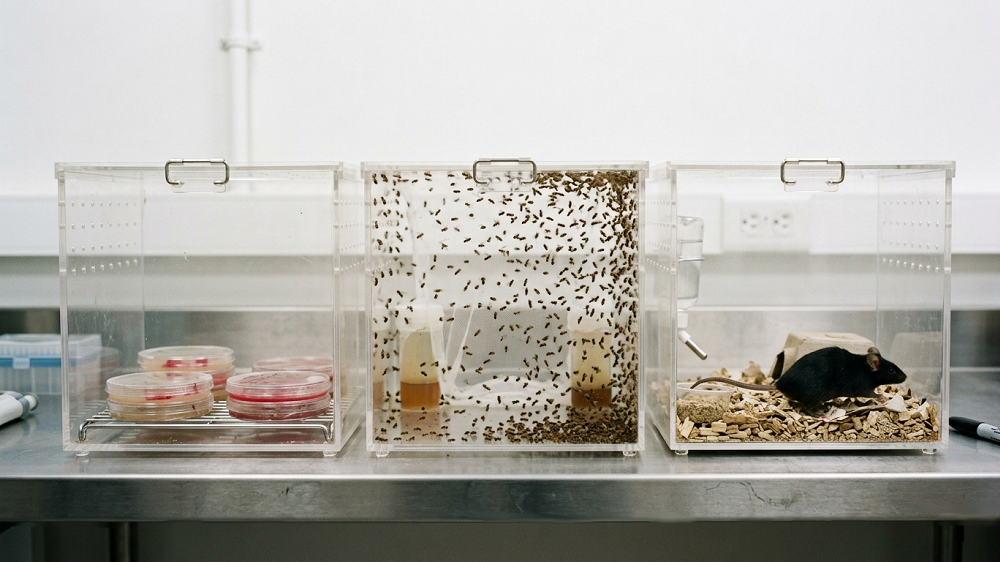
The authors first argue that there is a broad inverse relationship between organismal complexity and the size of lifespan extension produced by longevity interventions. In worms, changing one important node can reorganize a large fraction of the organism’s physiology. In Drosophila, the same pathways remain important, but effects are typically smaller and more conditional.
Mammalian lifespan is even harder to extend. For example, rapamycin in mice extends lifespan by around 10-25%, while caloric restriction has substantial but variable effects. Other compounds often improve health or particular aging phenotypes (“healthspan”) without comparably large extensions of maximal lifespan.
From simple pathways to huge networks
The rest of the paper attempts to explain this observation. First, according to the authors, increasing network complexity makes individual pathways less dominant. As biological networks acquire more cross-talk, redundancy, and feedback, perturbing one component produces less change in the overall system (the fraction of the total “aging system” controlled by the intervention’s target shrinks).
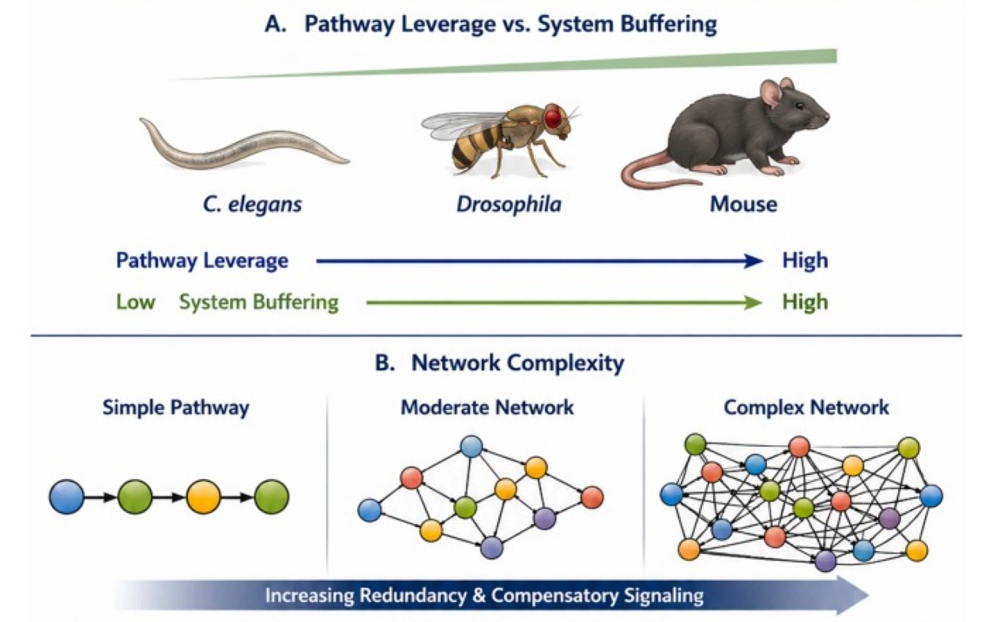
For instance, in the worm, pathways such as the insulin/insulin-like growth factor-1 signaling pathway (IIS), mTOR, and DAF-16/FOXO exert a lot of influence. Changing one produces organism-wide effects. In flies, those pathways interact more extensively with mitochondrial metabolism, reproductive signaling, dietary inputs, and stress responses. As a result, the effect of altering TOR, for example, is much more context-dependent.
In mammals, these pathways exist within even larger networks distributed among many tissues. mTOR inhibition is again the authors’ main example: it can produce beneficial effects, but it can also trigger compensatory changes in upstream insulin signaling and has different consequences in different tissues. In other words, the mammalian response to an intervention is partly a response against that intervention, as feedback and parallel pathways work to maintain stability.
That stability is, in fact, useful: a robust, long-lived organism should not have its entire metabolic state transformed whenever one signaling protein changes slightly. However, the very same robustness becomes a problem if the goal is to affect aging.
Specialized tissues and weak links
Next, the authors discuss tissue specialization. As organisms become more complex, aging stops being a mostly cell-intrinsic phenomenon. Instead, the same pathway can have different functions in different tissues. Inhibiting mTOR might be beneficial in one organ but interfere with repair or metabolism somewhere else. Moreover, improving one tissue does not necessarily move the entire organism toward rejuvenation. Recent research into organ-specific aging lends some support to this idea.

Complexity might also explain the “next weakest link effect,” where even if you successfully eliminate one major cause of aging-related death, another failure mode becomes limiting. The most well-known example is the calculation that eliminating cancer mortality altogether would only extend human life expectancy by about three years [4].
Moreover, complexity also means that many effects can be both good and bad (pleiotropic). For instance, growth pathways such as mTOR and IIS support cell proliferation – but sustained proliferative capacity can also drive cancer. Suppressing those pathways may reduce cancer and other hyperfunction-related damage while simultaneously compromising wound healing, immune activity, or regenerative capacity.
Likewise, chronic immune activation contributes to inflammaging and tissue damage, but suppressing immunity too much has its own dangers: cancer and acute infections, both major causes of age-related mortality. Maintaining highly proliferative stem-cell pools would aid tissue repair, but excessive or poorly controlled proliferation increases dysplasia and cancer risk.
Wait, the system is buffering
Organisms have finite resources that can broadly be allocated among growth, reproduction, and somatic maintenance. The authors argue that simple organisms can shift this allocation much more dramatically.
For instance, if food becomes scarce, a worm can substantially downregulate growth and reproduction and upregulate maintenance. Much of the extraordinary lifespan extension from dietary restriction or mutations in related pathways may represent this fundamental switching into a different life-history state. Flies retain this ability to some extent; for instance, amino-acid restriction can reduce reproductive investment and increase lifespan.
Mammals, on the other hand, have expensive specialized organs and tissues and rigid physiological commitments, meaning they cannot just redirect a huge fraction of their resources from one biological program and to maintenance without disrupting essential functions. Consequently, caloric restriction can still shift mammalian physiology toward maintenance, but to a lesser degree.
All these arguments are ultimately folded into one conceptual principle: maximum lifespan extension is proportional to pathway leverage divided by system buffering. As complexity rises, pathway leverage declines because aging control becomes distributed among more pathways, tissues, and physiological systems, while system buffering increases as redundancy, feedback, tissue interactions, and compensatory mechanisms become stronger. The predicted result is a decline in the maximum possible effect from a single intervention.
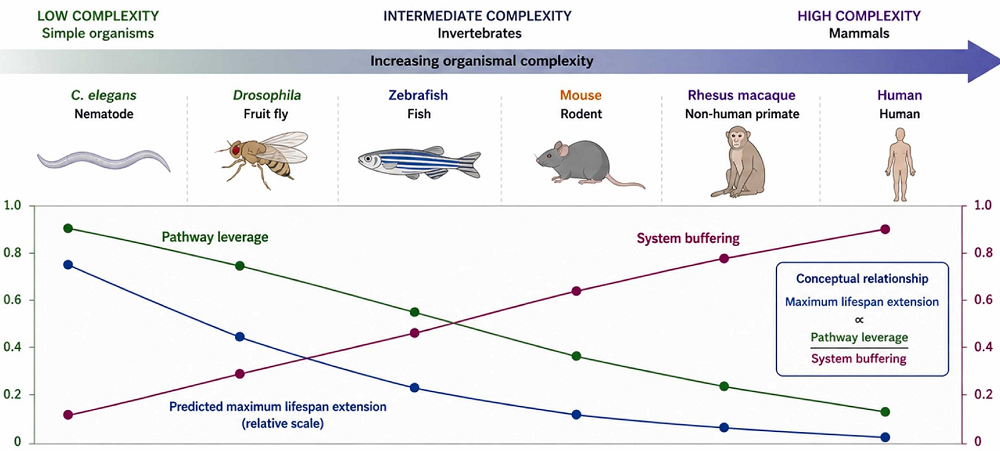
While this framework explains some observations, it remains mostly theoretical. However, if the authors are correct, meaningful human lifespan extension will probably require multi-target, multi-tissue interventions rather than finding one molecular “master switch.”
Literature
[1] Pirscoveanu, D. F., Papa, M. C., Kaltwasser, B., Hermann, D. M., Brockmeier, U., Cercel, A., … & Popa-Wagner, A. (2026). Biological limits of lifespan extension: evidence for a shift from pathway leverage to system-level buffering across species. Mechanisms of Ageing and Development, 112231.
[2] Kenyon, C., Chang, J., Gensch, E., Rudner, A., & Tabtiang, R. (1993). A C. elegans mutant that lives twice as long as wild type. Nature, 366(6454), 461-464.
[3] Harrison, D. E., Strong, R., Sharp, Z. D., Nelson, J. F., Astle, C. M., Flurkey, K., … & Miller, R. A. (2009). Rapamycin fed late in life extends lifespan in genetically heterogeneous mice. Nature, 460(7253), 392-395.
[4] Yashin, A. I., Ukraintseva, S. V., Akushevich, I. V., Arbeev, K. G., Kulminski, A., & Akushevich, L. (2009). Trade-off between cancer and aging: what role do other diseases play?: evidence from experimental and human population studies. Mechanisms of ageing and development, 130(1-2), 98-104.