A new study has found that restricting dietary valine extends both median and maximum lifespan in male mice while improving healthspan in both sexes. The mechanism remains unclear, though increased liver mitochondrial activity emerged as a leading clue.
Protein composition matters
The debates around how much protein people should consume to maximize their healthspan and lifespan are among the most heated in the longevity field. Some recent studies suggest that protein restriction can be beneficial [2], while higher animal-protein intake is associated with poorer metabolic health and a greater risk of several age-related diseases [3]. Others hint that the answer might be age-related: while protein restriction might be good for middle-aged adults, older people should ramp up their protein consumption to prevent muscle and bone loss [4].
A growing body of work suggests that these effects are not determined simply by the total amount of protein but may depend on the amino acids that make up the protein. In particular, intriguing results have been obtained for the three branched-chain amino acids, or BCAAs: leucine, isoleucine, and valine.
Previous research showed that restricting all three BCAAs improved metabolic health and extended male mouse lifespan. Restricting isoleucine alone also had substantial benefits, including lifespan extension in genetically heterogeneous mice [5]. Evidence that restricting leucine alone produces comparable benefits has so far been limited, while valine has remained understudied – a gap that a new study led by researchers at the University of Wisconsin-Madison and published in Nature Aging attempted to bridge.
Male-specific lifespan extension
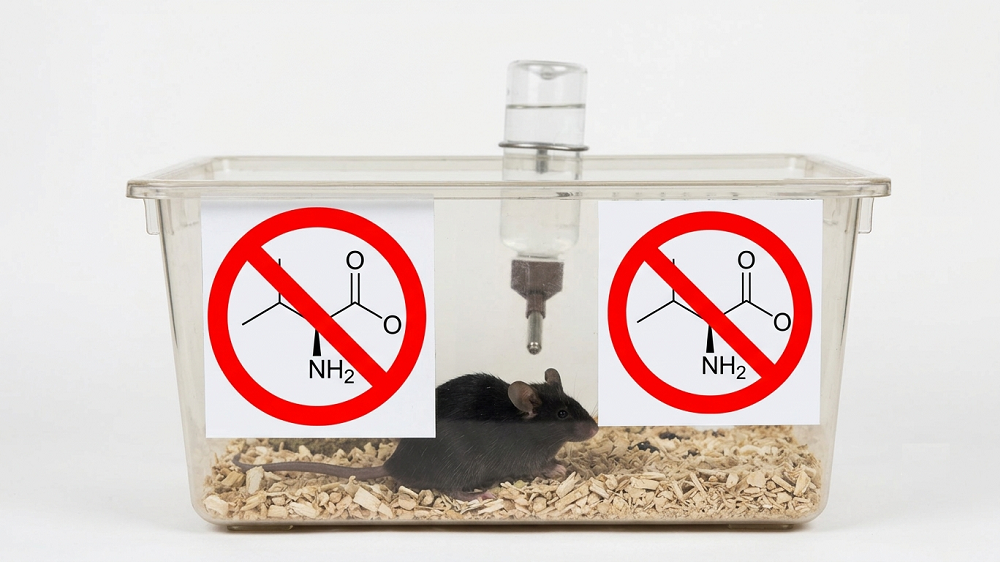
The authors placed male and female C57BL/6J mice on either a control amino-acid diet or a diet containing 67% less valine from four weeks of age and followed them throughout life. The diets were isocaloric and matched for fat, carbohydrates, and total calories from amino acids. The missing valine was replaced with non-essential amino acids.
Lifelong valine restriction increased median male lifespan from 777 to 959 days – a 23.4% increase. Importantly, it also increased male maximum lifespan: the longest-lived ten valine-restricted males lived roughly 15% longer than the longest-lived ten controls. This result suggests that valine restriction’s effect goes beyond simply compressing mortality.
Female median lifespan, however, was essentially unchanged: 842 days in controls versus 850 days with valine restriction, an increase of less than 1%. Many longevity interventions work differently in males and females, and the reasons for that are unclear.
“Very few interventions extend lifespan in both sexes, although there is the possibility that females might benefit from valine restriction under other conditions, such as a different degree of restriction, started at another time in life, or on a different genetic background,” said Dr. Dudley Lamming, the study’s corresponding author. “There are known differences in BCAA catabolism in male and female mice, so that could be part of it.”
Improved frailty, but not motor performance
Valine-restricted mice of both sexes gained much less weight – both fat and lean mass – and remained markedly leaner throughout adulthood. The reduction in fat was proportionally greater than the reduction in lean mass, so adiposity percentage fell in both sexes.
Importantly, the mice were not simply stunted. Femur and tibia lengths were unchanged, suggesting normal longitudinal skeletal growth. There were, however, potentially unfavorable changes in bone structure and microarchitecture.

Valine-restricted mice ate more calories relative to their body weight but actually stayed leaner than controls, possibly because their energy expenditure was higher. This was not explained by greater movement: activity was unchanged in males and lower in females.
The treated mice had some thermogenesis markers elevated, and brown fat, which participates in thermogenesis, showed morphology less geared towards lipid storage. Interestingly, genes involved in both lipid synthesis and lipid breakdown increased, which the authors interpret as possible futile lipid cycling: repeatedly building and breaking down lipids consumes energy without producing useful chemical work.
The authors also examined metabolic health. Valine restriction improved glucose tolerance in males from early adulthood through 24 months and across most of the female lifespan. Insulin-tolerance testing produced a weaker and more sex-specific result: males tended to respond more strongly to insulin, but females did not show a consistent overall improvement.
The researchers repeatedly scored a frailty index, which included coat condition, gait problems, tumors, body condition, sensory abnormalities, and signs of discomfort. Valine restriction lowered frailty in both sexes, but the treated animals generally did not show consistent improvements in motor performance.
Less senescence, more mitochondrial activity
Valine restriction reduced senescence-associated staining and gene-expression signatures in several tissues, including liver, kidney, and adipose tissue, although some senescence markers actually moved in the opposite direction. The treatment also reduced glial inflammatory markers in selected hypothalamic and hippocampal regions, with the clearest and most consistent effects in males. Males’ microglia – the brain’s resident macrophages – generally showed less activation-associated morphology.
The researchers expected that restricting an essential amino acid would suppress mTORC1, a nutrient-sensing protein complex that promotes growth and protein synthesis and whose chronic inhibition can extend lifespan. Contrary to this expectation, valine restriction increased hepatic mTORC1 signaling in both sexes. This result distinguishes valine restriction from interventions such as rapamycin and from some forms of total protein restriction.
Another interesting result was that male liver mitochondria showed greater respiratory activity. This male-specific change might be the paper’s leading mechanistic clue. However, this result is correlational.
“We didn’t previously know that valine restriction could extend lifespan in mice, nor that the effect would be sex-specific,” Lamming said. “Other key findings include many details about beneficial effects of valine restriction on healthspan in both sexes, which was previously unknown, and the fact that valine restriction actually increases mTOR signaling in male liver, despite extending lifespan. We also found that valine restriction boosts liver mitochondrial activity, which could be linked to the effects on lifespan.”
Literature
[1] Calubag, M. F., Ademi, I., Green, C. L., Manchanayake, D. N., Jayarathne, H. S., Marshall, R. N., … & Lamming, D. W. (2026). Lifelong restriction of dietary valine has sex-specific benefits for health and lifespan in mice. Nature Aging, 1-20.
[2] Ferraz-Bannitz, R., Beraldo, R. A., Peluso, A. A., Dall, M., Babaei, P., Foglietti, R. C., … & Foss-Freitas, M. C. (2022). Dietary protein restriction improves metabolic dysfunction in patients with metabolic syndrome in a randomized, controlled trial. Nutrients, 14(13), 2670.
[3] Lv, J. L., Wu, Q. J., Li, X. Y., Gao, C., Xu, M. Z., Yang, J., … & Zhao, Y. H. (2022). Dietary protein and multiple health outcomes: an umbrella review of systematic reviews and meta-analyses of observational studies Clinical Nutrition, 41(8), 1759-1769.
[4] Coelho-Junior, H. J., Rodrigues, B., Uchida, M., & Marzetti, E. (2018). Low protein intake is associated with frailty in older adults: a systematic review and meta-analysis of observational studies. Nutrients, 10(9), 1334.
[5] Green, C. L., Trautman, M. E., Chaiyakul, K., Jain, R., Alam, Y. H., Babygirija, R., … & Lamming, D. W. (2023). Dietary restriction of isoleucine increases healthspan and lifespan of genetically heterogeneous mice. Cell metabolism, 35(11), 1976-1995.