Modified Immune Cells Target Cancer’s Metabolic Signature
- The researchers found one crucial receptor.

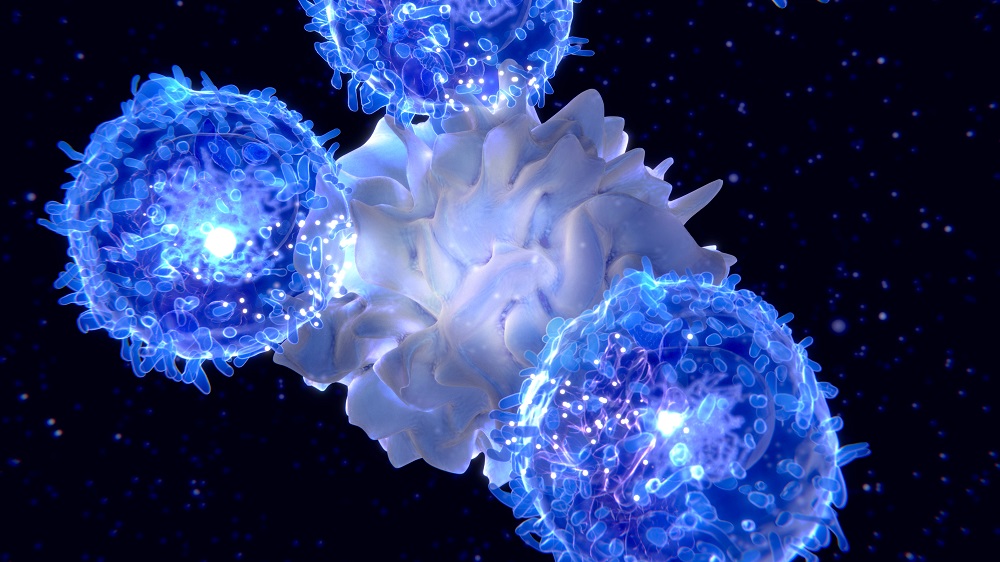
- The receptor GPR183 senses metabolites that originate from cancer cells.
- Introducing this receptor into natural killer cells causes them to infiltrate into tumors, significantly improving their performance against cancer in a mouse model.
Arming NK and T cells with metabolite-sensing receptors enhances their ability to infiltrate tumors and improves cancer outcomes in mice in a new study [1].
How to get immune cells into the tumor?
One of the central challenges in cancer immunotherapy is getting the right immune cells to the right place. Natural killer (NK) cells and cytotoxic T cells can recognize and destroy cancer cells, but even when artificially enhanced, such as by being armed with chimeric antigen receptors (CARs), these cells often fail to rein in solid tumors [2].
One reason is that the immune cells have trouble getting in, since solid tumors are surrounded by a hostile microenvironment that creates physical and biochemical barriers to immune cell entry. Tumors also actively suppress the signaling pathways used by immune cells to home on their targets [3]. In a new study from Stanford University, published in Nature Immunology, the researchers attempted to address this “targeting problem.”
Targeting metabolites
First, they ran an unbiased gain-of-function search for which receptors, if artificially switched on in killer cells, would cause those cells to migrate into tumors. The search targeted 256 candidate genes derived from two separate datasets. NK cells expressing any of eight receptors – GPR183, GPR84, GPR34, GPR18, LPAR2, FPR3, C5AR1, and CXCR2 – were consistently found at higher rates inside tumors than in reference tissues across all breast cancer models. Six of these also appeared in the ovarian cancer screen. A larger follow-up screen of over 5,500 genes in the ovarian cancer model again returned GPR183 and GPR84 as top hits.
Notably, only one chemokine receptor (CXCR2) appeared as a hit. Chemokines are signaling proteins that are often suppressed by cancer cells in an attempt to fool the immune system, which might be a reason why only one of them made it to the top-hit list. GPRs, on the other hand, are a large group of metabolite-sensing receptors. Tumor metabolism is usually very different than that of healthy tissues. The top-hit receptors reacted to those “metabolic idiosyncrasies,” causing the NK cells to home on their sources.
To specifically test directed migration toward a chemical gradient (chemotaxis) and infiltration, the authors ran two ingenious in vitro screens using cancer breast cancer cells and three-dimensional spheroids – miniature tumor-like structures. All GPRs were among the top 10 hits, confirming that NK cells expressing these receptors actively migrate toward factors secreted by cancer cells and effectively infiltrate spheroids. GPR183 was consistently at the top.
GPR signaling was also found to alter gene expression. GPR183 activation caused dramatic transcriptional remodeling, but only in the presence of its ligand. This ligand dependence means that GPR183 functions as a conditional switch, only altering cell behavior when the ligand is present – such as in a tumor environment.
Improved survival in breast cancer
Next, the authors tested whether the improved infiltration actually translates to better therapeutic outcomes. Mice bearing subcutaneous triple-negative breast cancer xenografts received weekly intravenous injections of either control NK cells or GPR183-overexpressing NK-92 cells. The latter significantly delayed tumor growth compared to both untreated mice and control NK cells.
To test the combination of tumor targeting (via CAR) and migration enhancement (via GPR183), the authors built a CAR targeting a surface antigen broadly expressed on breast cancer cells. GPR183-overexpressing CAR NK cells produced much better control of tumor growth than control CAR NK cells and significantly improved survival. The team achieved similar results with T cells from different human donors.All prior in vivo experiments used immunocompromised NSG mice, which lack functional mouse immune cells. This means that any interference – beneficial or harmful – from the host’s own immune system was absent.
To address this, the authors moved to a fully immunocompetent mouse model of breast cancer. The mouse homolog Gpr183 was introduced into mouse T cells, and these cells significantly delayed tumor growth and prolonged survival compared to control T cells. 7 out of 10 mice achieved complete responses (tumor elimination), compared to only 3 out of 10 in the control group.
“We found that when we equip immune cells with receptors that sense metabolites released by cancer cells, they can sense the tumor, migrate toward it, infiltrate it and control tumor growth, which markedly enhances the survival of mice with human breast and ovarian cancers,” said Livnat Jerby, Ph.D., assistant professor of genetics and the senior author of the paper.
“Surprisingly, we didn’t see many chemokine receptors among the winners,” she added. “What came up were receptors that recognize bioactive, chemoattracting metabolites that have not been studied nearly as much in the context of cell engineering and tumor immunology. To the best of our knowledge, no one has tried to use cancer metabolism, a hallmark of drug resistance and aggressive tumor growth, to attract cancer-killing immune cells to the tumor, but our study uncovered the potential of this approach, and the results are quite promising.”
Literature
[1] Kim, Y. M., Tsai, M. K., Sun, C., Laveroni, O., Akana, R. V., Frombach, K., & Jerby, L. (2026). Engineering NK and T cells with metabolite-sensing receptors to target solid tumors. Nature Immunology, 1-14.
[2] Marofi, F., Motavalli, R., Safonov, V. A., Thangavelu, L., Yumashev, A. V., Alexander, M., … & Khiavi, F. M. (2021). CAR T cells in solid tumors: challenges and opportunities Stem cell research & therapy, 12(1), 81.
[3] Joyce, J. A., & Fearon, D. T. (2015). T cell exclusion, immune privilege, and the tumor microenvironment. Science, 348(6230), 74-80.
About the author

Arkadi Mazin