The Blog

Building a Future Free of Age-Related Disease

Stopwatch

A Likely Beneficial Compound Also Predicts Mortality

Researchers publishing in Aging have found that fibroblast growth factor 21 (FGF21), an apparently beneficial protein naturally produced by the human body, heralds a greater likelihood of death.

Multiple documented benefits

FGF21 plays crucial roles in the human body. Secreted by the liver and many other tissues, it is responsible for glucose maintenance and fat (lipid) metabolism [1]. Mimics of FGF21 have been found to have beneficial effects against diabetes and metabolic issues, such as cholesterol and triglyceride imbalances [2]. Further work has found that it may have even farther-ranging benefits [3], and its administration increases the lifespan of mice [4].

However, previous research has also found that animals that produce more FGF21 over time are more likely to die early [5], making it a potential biomarker of aging [6]. These researchers, therefore, took a step towards reconciling these facts, looking into the details of how FGF21 concentrations are correlated with mortality risk.

More FGF21, more mortality risk

This study was conducted using data from 3,512 people who were at least 50 years old, with a roughly even gender balance. The data was taken from a Polish source (PolSenior2), and the vast majority of participants were of European descent.

Participants were grouped into tertiles by FGF21 quantity and by sex, as women have more FGF21 than men. Men in the highest tertile were, on average, a year older than men in the middle, who, in turn, were a year older on average than men in the lowest. BMI, heart failure, diabetes, and biomarkers of lipid metabolic problems all rose with increasing FGF21. For women, the difference was even more drastic, although this can be accounted for because, in women, FGF21 and age were even more tightly linked.

FGF21, as expected, was linked with mortality, even after correcting for age. In an age-adjusted analysis, people in the middle group were 1.3 times as likely to die than the lower group; people in the higher group were nearly twice as likely. Even in a multivariable analysis that accounted for many other factors, people in the middle group were 1.2 times as likely to die, and people in the highest group were 1.5 times as likely. This molecule, despite being tested as a protector, was directly and independently associated with all-cause mortality.

This is not a fluke; this research is in line with other studies showing an association between FGF21 and mortality [7, 8]. This has led these researchers to carefully consider what might be driving their results. They hypothesize that FGF21 may be produced by the body in response to metabolic problems in an effort to counteract them; they also propose that FGF21 receptors might be being degraded with age, leading to an increase in its production but a decrease in its effectiveness. It is also questionable if FGF21 affects rodents and people in the same way. Further work will need to be done to determine if FGF21 is a druggable target in human beings.

We would like to ask you a small favor. We are a non-profit foundation, and unlike some other organizations, we have no shareholders and no products to sell you. All our news and educational content is free for everyone to read, but it does mean that we rely on the help of people like you. Every contribution, no matter if it’s big or small, supports independent journalism and sustains our future.

Literature

[1] Chen, Z., Yang, L., Liu, Y., Huang, P., Song, H., & Zheng, P. (2022). The potential function and clinical application of FGF21 in metabolic diseases. Frontiers in pharmacology, 13, 1089214.

[2] Talukdar, S., Zhou, Y., Li, D., Rossulek, M., Dong, J., Somayaji, V., … & Calle, R. A. (2016). A long-acting FGF21 molecule, PF-05231023, decreases body weight and improves lipid profile in non-human primates and type 2 diabetic subjects. Cell metabolism, 23(3), 427-440.

[3] Tan, H., Yue, T., Chen, Z., Wu, W., Xu, S., & Weng, J. (2023). Targeting FGF21 in cardiovascular and metabolic diseases: from mechanism to medicine. International Journal of Biological Sciences, 19(1), 66.

[4] Zhang, Y., Xie, Y., Berglund, E. D., Coate, K. C., He, T. T., Katafuchi, T., … & Mangelsdorf, D. J. (2012). The starvation hormone, fibroblast growth factor-21, extends lifespan in mice. elife, 1, e00065.

[5] Tezze, C., Romanello, V., Desbats, M. A., Fadini, G. P., Albiero, M., Favaro, G., … & Sandri, M. (2017). Age-associated loss of OPA1 in muscle impacts muscle mass, metabolic homeostasis, systemic inflammation, and epithelial senescence. Cell metabolism, 25(6), 1374-1389.

[6] Hanks, L. J., Gutiérrez, O. M., Bamman, M. M., Ashraf, A., McCormick, K. L., & Casazza, K. (2015). Circulating levels of fibroblast growth factor-21 increase with age independently of body composition indices among healthy individuals. Journal of clinical & translational endocrinology, 2(2), 77-82.

[7] Conte, M., Ostan, R., Fabbri, C., Santoro, A., Guidarelli, G., Vitale, G., … & Salvioli, S. (2019). Human aging and longevity are characterized by high levels of mitokines. The Journals of Gerontology: Series A, 74(5), 600-607.

[8] Li, M., Jiang, L. Q., Zhang, M. Y., Liu, S. S., Sawh, R. R. R., Zheng, J., … & Wang, B. (2023). Elevated serum FGF21 is an independent predictor for adverse events in hemodialysis patients from two large centers: a prospective cohort study. Renal Failure, 45(2), 2256414.

Cynomolgus monkeys

Metformin Slows Aging in Non-Human Primates

In a new study, metformin, which has already shown good results in rodents and in human epidemiological studies, alleviated multiple signs of aging in male cynomolgus monkeys [1].

Now in monkeys

Metformin, a well-established anti-diabetes drug, has been touted as a possible geroprotector since a study suggested that diabetes patients on metformin outlived age-matched healthy controls [2]. A newer study put these claims in doubt [3], but metformin is far from being dethroned.

While a rigorous study by the Interventions Testing Program (ITP) failed to produce life extension in mice on metformin [4], smaller studies have. In animal models, metformin has alleviated multiple hallmarks of aging, and it has also been linked to a reduction in health risks in humans. The ambitious Targeting Aging with Metformin (TAME) study is expected to shed more light on the drug’s effects, when and if it takes off the ground.

Meanwhile, a group of Chinese scientists performed a groundbreaking long-term study of metformin in cynomolgus monkeys. These relatively long-lived non-human primates match human biology much better than mice.

Improved cognitive function

The study lasted for 40 months and “encompassed a comprehensive suite of physiological, imaging, histological, and molecular evaluations” with 68 parameters overall. For their study group, the researchers took male cynomolgus monkeys aged 13 to 16 years, which is roughly equivalent to 40 to 50 human years. There were also three control groups: old, young, and middle-aged monkeys. The dose chosen was 20 mg/kg, which is a standard dosage for long-term anti-diabetes use in humans.

Metformin was mostly safe in these monkeys, just like in humans. The researchers periodically assessed multiple parameters and found that the treatment was associated with numerous health benefits. To begin with, the monkeys on metformin demonstrated better cognitive performance than age-matched controls in both memory and learning.

These results matched the analysis of cortical thickness in several brain regions. Compared to controls, which showed a decrease in cortical thickness with age, “in metformin-treated aged monkeys, frontal lobe cortical thickness was preserved, with a trend toward increased thickness in the parietal lobe,” the paper says.

Less transcriptomic aging and inflammation

Digging deeper into the mechanisms of metformin-related improvements, the researchers conducted organism-wide and genome-wide RNA sequencing, profiling 79 tissues and organs. They found that in terms of expression, genes in control groups could be divided into four clusters: expression goes down with age (D), expression goes up with age (U), expression goes up and then down (UD), and expression goes down then up (DU). In all four clusters, age-dependent changes were significantly mitigated by the treatment:

Metformin in monkeys

Metformin was also associated with decreased accumulation of senescent (p21-positive) cells in multiple tissues and with less fibrosis in the lung, kidney, and heart. There were signs of slower muscle aging and of increased epigenetic stability (lower endogenous retroviral activity).

“Strikingly,” the paper says, “we detected a widespread, potent effect of metformin in curbing chronic inflammation, a cardinal hallmark of aging that underlies almost all aging-related diseases.” Metformin was associated with reduced age-related inflammation in the liver and stomach. A reduction in immune cell infiltration was detected in the lung, liver, and kidney.

The clock ticks slower

The researchers constructed a set of biological age clocks using multi-omics data. Their analysis showed a 6.41-year reduction in biological age following metformin treatment, with the biggest reductions in the brain, lung, kidney, and liver. In all 13 tissues analyzed, the clock was reversed to some degree.

Several cell types were also analyzed in depth using single-nucleus transcriptomics. Mirroring the tissue-level results, hepatocytes (liver cells) and various brain cells showed the most robust slowing of biological age following the treatment.

Finally, the researchers reported that metformin reduced aging-associated periodontal bone loss. Not only is periodontal disease caused by aging, but it also probably exacerbates other aging processes by increasing inflammation [5].

Among the limitations of this study is its small sample size and its use of only male monkeys. This makes it harder to extrapolate the results to the female population, since females and males age differently.

Over 3 years, we evaluated metformin’s systemic geroprotective effects in healthy monkeys, taking advantage of their physiology and organ structure akin to humans, as well as their disease and medication responses. Our results indicate metformin’s capacity to ameliorate aging across the primate body, with multidimensional aging clocks showing a rejuvenation trend post-treatment… Our study reveals metformin’s tissue- and cell-specific geroprotective actions, notably enhancing cognitive performance in primates.

We would like to ask you a small favor. We are a non-profit foundation, and unlike some other organizations, we have no shareholders and no products to sell you. All our news and educational content is free for everyone to read, but it does mean that we rely on the help of people like you. Every contribution, no matter if it’s big or small, supports independent journalism and sustains our future.

Literature

[1] Yang, Y., Lu, X., Liu, N., Ma, S., Zhang, H., Zhang, Z., … & Liu, G. H. (2024). Metformin decelerates aging clock in male monkeys. Cell.

[2] Bannister, C. A., Holden, S. E., Jenkins‐Jones, S., Morgan, C. L., Halcox, J. P., Schernthaner, G., … & Currie, C. J. (2014). Can people with type 2 diabetes live longer than those without? A comparison of mortality in people initiated with metformin or sulphonylurea monotherapy and matched, non‐diabetic controls. Diabetes, Obesity and Metabolism, 16(11), 1165-1173.

[3] Stevenson-Hoare, J., Leonenko, G., & Escott-Price, V. (2023). Comparison of long-term effects of metformin on longevity between people with type 2 diabetes and matched non-diabetic controls. BMC Public Health, 23(1), 804.

[4] Strong, R., Miller, R. A., Antebi, A., Astle, C. M., Bogue, M., Denzel, M. S., … & Harrison, D. E. (2016). Longer lifespan in male mice treated with a weakly estrogenic agonist, an antioxidant, an α‐glucosidase inhibitor or a Nrf2‐inducer. Aging cell, 15(5), 872-884.

[5] Hajishengallis, G., & Chavakis, T. (2021). Local and systemic mechanisms linking periodontal disease and inflammatory comorbidities. Nature Reviews Immunology, 21(7), 426-440.

International Institute of Longevity

Insights from the Roundtable of Longevity Clinics 2024

The quest to extend human lifespan and improve healthspan is advancing rapidly, and one of the most prestigious platforms for driving these discussions is the Roundtable of Longevity Clinics. This annual gathering brings together global experts to exchange knowledge on cutting-edge research, innovations, and regulatory strategies aimed at enhancing human longevity.

The 2024 edition promises to be a groundbreaking event, assembling the most prominent longevity clinics and leading solution providers to discuss the gold standards in the industry. Together, they will create a unified voice for the longevity field, shaping the future of aging interventions.

Key Themes at the Roundtable of Longevity Clinics 2024

  • Longevity Medicine in Practice: This theme focuses on the real-world application of longevity interventions in clinical settings, discussing how to integrate cutting-edge treatments into everyday medical practice to improve healthspan.
  • Longevity Diagnostics: Understanding early biomarkers of aging is critical for intervention. This segment highlights breakthroughs in diagnostic tools, including biological clocks, epigenetic markers, and advanced medical imaging, which allow for personalized longevity plans.
  • Longevity Interventions: A deep dive into regenerative medicine, gene therapies, and other emerging treatments that aim to reverse or halt age-related decline. The section will also cover key lifestyle interventions, including sleep optimization, fasting, supplements, music therapy, and other approaches to enhance healthspan and longevity.
  • Digital Longevity: The role of digital tools, and machine learning in longevity research and practice. Discussions will center on how AI-driven insights are transforming personalized treatments and accelerating the discovery of new longevity therapies.
  • Client Engagement: Exploring how healthcare providers can maintain client engagement in long-term longevity programs, ensuring adherence to treatment protocols and sustained health improvements.
  • Longevity Roundtable: This event will feature dynamic panel discussions where representatives from leading longevity clinics and top service providers will explore current trends, cutting-edge diagnostic solutions, innovative interventions, and the business aspects of the rapidly evolving longevity industry.

Notable Speakers

The Roundtable of Longevity Clinics 2024 will feature an impressive lineup of leading experts, including:

  • Peter H. Diamandis (XPRIZE Foundation)
  • Dr. Eric Verdin (Buck Institute for Research on Aging)
  • Dr. Leroy Hood (Phenome Health)
  • Dr. Dean Ornish (Ornish Lifestyle Medicine)
  • Dr. Michael Roizen (Cleveland Clinic)
  • Dr. Andrea B. Maier (CHI Longevity)
  • Joanna Bensz (Longevity Center)

For more details, visit the official conference site. These thought leaders and many others will present their latest findings and explore the path to translating scientific discoveries into practical interventions that could redefine aging.

Why the Roundtable of Longevity Clinics Matters

With global life expectancy rising, extending healthspan is becoming a critical issue. The Roundtable of Longevity Clinics is a leading forum for shaping the future of aging. This event will aim to set new standards in longevity treatments, ensuring that the therapies and innovations discussed will accelerate how we approach aging and health. The ideas and collaborations formed here will help define the next generation of therapies capable of transforming how we age, making this conference essential for researchers, investors, and innovators alike. For entrepreneurs, the longevity field offers exciting growth opportunities—from biotechnology startups to AI-driven healthcare solutions. The insights gained at this conference could pave the way for significant economic expansion in the sector.

Join the Future of Longevity!

Get your ticket now for the Roundtable of Longevity Clinics 2024 and connect with world-leading experts. Don’t miss out— secure your spot today to be part of the conversations shaping the future of aging interventions!

How to Follow the Conference

Stay connected with the latest developments at the Roundtable of Longevity Clinics 2024 by following lifespan.io for key takeaways, interviews, and insights. Join the conversation on social media using #LongevityRoundtable and #LifespanRevolution to be part of the global movement shaping the future of longevity.

On Social Media

Unlock the secrets to a longer, healthier life! The Roundtable of Longevity Clinics 2024 is happening soon, featuring top scientists, innovators, and thought leaders in human longevity. Stay tuned for exclusive coverage from lifespan.io and get insights from the brightest minds in aging research. Let’s reshape the future of health together! #LongevityRoundtable #LifespanRevolution #HealthyAging #FutureOfLongevity

We would like to ask you a small favor. We are a non-profit foundation, and unlike some other organizations, we have no shareholders and no products to sell you. All our news and educational content is free for everyone to read, but it does mean that we rely on the help of people like you. Every contribution, no matter if it’s big or small, supports independent journalism and sustains our future.
Stem cells

MSC Treatment Improves Age-Related Phenotypes in Rats

In a recent study, researchers injected rats with mesenchymal stromal cells. They observed improvements in aging-related biomarkers and phenotypes in many organs [1].

The rejuvenating role of MSCs

Mesenchymal stromal cells (MSCs) can be obtained from diverse sources, including bone marrow, adipose tissue, perinatal tissue, and dental tissues [2].

MSCs have been shown to have multiple beneficial effects. Previous research has found that they can “alleviate oxidative stress and inflammatory responses, promote tissue repair, and restore proper immunological functions” [3, 4], stimulate angiogenesis [5], extend murine lifespan and healthspan, and have a protective effect against stem cell and fibroblast aging [6]. MSCs’ safety and efficacy have been shown in Phase I and II clinical trials investigating aging-related frailty [7].

Positive impact on aging biomarkers

This study aimed to comprehensively evaluate the impact of human-derived umbilical cord-derived mesenchymal stromal cells (UC-MSCs) on senescence in rats.

The researchers used ten naturally aged male rats (24 months old) and five young male rats (8 weeks old). They treated them with four weekly tail vein injections of UC-MSCs. The authors stated that they wished to have more animals in the study, but they were limited due to the scarcity of naturally aged animals.

The researchers observed a significant increase in p16, p21, SA-β-gal, and lipofuscin, which are aging-related factors and biomarkers of aging and senescence, in the heart, brain, lung, kidney, liver, spleen, intestinal tissues, and peripheral blood of aged rats. Depending on the tissue, this was observed for some or all of the markers. MSC treatment significantly reduced those markers.

The authors also measured oxidative stress markers. The levels of SOD, an enzyme that plays a role in preventing the toxic effects of free radicals, were decreased in the multiple tested organs and peripheral blood of aged rats. MSC treatment led to a significant increase in SOD levels.

Levels of MDA, a biomarker of lipid oxidative damage, significantly increased in multiple organs, brain tissue, and peripheral blood of aged rats, but MSC treatment resulted in a decrease in MDA.

The third marker, the antioxidant GSH, wasn’t consistent between different organs of aged rats. Still, the MSC treatment always increased its levels in measured tissues (but not always significantly) compared to aged controls.

The next group of measured biomarkers consisted of aging-related biomarkers related to the immune system: an antibody IgG (Immunoglobulin G) and two pro-inflammatory cytokines, IL-1β and IL-6.

The authors observed decreased levels of IgG in the brain, multiple organs, and peripheral blood of old rats compared to young rats. The difference in brain, liver, lungs, kidneys, and peripheral blood was statistically significant, and following MSC treatment, those levels increased.

In the lungs, kidneys, liver, and peripheral blood of aged rats, the researchers observed an increase in IL-1β and IL-6. MSC treatment decreased both of the cytokines in the lungs and kidneys and IL-1β in the liver.

The researchers summarize that there is an increase in aging-related factors, oxidative stress, and chronic inflammation in multiple organs of old rats. However, MSC treatment can significantly ameliorate these aging-related phenotypes.

Rejuvenating organs and the microbiome

Starting with the brain, the researchers investigated changes in two regions: the prefrontal cortex and the hippocampus. Previous research linked aging-related changes in those brain regions “to cognitive deficits, intellectual decline, sleep disorders, and circadian rhythm disruptions” [8].

The study’s authors observed aging-related phenotypes in those regions, for example, a significant decrease in the number of neurons, which was increased following MSC treatment along with improvement in other aging-related phenotypes.

Other organs also suffered from aging-related changes. Compared to young cells, aged heart cells exhibited age-related phenotypes, including accumulation of collagen fibers and increase in cellular size (hypertrophy). MSC treatment helped improve both of them.

The heart, along with the liver, also suffered from an age-related increase in the deposition of fats. Following MSC treatment, those fat depositions decreased in the old rats, suggesting that MSCs have an impact on lipid metabolism.

It is known that aging affects microbiota and that gut diversity in the elderly is lower compared to young people [9]. In this study, the researchers observed aging-related changes in the microbiomes of rats.

MSC treatment of older rats helped to increase microbial diversity and rejuvenate the microbiome towards that of younger animals. The authors suggest that such alterations might have broader effects on other organs through the modulation of amino acid and carbohydrate metabolism.

Rejuvenating the immune system

Aging is associated with the decline of the proper functioning of the immune system in a process known as immunosenescence. One of the manifestations of aging immune systems is a change in different types of immune cells, specifically ”changes in the ratio of naïve T cells and memory T cells, imbalanced CD4 + T cells and CD8 + T cells” [10].

In this study, the researchers observed those and other aging-related phenotype in the aged rats. Those included, reduced CD4 + T/CD8 + T ratio in peripheral blood, disordered structure of spleen, lower number of spleen cells, and higher number of apoptotic spleen cells. MSCs treatment improved those phenotypes in the aged rats.

More comprehensive, but not long-term

While the anti-aging benefits of MSCs were studied previously, the authors emphasize that their study is more comprehensive than the previous research and shows “that MSCs can modulate the entire organism’s aging process and achieve deceleration of aging through reciprocal interactions among different organs and systems.”

However, further research is needed into the molecular mechanisms of MSCs’ anti-aging action. There is also a need to assess such treatment’s long-term effects and possible side effects.

We would like to ask you a small favor. We are a non-profit foundation, and unlike some other organizations, we have no shareholders and no products to sell you. All our news and educational content is free for everyone to read, but it does mean that we rely on the help of people like you. Every contribution, no matter if it’s big or small, supports independent journalism and sustains our future.

Literature

[1] Wang, L., Deng, Z., Li, Y., Wu, Y., Yao, R., Cao, Y., Wang, M., Zhou, F., Zhu, H., & Kang, H. (2024). Ameliorative effects of mesenchymal stromal cells on senescence associated phenotypes in naturally aged rats. Journal of translational medicine, 22(1), 722.

[2] Galipeau, J., & Sensébé, L. (2018). Mesenchymal Stromal Cells: Clinical Challenges and Therapeutic Opportunities. Cell stem cell, 22(6), 824–833.

[3] He, Y., Chen, D., Yang, L., Hou, Q., Ma, H., & Xu, X. (2018). The therapeutic potential of bone marrow mesenchymal stem cells in premature ovarian failure. Stem cell research & therapy, 9(1), 263.

[4] Wang, L., Li, Y., Xu, M., Deng, Z., Zhao, Y., Yang, M., Liu, Y., Yuan, R., Sun, Y., Zhang, H., Wang, H., Qian, Z., & Kang, H. (2021). Regulation of Inflammatory Cytokine Storms by Mesenchymal Stem Cells. Frontiers in immunology, 12, 726909.

[5] Xiao, X., Xu, M., Yu, H., Wang, L., Li, X., Rak, J., Wang, S., & Zhao, R. C. (2021). Mesenchymal stem cell-derived small extracellular vesicles mitigate oxidative stress-induced senescence in endothelial cells via regulation of miR-146a/Src. Signal transduction and targeted therapy, 6(1), 354.

[6] Dorronsoro, A., Santiago, F. E., Grassi, D., Zhang, T., Lai, R. C., McGowan, S. J., Angelini, L., Lavasani, M., Corbo, L., Lu, A., Brooks, R. W., Garcia-Contreras, M., Stolz, D. B., Amelio, A., Boregowda, S. V., Fallahi, M., Reich, A., Ricordi, C., Phinney, D. G., Huard, J., … Robbins, P. D. (2021). Mesenchymal stem cell-derived extracellular vesicles reduce senescence and extend health span in mouse models of aging. Aging cell, 20(4), e13337.

[7] Zhu, Y., Ge, J., Huang, C., Liu, H., & Jiang, H. (2021). Application of mesenchymal stem cell therapy for aging frailty: from mechanisms to therapeutics. Theranostics, 11(12), 5675–5685.

[8] Satoh, A., Imai, S. I., & Guarente, L. (2017). The brain, sirtuins, and ageing. Nature reviews. Neuroscience, 18(6), 362–374.

[9] Claesson, M. J., Jeffery, I. B., Conde, S., Power, S. E., O’Connor, E. M., Cusack, S., Harris, H. M., Coakley, M., Lakshminarayanan, B., O’Sullivan, O., Fitzgerald, G. F., Deane, J., O’Connor, M., Harnedy, N., O’Connor, K., O’Mahony, D., van Sinderen, D., Wallace, M., Brennan, L., Stanton, C., … O’Toole, P. W. (2012). Gut microbiota composition correlates with diet and health in the elderly. Nature, 488(7410), 178–184.

[10] Goronzy, J. J., & Weyand, C. M. (2013). Understanding immunosenescence to improve responses to vaccines. Nature immunology, 14(5), 428–436.

Greenland Shark

The Greenland Shark’s Genome Reveals Clues to Its Longevity

Scientists have compiled the most complete genome ever of the Greenland shark, an exceptionally long-lived species. Living up to 400 years probably has a lot to do with superior DNA repair mechanisms.

Methuselahs of the sea

Greenland sharks, giant, slow-moving abyss dwellers, hold the title of the longest-lived vertebrate. While estimating a wild species’ maximum lifespan is challenging, Greenland sharks are thought to live to about 400, give or take a century [1]. The closest other shark species can get to that is 100 years, which is already respectable.

Scientists have been studying Greenland sharks in an attempt to understand the origins of their exceptional longevity. In a new paper, currently published as a pre-print that has not yet been peer-reviewed, a group of researchers report having compiled the most complete Greenland shark genome ever. This allowed them to make a few educated guesses.

Don’t let it break

Just like the Greenland shark itself, its genome is gigantic and full of repetitive sequences. Those account for 70% of the shark’s genome and consist mostly of retrotransposons: remnants of retroviruses that have inserted their genetic code into their hosts’ genomes over the eons of evolution. Some retrotransposons are still able to reproduce by copying themselves and inserting new copies back into the genome. Retrotransposon activity has been linked to multiple hallmarks of aging [2], and long-lived species must develop ways to mitigate it.

The researchers noticed the impressive conservation of gene order (synteny) between the Greenland shark and other shark species, such as the great white shark, even though they diverged about 250 million years ago. When we hear that sharks haven’t changed since the dawn of time, that’s what it means, genetically. “Overall, despite an evolutionary distance of several hundred million years between them,” the researchers write, “the Greenland shark and the great white shark show striking similarities in their genomic structure and organization.”

However, there still must be something in the Greenland shark’s genome that makes it live four times longer than any other shark species. Often, mechanisms that prolong lifespan involve gene duplication. For instance, elephants have several copies of the p53 gene, a crucial tumor suppressor [3].

When the researchers tested the Greenland shark’s genome for gene duplication, they found 81 genes that exist as single copies in all other members of Elasmobranch, a subclass of animals that includes sharks and rays, but have multiple copies in the Greenland shark. Those genes behave a lot like a network and, according to gene ontology analysis, are related to double-strand DNA break repair.

Interestingly, although p53 appears to act as this network’s master regulator, it exists as a single copy. However, that single p53 gene also carries a mutation specific to the Greenland shark.

“Taken together,” the authors conclude, “duplications of genes associated with DNA repair and the p53 pathway appear to distinguish the extremely long-lived Greenland shark from other Elasmobranch species, outlining the path for additional analyses and validations.”

The researchers also identified genes showing positive selection, i.e., representing significant evolutionary changes in the Greenland shark compared to closely related species. Interestingly, only eight such genes were found, which is more evidence that even relatively minor genetic changes can facilitate a massive lifespan extension.

The arms race

The authors hypothesize that what appears to be the Greenland shark’s superior DNA repair ability may have something to do with the abundance of retrotransposons in its genome. Since retrotransposons can themselves cause double-strand DNA breaks, it is possible that retrotransposon activity caused the development of highly efficient DNA repair mechanisms in sort of an arms race.

The researchers made the Greenland shark’s genome and troves of related data available to everyone via a dedicated genome browser. This means that you can try your luck in discovering other possible mechanisms that allow this amazing animal to outlive humans by a factor of four.

The expansion of retrotransposon sequences in both species contributed substantially to the increased genome sizes. In the case of the GLS, we have provided evidence that this mechanism may have contributed to the expansion of DNA repair gene sequences. Given that retrotransposons themselves are a source of double-strand breaks (Warkocki 2023), our findings suggest that the evolution of DNA repair genes and retrotransposons may be interlinked in the GLS. Specifically, retrotransposon activity may have led to the expansion of DNA repair-associated retrogenes, which, in turn, allowed for the tolerance of higher retrotransposon activity.

We would like to ask you a small favor. We are a non-profit foundation, and unlike some other organizations, we have no shareholders and no products to sell you. All our news and educational content is free for everyone to read, but it does mean that we rely on the help of people like you. Every contribution, no matter if it’s big or small, supports independent journalism and sustains our future.

Literature

[1] Nielsen, J., Hedeholm, R. B., Heinemeier, J., Bushnell, P. G., Christiansen, J. S., Olsen, J., … & Steffensen, J. F. (2016). Eye lens radiocarbon reveals centuries of longevity in the Greenland shark (Somniosus microcephalus). Science, 353(6300), 702-704.

[2] Gorbunova, V., Seluanov, A., Mita, P., McKerrow, W., Fenyö, D., Boeke, J. D., … & Sedivy, J. M. (2021). The role of retrotransposable elements in ageing and age-associated diseases. Nature, 596(7870), 43-53.

[3] Abegglen, L. M., Caulin, A. F., Chan, A., Lee, K., Robinson, R., Campbell, M. S., … & Schiffman, J. D. (2015). Potential mechanisms for cancer resistance in elephants and comparative cellular response to DNA damage in humans. Jama, 314(17), 1850-1860.

Axolotl

Axolotls’ Epigenetic Clocks Stop Ticking

In a preprint published in bioRxiv, researchers have published their findings in applying an epigenetic clock to the axolotl, a salamander species that does not age like humans.

More than just regeneration

Axolotls, and salamanders more generally, are well-known for their regenerative capabilities, being able to grow back lost limbs [1]. These amphibians, similarly to naked mole rats, have not been found to age the way we do: they do not decline in physical function, their regeneration continues throughout life, they live a very long time, and their lifespan curve does not look like other species’ [2]. Despite their regenerative power, they are also notably resistant to cancer, even when directly injected with carcinogens [3].

In fact, with an average lifespan of 10-13 years, which is very high for a small amphibian, the axolotl does not live as long as other salamanders. This has made it attractive as a research target, as modern transfection and genetic analysis techniques that are normally associated with murine research have been developed to work with this species [4].

While there are known pan-mammalian epigenetic clocks that work on people, mice, and naked mole rats [5], the axolotl is an amphibian, not a mammal. However, as similarities have been found between the African clawed frog (another amphibian) and mammals [6], the researchers surmised that epigenetic aging is similar enough between these species for this line of inquiry to be effective. However, unlike mammals, amphibians’ epigenetic ages do not vary considerably between tissues.

No differences between old and young

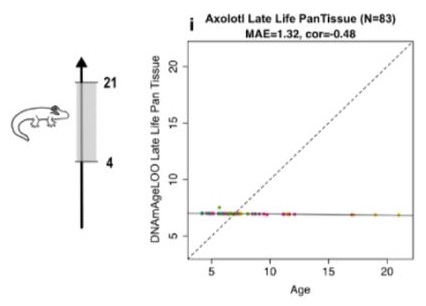
The researchers found 5,386 epigenetic CpG sites that axolotls, clawed frogs, and mammals have in common. They then attempted to use an algorithm to create a clock with these sites that works over the axolotl’s lifespan. This effort failed completely: there appeared to be no significant correlation between epigenetic age and chronological age, whether they attempted to build a single-tissue or pan-tissue clock. This was in spite of having more than a sufficient number of high-quality samples to use, and an even closer examination failed to reveal any significant differences between the methylation of a 3.55-year-old axolotl and a 9.83-year-old axolotl.

Axolotl clock

However, the axolotls did appear to be aging earlier in life, so the researchers developed a clock that was only trained on animals up to 4 years of age. This clock was able to predict ages of these salamanders within a few months. The researchers, therefore, concluded that axolotl epigenetic aging is “biphasic”: they age up to a certain point, and then they simply stop epigenetically aging to any measurable degree.

An axolotl early-life clock was also demonstrated to be compatible with epigenetic clocks for clawed frogs and people. According to this dual-species clock, very young humans had similar methylation as very young axolotls, but as the humans aged, the axolotls did not age with them.

A closer examination revealed the similarities and differences. HOX genes, which are associated with organismal development, all change methylation in the early lives of people, frogs, and axolotls, demonstrating growth. However, CpGs that were associated with an increase in mortality risk, such as cancer, simply did not exist in the axolotl clock.

Even limb regeneration did not appear to age these animals. Cutting off an axolotl’s tail six times in a row did not have any significant effects on that area’s epigenetic age, although there was a trend towards being marked as epigenetically older. On the other hand, amputating one of its limbs three times made the epigenetics of that repeatedly regrown limb younger. The researchers found that this correlated with the expression of factors that are known to affect cells at various stages of differentation, and they posit that this “dynamic regulation may be central to the epigenetic rejuvenation that takes place upon limb regeneration.”

Medical professionals, and people who have suffered severe injuries, have desired to harness the salamander’s regeneration for a long time. Now, it appears that this regeneration might also come along with significant anti-aging effects. Applying these effects to mammals, however, will require significant amounts of time and experimentation.

We would like to ask you a small favor. We are a non-profit foundation, and unlike some other organizations, we have no shareholders and no products to sell you. All our news and educational content is free for everyone to read, but it does mean that we rely on the help of people like you. Every contribution, no matter if it’s big or small, supports independent journalism and sustains our future.

Literature

[1] Brockes, J. P., & Kumar, A. (2008). Comparative aspects of animal regeneration. Annual review of cell and developmental biology, 24(1), 525-549.

[2] Yun, M. H. (2021). Salamander insights into ageing and rejuvenation. Frontiers in cell and developmental biology, 9, 689062.

[3] Ingram, A. J. (1971). The reactions to carcinogens in the axolotl (Ambystoma mexicanum) in relation to the ‘regeneration field control’hypothesis. Development, 26(3), 425-441.

[4] Murawala, P., Oliveira, C. R., Okulski, H., Yun, M. H., & Tanaka, E. M. (2022). Baculovirus Production and Infection in Axolotls. In Salamanders: Methods and Protocols (pp. 369-387). New York, NY: Springer US.

[5] Lu, A. T., Fei, Z., Haghani, A., Robeck, T. R., Zoller, J. A., Li, C. Z., … & Singh, K. (2023). Universal DNA methylation age across mammalian tissues. Nature aging, 3(9), 1144-1166.

[6] Zoller, J. A., Parasyraki, E., Lu, A. T., Haghani, A., Niehrs, C., & Horvath, S. (2024). DNA methylation clocks for clawed frogs reveal evolutionary conservation of epigenetic aging. GeroScience, 46(1), 945-960.

BOAC logo

Biomarkers of Aging Consortium Announces Second Conference

The Biomarkers of Aging Consortium is proud to announce its second annual Biomarkers of Aging Conference, scheduled for November 1-2, 2024, at the Joseph Martin Conference Center at Harvard Medical School. This event stands as the premier conference dedicated to all aspects of biomarkers of aging, bringing together the brightest minds in the field.

Building on the success of its inaugural event, the 2024 conference has been expanded in both length and scope to accommodate the rapidly evolving landscape of aging research. The two-day format will offer attendees a comprehensive exploration of the latest developments in the field:

  • Day 1: Cutting-Edge Research – Focused on the latest breakthroughs and emerging technologies in biomarkers of aging.
  • Day 2: Clinical Translation – Dedicated to bridging the gap between laboratory findings and practical applications in healthcare.

The conference boasts a stellar lineup of speakers, featuring renowned experts from across the globe. Attendees can expect engaging presentations, panel discussions, and networking opportunities with the foremost authorities in aging research.

  • Key highlights of the conference include:
  • Talks from pioneering researchers in the field
  • Panel discussions on the future of aging biomarkers in medicine
  • Poster sessions showcasing emerging research from early-career scientists
  • Networking opportunities to foster collaboration and partnership opportunities

Registration for the 2024 Biomarkers of Aging Conference is now open. For more information on the conference program, registration details, and sponsorship opportunities, please visit https://www.agingconsortium.org/conference-2024.

About the Biomarkers of Aging Consortium: We are a consortium of scholars and practitioners developing, validating, and implementing biomarkers of aging and longevity. Our academic members are affiliated with the leading research institutes and groups in the field of aging. Our practitioners are at the forefront of research and development in the longevity industry.

Contact: Nicholas Fiorenza nicholas.fiorenza@mfoundation.org

We would like to ask you a small favor. We are a non-profit foundation, and unlike some other organizations, we have no shareholders and no products to sell you. All our news and educational content is free for everyone to read, but it does mean that we rely on the help of people like you. Every contribution, no matter if it’s big or small, supports independent journalism and sustains our future.

ARDD Conference

For the 11th Year in Copenhagen: Highlights from ARDD 2024

The Copenhagen-based Aging Research and Drug Discovery Meeting (ARDD) was already enormous. Last year, there were well over a thousand physical participants, and many more online, attending five days of wall-to-wall talks: more than a hundred in total. We called it “the mother of all longevity conferences.” At the dawn of its second decade, ARDD’s attendance of researchers, entrepreneurs, and enthusiasts grew even bigger and was sold out even sooner, solidifying its iconic status in the field.

While the venue and the duration remained the same, not that there’s anything wrong with the beautifully decorated and centrally located Copenhagen University’s Museumhuset, the expansion was achieved by adding tracks: Longevity Medicine Track & XPRIZE Healthspan Team Summit, Emerging Tech Workshop, and Physics in Aging Biology. As a result, the overall number of talks shot up to about 160.

A few times, this made me desperately want to have that clock that allowed Hermione to attend multiple Hogwarts classes simultaneously. Unfortunately, we can’t turn the clock back literally, but we hope to eventually be able to do this figuratively, by reversing aging, which is, of course, what the conference was about.

As usual, we are only able to bring you a fraction of the talks (in ARDD’s case, a particularly small fraction). We apologize to all the amazing speakers who didn’t make the cut.

The case for bioidentical hormones

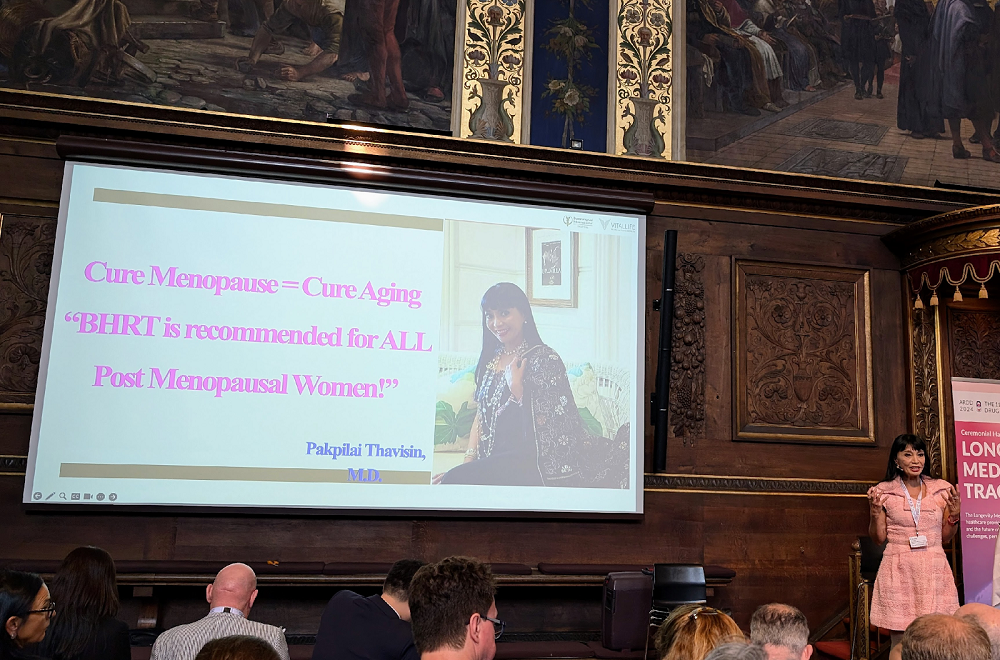
Longevity medicine, traditionally well-represented at ARDD, took an even more prominent place this time. The first day of the conference saw a number of appearances, including by the first lady of Thailand, Pakpilai Thavisin.

Pakpilai, a medical doctor, talked about the numerous health problems associated with menopause, such as mood and sleep disorders. However, there is evidence that harm from menopause goes far beyond that. For instance, premenopausal women have lower incidences of hypertension and other cardiovascular events than men, but those differences diminish after menopause, hinting at a potentially protective role of estrogen. “If we want to cure aging,” Pakpilai asked, “why not cure menopause?”

It’s not just about dwindling estrogen levels. According to Pakpilai, all hormones decline with age. “Our biological clock tells us ‘to shrink and die’ as we age,” she explained.

However, hormone replacement therapy (HRT) got a bad rap due to associations with cancer. Estrogen alone, Pakpilai said, indeed increases the risk of endometrial cancer. This is mitigated by adding progesterone, but this combo has been linked to an increased risk of breast cancer.

Pakpilai argued that the problem was non-bioidentical hormones – synthetic molecules that are similar but not identical to human hormones. Those molecules are produced by pharma companies because they can be patented, unlike bioidentical ones. The latter can be derived from various natural sources and are associated with fewer side effects and health risks.

Pakpilai stressed the need to find a business model for producing bioidentical hormones for HRT and called for a wider acceptance of HRT based on those hormones for postmenopausal women.
ARDD Conference 1

More longevity medicine

Other speakers highlighted the successes and challenges of today’s longevity medicine. Most of those challenges have remained the same since last year and include a lack of proven anti-aging therapies. Nevertheless, longevity clinics are relevant due to their proactive/preventative approach not seen in traditional medicine, extensive testing, and creative mixing of therapies that have been documented to be geroprotective, such as diet, exercise, repurposed drugs, and various supplements.

Evelyne Bischof, a pioneer of longevity medicine, reminded the audience that back in 2019, she, Alex Zhavoronkov of InSilico, and several others found the Longevity Education Hub. The hub features a basic longevity medicine course, an advanced one, and a third course on investing in longevity biotech, all of which are free to take. The medicine courses were translated into several languages by volunteers. Today, the enrollment stands at about 7,000.

However, the big news was that for the first time, the curriculum has been implemented in an academic institution. In one of Indonesia’s universities, it became an obligatory course for medical doctors, and several other countries are currently on the way to adopting it, according to Evelyne.

Alex Zhavoronkov, ARDD co-founder, also stressed the importance of longevity medicine, saying that this industry “cannot move faster than physicians.”

Aging and salmon suicide

Michael Ringel of Boston Consulting Group gave a deep and fascinating talk on the evolutionary origins of aging. Geroscientists are mostly focused on how aging happens, but why it happens is also important.

Several theories have been proposed. According to Ringel, those explanations can be divided into three broad categories: Mechanistic, Weakening Selection, and Optimization. The first one posits that aging happens due to the inability of evolution to eliminate physical constraints such as the damage that arises from normal biological processes. Basically, miracles don’t happen.

The second one means that, as organisms age and survival declines, there is less evolutionary pressure to maintain the traits that would keep them healthy later in life. Selection becomes so weak that random mutations, including those that accelerate aging or cause diseases, are no longer removed effectively from the gene pool. This allows aging and late-life deterioration to persist in the population.

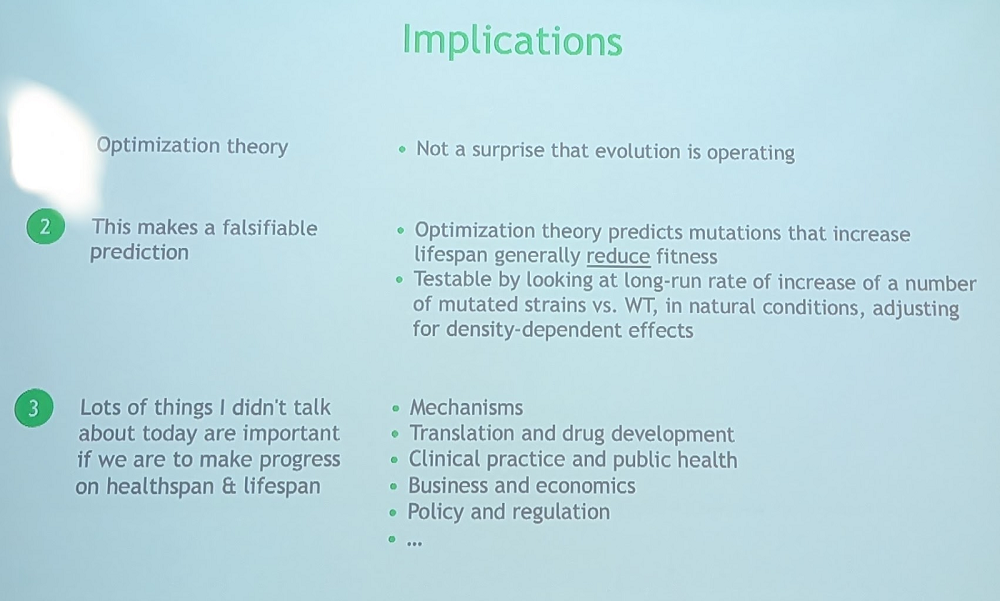
Finally, the optimization paradigm says, in the words of one paper, that “nature strikes a balance in allocating resources to growth vs. maintenance vs. reproduction.” What is optimized is reproduction fitness: the “long-run rate of increase of a line of descent”, which includes survival, fecundity (the number of offspring), generation time, and quality of those offspring. That’s all evolution is concerned with rather than the survival of one organism.

Michael argued that current empirical evidence is best explained by the optimization paradigm. This has an important implication: a vast majority of pro-longevity mutations, just like other mutations, are a step away from that carefully optimized state. While evidence exists that “you can get longevity without fecundity trade-off,” Michael claims that if you look at a broader context of reproductive fitness, which stretches beyond fecundity, you will probably find how it is hurt by the mutation.

For instance, salmon’s seemingly aimless self-destructive behavior makes sense when you look at offspring fitness: adult salmon’s carcasses are food, essential for offspring survival in nutrient-poor streams. However, in a nutrient-rich environment, salmon can quickly develop the ability to spawn.

Optimization theory makes a testable prediction that lifespan-increasing mutations generally reduce fitness. This can be important for numerous aspects of geroscience, such as translation and drug development.
ARDD Conference 2

A peptide that could

Some longevity biotechs don’t shy from making big claims, and Maxwell Biosciences is one of them. Its goal is to create “a synthetic immune system” that would give us wide protection against microbial pathogens.

Maxwell’s founder and CEO, J. “Scotch” McClure, stressed the importance of the microbiome for most, if not all, hallmarks of aging. For instance, dysbiosis affects mitochondrial health, which is evident in chronic kidney diseases and in HIV. Bacterial and viral factors have also been implicated in genomic instability, dysregulated nutrient sensing, telomere attrition, and other problems.

Those microbial pathogens present unique challenges. Bacteria and viruses evolve quickly, developing drug resistance. Fungi can wreak a lot of havoc and are understudied. The body has defense mechanisms, but they dwindle and get overwhelmed as we age.

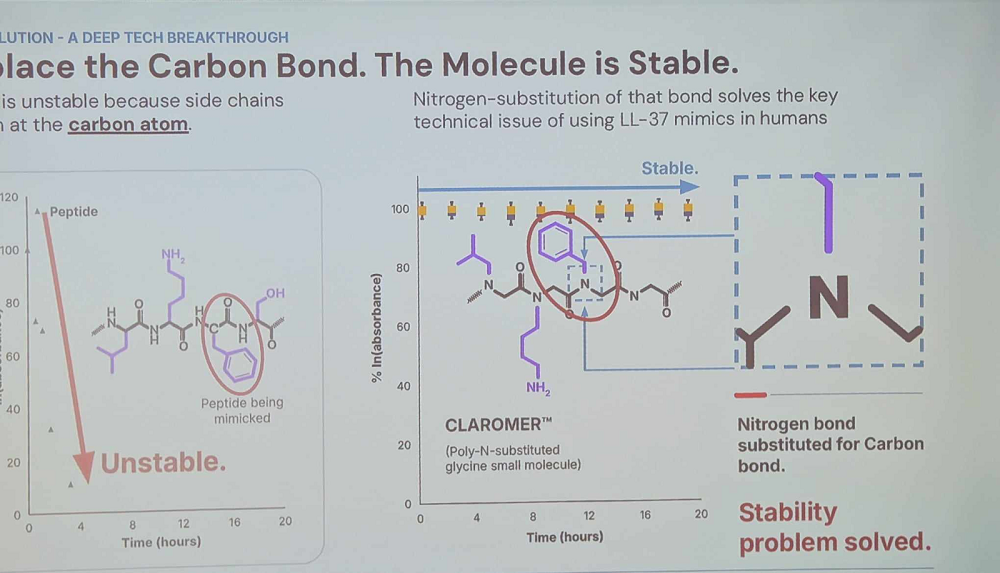
One such mechanism is the antimicrobial peptide LL-37. According to McClure, it’s potent against virtually all types of microbial pathogens but is rapidly degraded by proteasomes that target the carbon bond. Maxwell’s answer is to replace that carbon bond with a more stable nitrogen bond. The resulting product “captures all the innate virucidal, bactericidal, fungicidal, and anti-aging benefits of natural LL-37 in a stable form optimized for humans.”

Maxwell’s LL-37-mimicking candidate kills viruses and bacteria by permeating their membranes and is effective even against highly resistant bacterial strains because its “membrane-targeting mechanism of action cannot be circumvented by current or feasible bacterial resistance mechanisms.” It’s also effective against fungi.

Maxwell runs several high-profile collaborations and is wrapping up a study in rhesus macaques with results expected later this month. Human clinical trials will begin next year. If all this sounds too good to be true, there is a caveat: a study linked LL-37 to Alzheimer’s disease progression.
ARDD Conference 3

The long-overdue Alzheimer’s breakthrough?

This ARDD saw increased attention from locals, including opening speeches by Henrik Wegener, Rector of the University of Copenhagen, and Mette Kierkgaard, Danish Minister for Senior Citizens. Some Danish companies were also represented, such as the international pharma company H. Lundbeck A/S (commonly known simply as Lundbeck). Johan Luthman, head of R&D, gave a talk centered on brain aging, one of Lundbeck’s key areas of interest.

The symptoms of brain aging include decreased cerebral blood flow, brain volume shrinkage, and brain lesions, such as hyperintensities and microbleeds. While in most brains, it only results in slowly deteriorating function (although some functions actually get enhanced), in some, brain aging can speed up and progress towards brain frailty and sickness.

While many neurodegenerative diseases have strong ties to family history, aging is still the greatest risk factor. Bad sleep quality also correlates substantially with brain health. Johan’s point was that neurodegeneration can be reversed, putting the brain back on track for “healthy” brain aging.

One of the main functions that are disrupted in brain aging, leading to neurodegeneration, is what Johan called “brain washing” – the action of the glymphatic system. This is a network of channels in the brain that allows cerebrospinal fluid (CSF) to flush out waste, including proteins like beta-amyloid and tau, which are associated with neurodegenerative diseases. The glymphatic system is most active during deep sleep.

Johan then gave a review of new anti-Alzheimer’s drugs. After two decades of failures, he claimed, there’s finally a breakthrough in the field, with Leqembi being the first ever drug to receive full US approval as a disease-modifying treatment in AD. Leqembi works by stimulating the glymphatic system, just like another novel drug, Kisunla (Leqembi was approved in 2023, and Kisunla in 2024).

The third drug, Rexulti, is the first ever US-approved treatment for behavioral and psychological symptoms of dementia (BPSD). The new drug treats Alzheimer’s-related agitation. Often overlooked, this symptom is “what drives people into nursing homes,” Johan said.

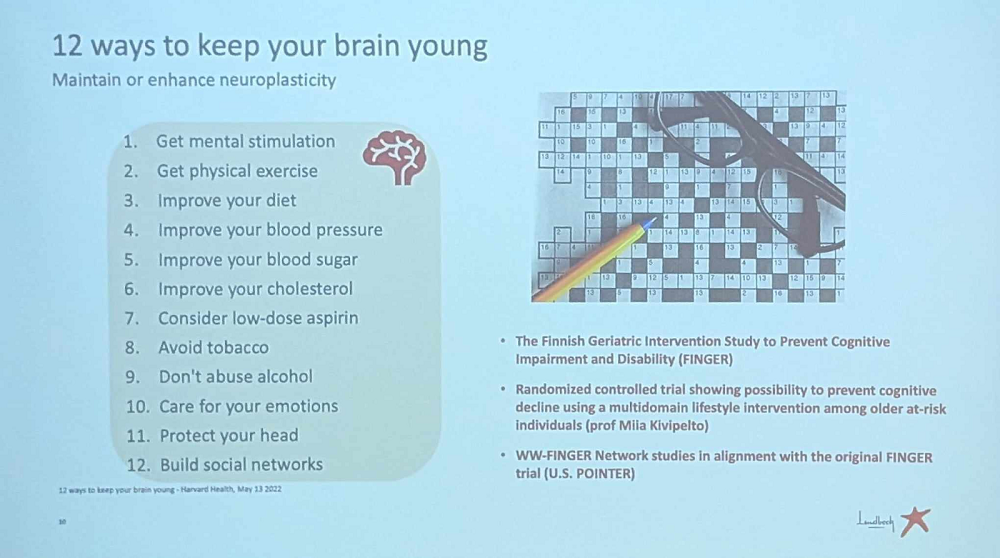
Johan is optimistic about the future of anti-dementia therapies. He pointed at the recent changes in regulation that favor their approval, including acceptance of new biomarkers such as PET imaging as a marker of amyloid pathology, and neurofilament light chain (NfL) as a fluid biomarker of neurodegeneration. Meanwhile, people can keep their brains healthier using these tips from Johan:
ARDD Conference 4

In sickness and in health

InSilico, the company co-founded by Alex Zhavoronkov, was widely represented at the conference. Alex himself gave a talk describing the progress the company has made over the past year.

Interestingly, he did not start with aging biology. Instead, he touted InSilico’s and ARDD’s focus on sustainability. This year, the conference organizers decided to use some of the proceedings to plant 10,000 trees. Alex also said that the technology for small molecule discovery his company is developing can be used for carbon capture, and InSilico is already profiting from selling their software to the companies in the field. You can sign ARDD’s Copenhagen Longevity and Sustainability Declaration here.

InSilico, an AI-centered company that created a software suit for drug discovery automation, prides itself on discovering targets and drug candidates and moving them through the pipeline at lightning speeds. The average time of developing a preclinical candidate (PCC) is 13 months, and the company currently has 18 PCCs nominated. Nine of them are in human clinical trials, including two in Phase 2.

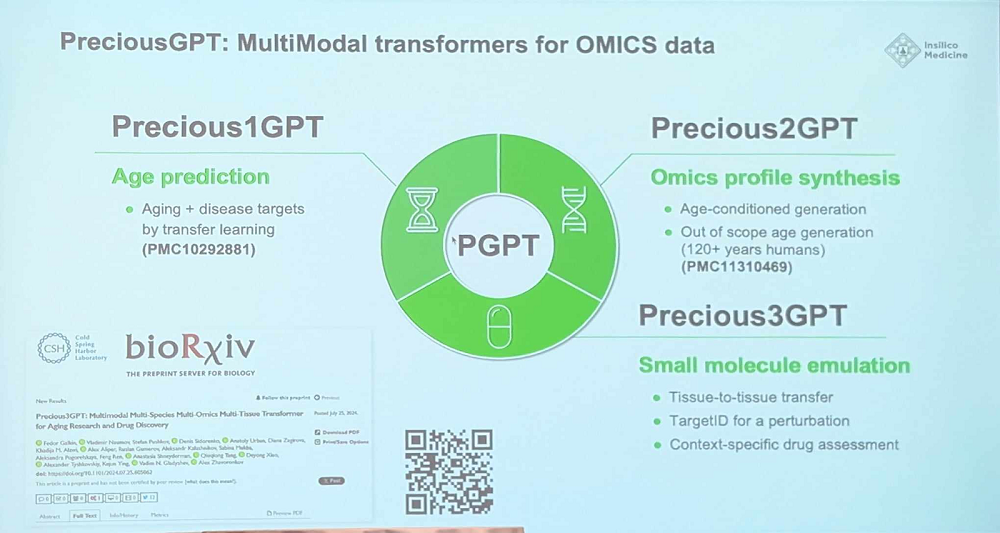
Another big project is creating a multimodal transformer AI model for aging. This idea was first voiced by Alex two years ago, and now the model lineup includes Precious1GPT (“a transformer-based model with aging clock functionality for aging-related pathology research”), Precious2GPT (“a compound model combining a transformer and a diffusion architectures with omic data generation capabilities”), and Precious3GPT (“a genuinely multimodal transformer-based model trained to emulate the workflow of case-control studies, with an emphasis on chemical perturbations.”) This versatile model can feed on multiple data types and perform multiple tasks such as small molecule emulation. The name was chosen to reflect the versatility and the ambition (“One model to rule them all”, Alex said).

In probably the most interesting part of the talk, Alex told the audience how he was amazed to find that between the genes linked to aging by multi-species, multi-tissue mammalian epigenetic clocks were several of the targets their model had proposed, including TNIK, in which Alex places a lot of hopes.

According to Alex, analyzing CpG cites and linking them to targetable genes is a promising novel discovery route, and it shows that “you can derive useful therapeutic targets from aging research, which is the entire point of this conference.” Pharma is opening up to aging research, Alex said, and this kind of studies gives them more evidence.
ARDD Conference 5

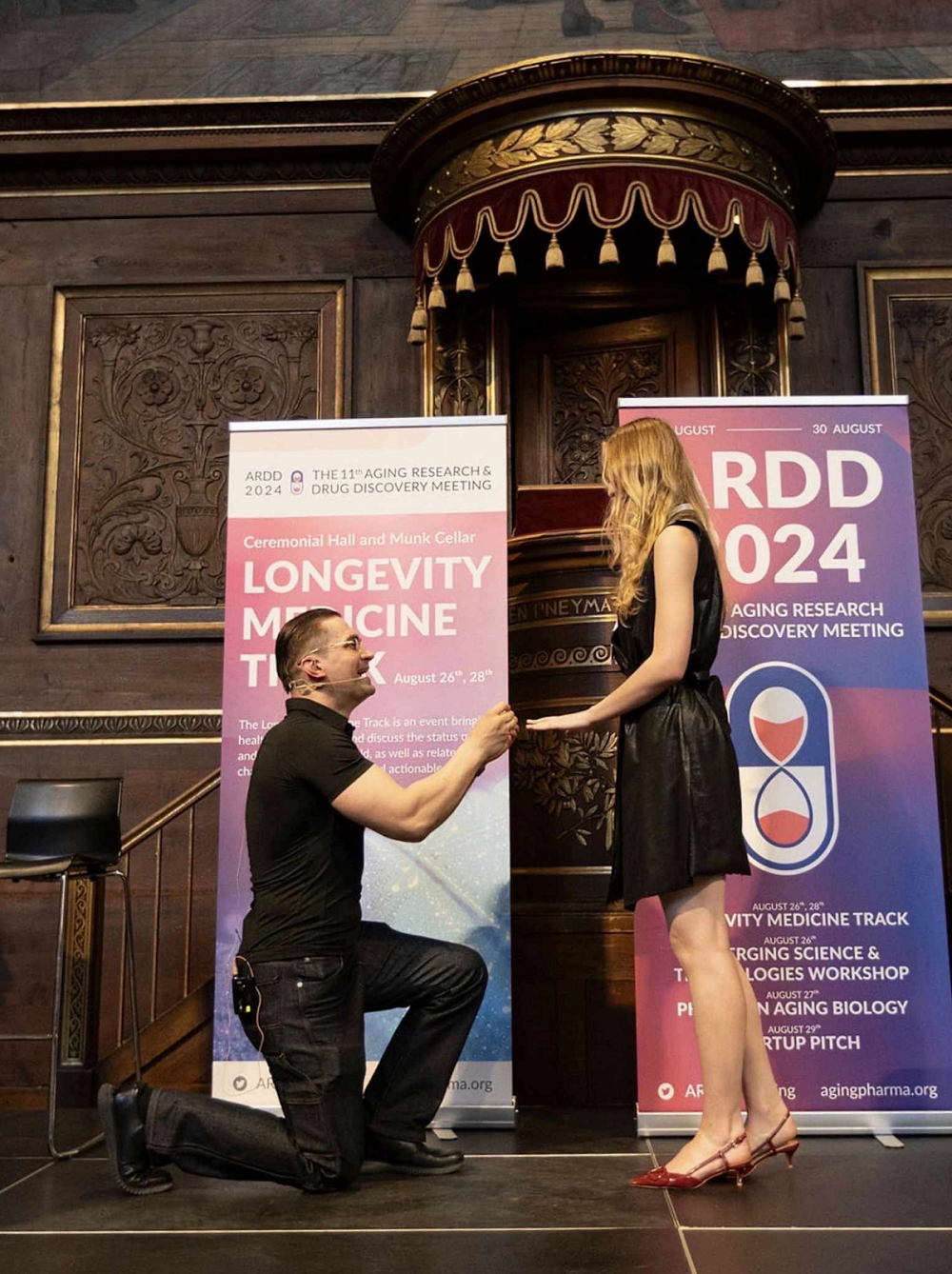
Very rarely do longevity conferences provide decent gossip fodder, but this ARDD was an enormous exception. In an unexpected grand finale to his talk, Alex proposed on stage to Dominika Wilczok, a longevity activist and researcher. lifespan.io congratulates the couple and wishes them an infinite lifetime of love, happiness, curiosity, and discovery.
ARDD Conference 6

TNIK, TNIK everywhere

Another local, Lykke Sylow of the University of Copenhagen, talked about her research that probably made Alex even happier. Lykke’s team is looking for targets that can be used to alleviate muscle aging and atrophy.

According to Lykke, the obesity epidemic should be called “the sarcopenic obesity epidemic,” because obesity is often accompanied by skeletal muscle loss. While people can lose weight, including with the latest and greatest weight loss drugs such as GLP-1 receptor agonists, they are also poised to lose a lot of muscle mass in the process: about 40% on average of the total weight loss.

This muscle mass loss, as well as the rebound in body weight after intervention cessation, can be partially mitigated by exercise. However, exercise has low levels of adherence and might not be available to everyone. Lykke called exercise “an old trick” and said they were looking for new ones: interventions that would mimic the effects of exercise.

Several companies in the field are already working on this, including BioAge. Lykke also mentioned Eli Lilly’s acquisition of Versanis, manufacturer of bimagrumab, in order to combine this drug with the weight loss drug tirzepatide.

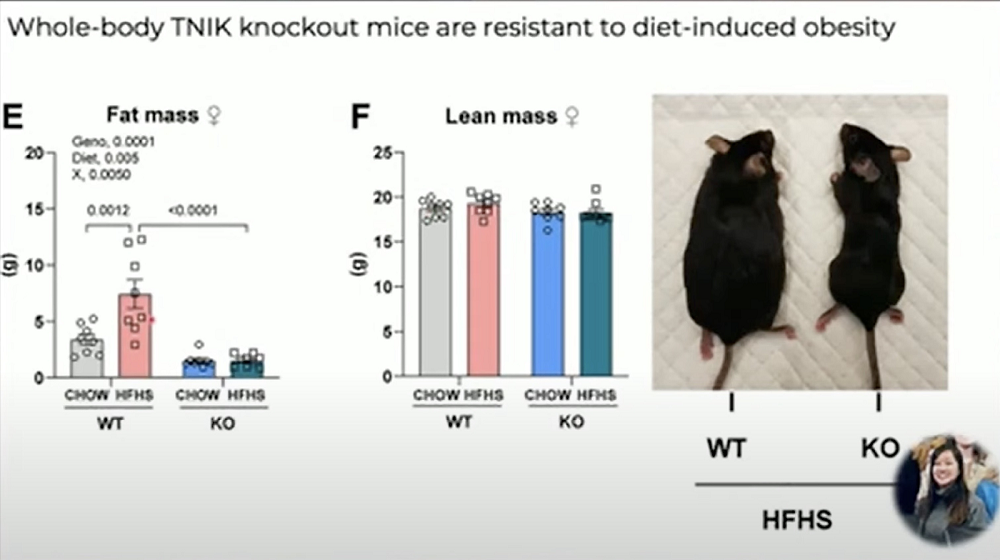
One of the targets that Lykke’s team identified is the crucial molecule TNIK. Knocking out msn, the TNIK ortholog in flies, made them metabolically inflexible: unable to switch energy sources between fat, glucose, and protein. Metabolic flexibility is also impaired in aging.

The group then created TNIK-knockout mice and placed them either on a regular or on high fat / high sucrose diet, which mimics a standard “Western” diet. The knokout mice were resistant to diet-induced obesity, despite consuming the same or greater number of calories. Yet, they retained their lean mass and showed increased energy expenditure and activity.

TNIK deficiency also rescued glucose tolerance and insulin sensitivity in mice on a high-fat/high-fructose diet by improving insulin-stimulated glucose uptake and prevented hepatic steatosis. Finally, the group found that TNIK variants in humans correlate with obesity and diabetes-related traits.
ARDD Conference 7

Reining transposons in

John Sedivy of Brown University reminded the audience that about half of our genome consists of repeated sequences, mostly transposons associated with viruses. While some transposons are benign “viral fossils” that lost their ability to replicate, a majority can still do it if the patches of the chromatin where they are located are derepressed.

Transposon reactivation increases with age and has been linked to multiple age-related conditions. This can happen in a positive feedback loop: cellular senescence leads to chromatin opening, LINE-1 (the most ubiquitous retrotransposon) derepression, antiviral response, and then to chronic inflammation.

How do retrotransposons procreate? When their DNA is derepressed and transcribed into RNA, the enzyme reverse transcriptase transcribes this RNA back into DNA, which is called complementary DNA (cDNA). These cDNA strands can then insert themselves into other parts of the genome (that’s how humans and many other species ended up with huge chunks of their DNA consisting of nothing but retrotransposons). However, cDNA is recognized by the CGAS/STING pathway, which triggers an inflammatory response.

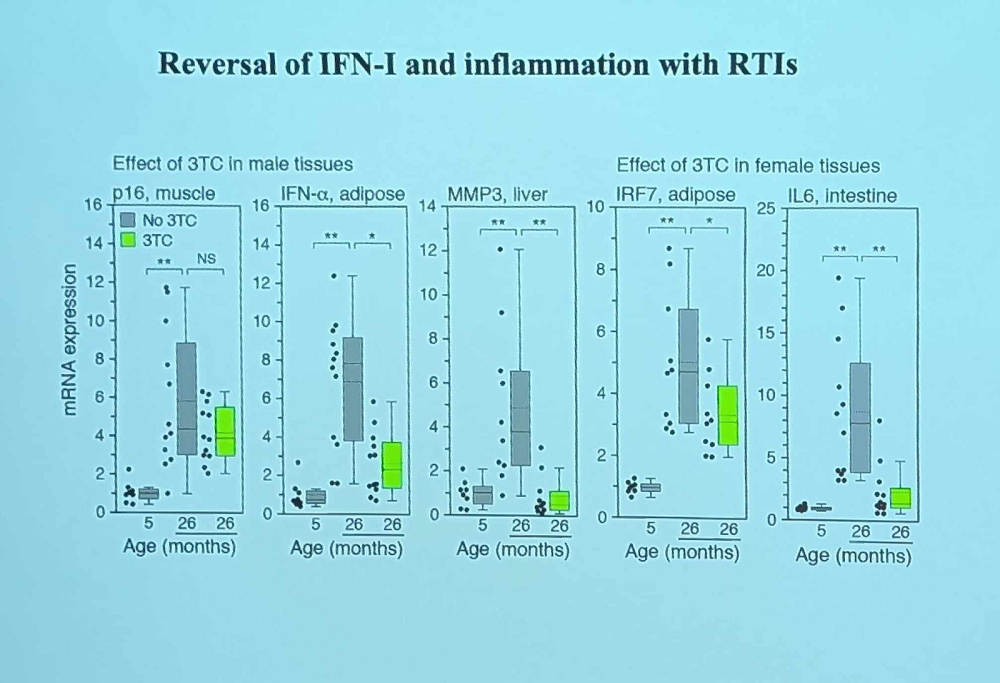
Transposon Therapeutics, the company that John advises, is built on the idea that we can use existing reverse transcriptase inhibitors (such as anti-HIV drugs) against age-related retrotransposon activation. Studies in animal models show that these drugs can have a massive effect on inflammation, cellular senescence, and age-related cognitive decline.

The company is already deep in clinical trials with censavudine. This reverse transcriptase inhibitor was discovered at Yale, licensed to GSK to market as an HIV drug, and then licensed by Transposon, which also acquired all the NID-enabling data.

According to Jogn, censavudine proved to be highly potent and bioavailable, demonstrating low off-target binding and good brain penetration. The company’s main indication is progressive supranuclear palsy (PSP), although it also eyes amyotrophic lateral sclerosis (ALS). The candidate drug TPN-101 produced large reductions in neurofilament light chain and the pro-inflammatory cytokine IL-6.
ARDD Conference 8

New is the well-forgotten old

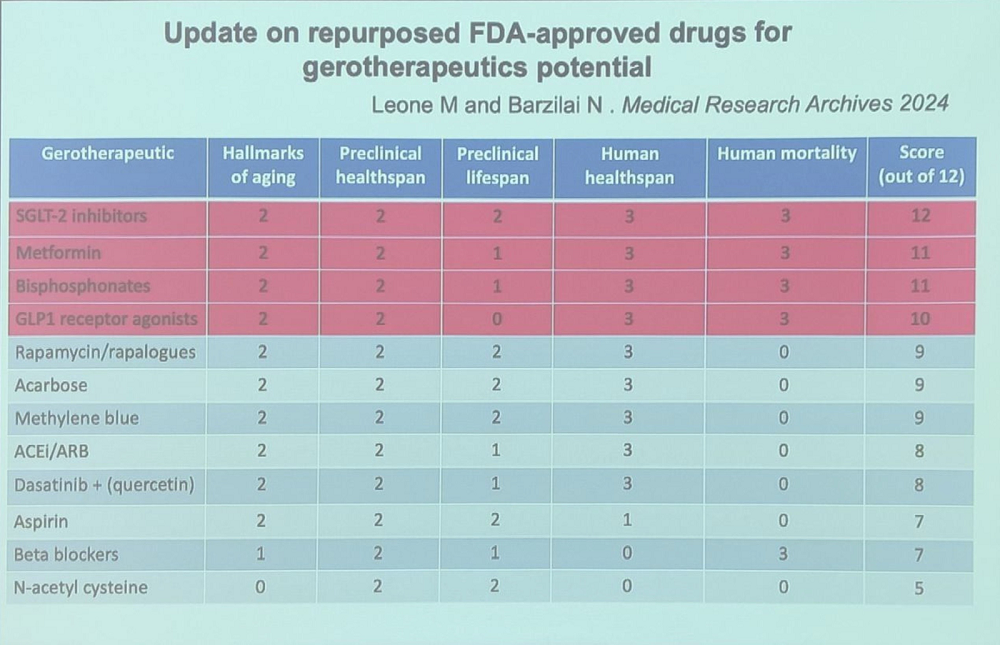
The renowned geroscientist Nir Barzilai of Albert Einstein College of Medicine presented a new paper he co-authored with Michael Leone, which is an update of an earlier study on the same topic. The paper compiles data on possible anti-aging effects of FDA-approved drugs.

Nir has argued for years for using existing drugs as possible geroprotectors and is known as a big proponent of metformin. Nir conceived the widely anticipated Targeting Aging with Metformin (TAME) trial, which has yet to take off the ground.

In the new paper, 12 drugs or drug classes were ranked by several criteria: the number of hallmarks of aging they are currently known to hit, as well as their effects on healthspan and lifespan in preclinical models, human healthspan, and human mortality.

Anti-diabetes medications – SGLT2 inhibitors and metformin – took the crown. The former include drugs such as canagliflozin, which have been recently shown to extend lifespan in animal models. However, these two types of drugs lead mostly because of human data, which is to be expected: both have been prescribed to chronically ill patients for many years and hence are well-studied in the context of human mortality.

Bisphosphonates are a class of drugs used to treat osteoporosis and other bone conditions. According to Nir, they significantly lower ICU mortality. The fourth place is taken by GLP1 receptor agonists which include popular novel weight loss drugs such as semaglutide. Recent data suggests that in addition to reversing obesity, those drugs might exert geroprotective effects in other ways.

Rapamycin and acarbose only took the 5th and 6th places, despite producing better results in mouse studies. Rapamycin is one of the most potent lifespan-extending drugs in animal models, and combining it with acarbose produces a synergistic effect. However, human mortality data is scarce.
ARDD Conference 9

The Longevity Shark Tank

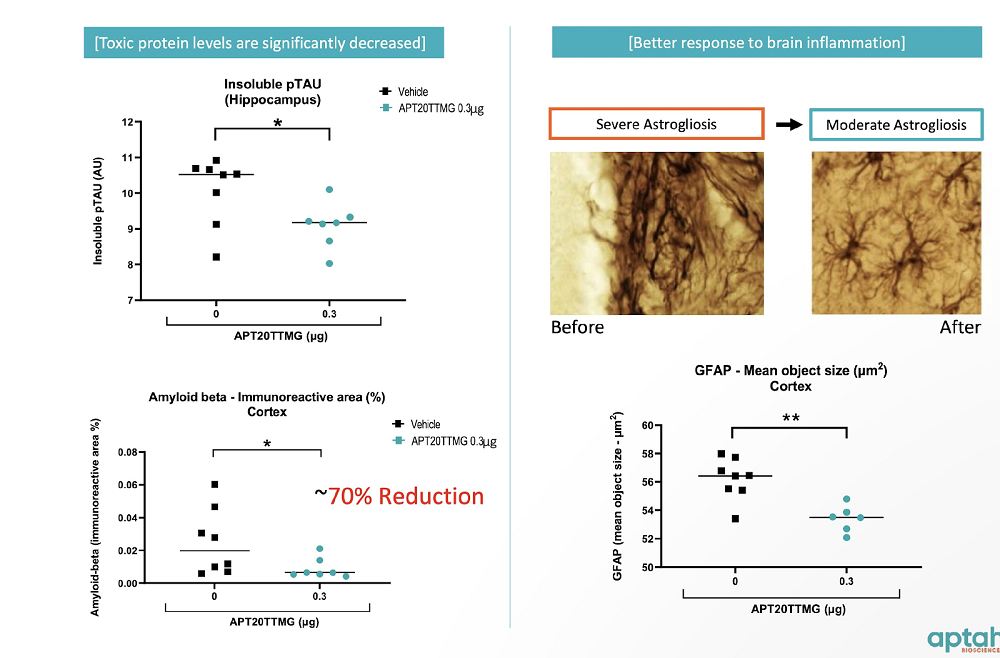
Another unusual format test-driven at ARDD was the startup pitch. A string of startup founders came up before a panel of three actual investors to tell them about their ideas. We don’t know if the investors were convinced to actually invest, but a winner was proclaimed, and it was Aptah Bio, founded by Rafael M. Bottos around a big idea: solving the problem of RNA integrity.

Transcription from DNA to RNA is regulated by intricate and delicate machinery, which, unsurprisingly, gets dysregulated with age. Faulty transcripts produce faulty proteins – or none at all. Loss of RNA integrity over time has been linked to numerous pathologies and hallmarks of aging.

The longer the gene, the likelier its transcript is to suffer premature cleavage and splicing errors. According to Bottos, about 60% of human tissues demonstrate gene-length-dependent transcriptional decline, with the strongest effects in neural tissue.

Aptah’s candidate drug targets the protein complex U1-snRNP, “the RNA guardian” that ensures transcription quality. Abnormalities in U1 cause pathological RNA processing.

Aptah has conducted several in vitro and in vivo studies in which their candidate simultaneously reduced the expression of multiple toxic proteins, such as insoluble phosphorylated tau and amyloid beta, two well-known hallmarks of Alzheimer’s disease. The drug also showed promising results in a glioblastoma model.

Aptah has engaged in high-profile collaborations with UC San Diego and NASA. Brain organoids treated with Aptah’s compound will be launched into space later this year to study the possibility of rescuing accelerated brain aging in astronauts.
ARDD Conference 10

Eyes on the XPRIZE!

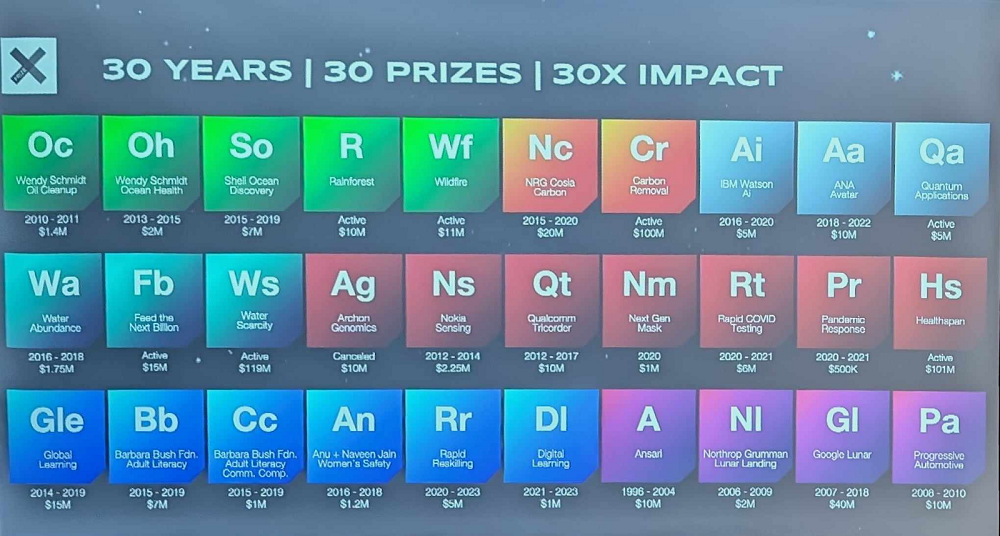
XPRIZE Healthspan, the biggest XPRIZE in history (101 million dollars) sent a whole team to ARDD. In a series of talks, its representatives explained the intricacies of the humongous prize and gave tips on how to apply. Jamie Justice, XPRIZE Healthspan executive director, introduced the endeavor, starting with the famed three-decades-long history of the XPRIZE.

The prize was years in the making, in part, due to the difficulty of defining endpoints. Since humans are so long-lived, demonstrating life extension by a novel therapy using mortality is problematic. After consulting world-renowned experts such as David Sinclair and George Church, the team settled on a different criterion: reversal of loss of function. If your therapy can demonstrate true reversal of age-related loss of function, such as muscle or brain function, you have a chance to win.

XPRIZE Healthspan was made possible by the relentless work and generosity of several people, starting with Peter Diamandis, XPRIZE founder. Read our recent interview with him for more details. Big contributions were made by Chip Wilson, founder of the fashion brand Lululemon, entrepreneurs Christian Angermayer and Sergey Young, Hevolution Foundation, and others.
ARDD Conference 11

Restoring epigenetic information

Harvard professor David Sinclair is probably the most recognizable face in the longevity field. As usual, the celebrity geroscientist and the best-selling author of Lifespan: Why We Age and Why We Don’t Have To gave a fast-paced talk and was ushered away immediately after.

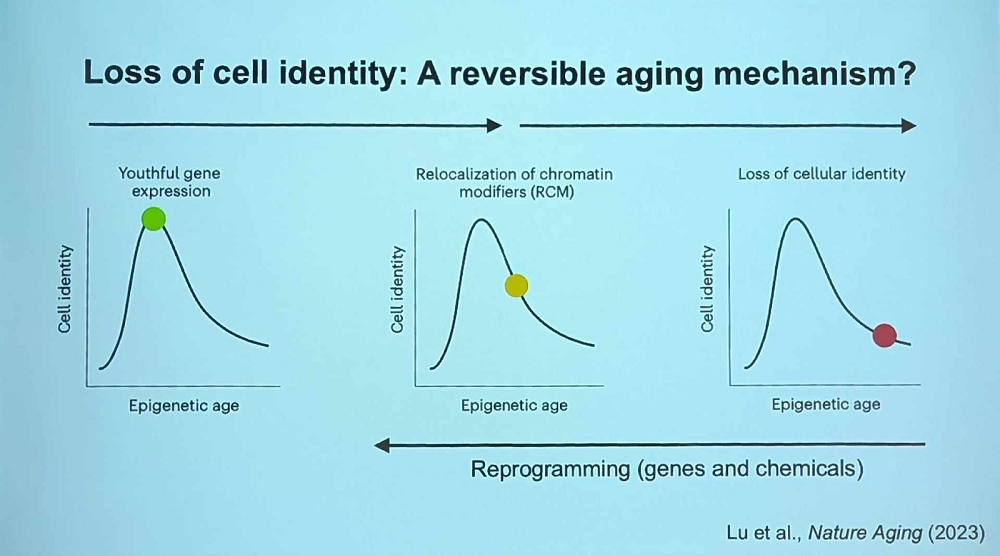
During the minutes he spent on stage, Sinclair gave an update on his information theory of aging. This theory centralizes epigenetic changes, which are caused by the imperfect character of the DNA double-strand break response. This response is facilitated by the proteins SIRT1 and SIRT6, which also have the responsibility of keeping chromatin from unwinding, thus preventing unwanted gene expression. Basically, those proteins were given two jobs by evolution, and neither is being done flawlessly, which probably sounds familiar.

This arrangement gives us several decades of life, which means it’s good enough from the evolutionary standpoint. However, it causes the accumulation of epigenetic mutations (i.e., loss of epigenetic information, hence the theory’s name) and various age-related pathologies. According to Sinclair, cellular reprogramming suggests the existence of a backup copy of this information inside each cell, and his team is looking for this mechanism.

While we don’t know how it works yet, we can already apply it towards curing age-related diseases. Sinclair’s group has done groundbreaking research, restoring vision in animal models, including non-human primates, by reprogramming retinal ganglion cells (RGCs) in vivo.

The team uses three reprogramming factors out of the original Yamanaka’s OSKM cocktail, delivered using adenovirus-associated viral vectors (AAV2-OSK) in an inducible expression system for reliable and safe partial reprogramming. Sinclair’s company Life Biosciences, which also presented at the conference, is gearing up for human trials of this technology and might well become the first company to bring cellular reprogramming to clinic.

Sinclair talked about other possible use cases his group has been studying. Apparently, OSK treatment partially restores senescent cells’ transcriptome, suggesting it can work as a senomorphic. Peculiarly, cancerous cells treated with OSK change their morphology towards their original cell type and become much less active. “When cancer cells wake up to their identity, they freak out and kill themselves,” Sinclair said.

Sinclair’s group has also been successfully experimenting with in vitro reprogramming using small molecules. This treatment leads to “an almost complete restoration of nuclear integrity, even better than gene therapy,” he said, and can restore identity in cells that lost it many years ago.
ARDD Conference 12

Organ-specific aging

Another Harvard professor, Vadim Gladyshev, is fascinated with what aging is and how to measure it. Aging, he said in his talk, can be quantified on many levels – damage, functional decline, disease, mortality, and so on. Many epigenetic clocks are trained to predict mortality, and an important advantage of such clocks, according to Vadim, is that they can also predict the effects of interventions.

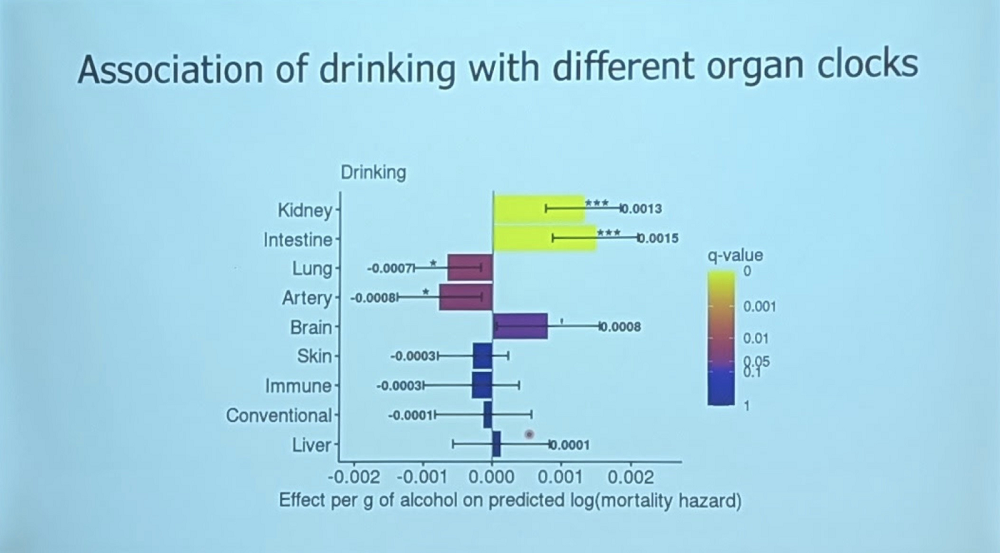
It is also important to distinguish between organismal and organ-specific aging. In different people, different organs age at different rates. Your heart can be younger than your liver and vice versa. Transcriptomic clocks are well-suited to capture organ-specific aging, since transcriptome can be decomposed into modules, and clocks can be developed from those modules (for example, a clock for the extracellular matrix).

Even organ-specific clocks can be trained on mortality data, which allows you to predict mortality of the organism from the age of an organ. Organ-specific plasma protein models can track organ-specific diseases, Vadim said. For instance, lung-specific models can predict chronic obstructive pulmonary disease (COPD), while liver-specific models can predict liver damage.

This approach yields many interesting insights. Associations of various factors with organ-specific aging can be measured. Smoking, unsurprisingly, is associated with increased aging in all organs. Alcohol consumption, on the other hand, produced mixed results: while it’s obviously bad for kidneys and the intestine, it’s good for the lungs and arteries. “If your arteries age fast, go to Bar 7,” Vadim joked, referring to the nearby establishment where the attendees enjoyed free booze every evening of the conference.

Jokes aside, it’s a serious matter. Vadim hopes that measuring organ-specific age will give us better diagnostics and more personalized interventions.
ARDD Conference 13

Bonus – part of the bespoke cocktail menu from Bar 7:
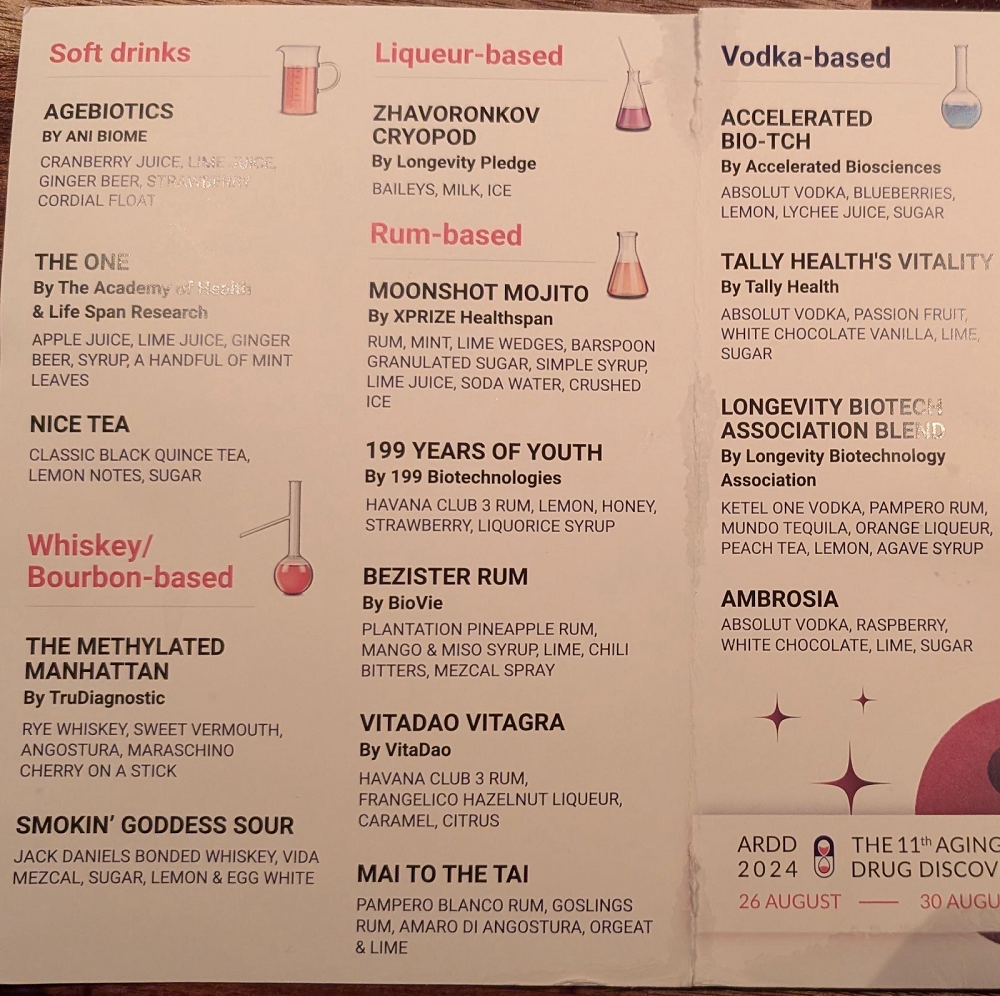
ARDD Conference 14

Maximum lifespan vs chronological age

In the last talk of the conference, another star geroscientist, Steve Horvath, currently with Altos Labs, continued with the theme.

While methylation clocks have been at the center of Steve’s scientific career, he also recognizes their limitations, such as a lack of biological interpretability: we don’t really know what mechanisms move the needle. Why is methylation such a strong predictor of morbidity?

Still, methylation clocks have a lot of appeal. Steve talked about “intuitive appeal” (if the molecule that carries the genetic information also encodes time, it suggests a profound relationship with aging), and “technical appeal” (methylation clocks are ready for human clinical trials, can be used in vitro, and can be multi-species).

Creating multi-species clocks has fascinated Steve for several years now. Pan-mammalian clocks are important for developing interventions, he said, because “whatever moves them, probably will work in humans.” Speaking further about interventions, Steve referenced Alex Zhavoronkov’s talk about deducing therapeutic targets from methylation data, calling it “the best talk in the longevity field ever.”

One interesting direction is clocks that predict the maximum lifespan of a species. It’s not as easy as it seems, as “biological processes that relate to time-to-death (of an individual) often differ from those that relate to maximum lifespan of the species,” Steve said.

As evidence to that, methylation sites used in epigenetic clocks (CpG sites) associated with maximum lifespan “show minimal overlap with those linked to chronological age”, and predicted maximum lifespan does not relate to human mortality risk in epidemiological cohorts.

Methylation signatures of long-lived species differ from those of short-lived species, and the rate of change of methylation seems to be a good predictor of maximum lifespan, but only in certain DNA regions (e.g., bivalent promoter regions). By definition, Steve said, for any biomarker that increases with age, its rate of change will be inversely correlated with the species’ maximal lifespan.
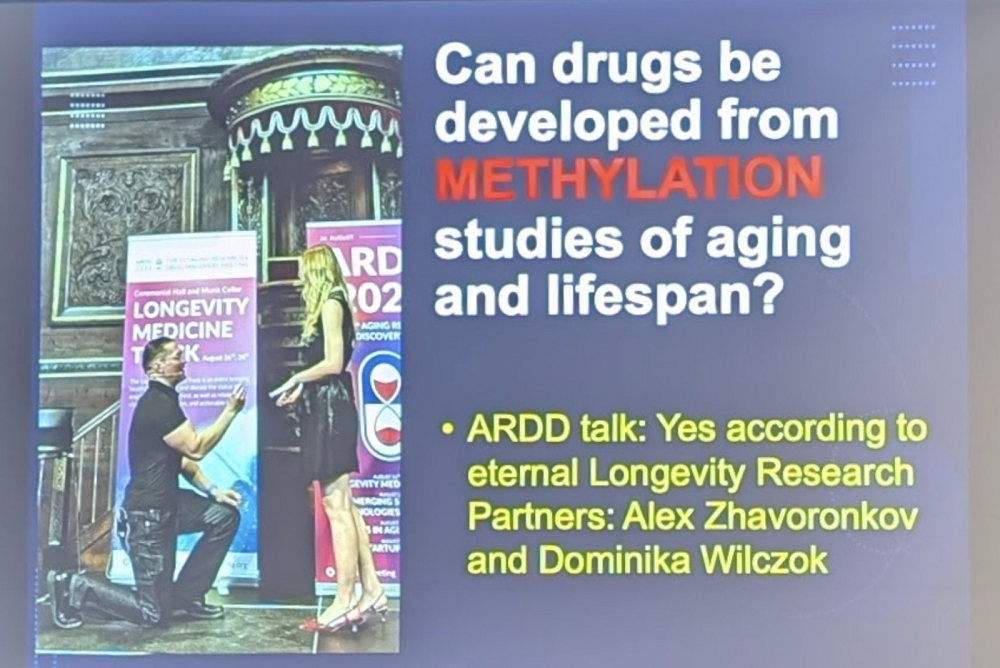
ARDD Conference 15
We would like to ask you a small favor. We are a non-profit foundation, and unlike some other organizations, we have no shareholders and no products to sell you. All our news and educational content is free for everyone to read, but it does mean that we rely on the help of people like you. Every contribution, no matter if it’s big or small, supports independent journalism and sustains our future.

Heart ventricles

The Ventricles of the Heart Age Differently

In Aging Cell, researchers have published their findings on how the right ventricle of the heart ages differently from the left one.

Not just organs, but parts of organs

Research on aging has agreed that organs age differently: that the arteries, brain tissue, muscles, and skin, along with all of the various digestive and maintenance organs, all have their own unique issues and challenges related to aging.

It appears that this heterogeny even applies to specific parts of organs as well. Previous research has found that the right ventricle (RV), which drives deoxygenated, venous blood into the lungs, is critical in the prognosis of age-related heart diseases [1]. However, many drugs that work against failures of the left ventricle (LV), which drives oxygenated blood through the body, are ineffective against RV failure [2] and may even make the problem worse [3]. Such facts have led researchers at the National Heart, Lung, and Blood Institute to state that, despite these both being ventricles of the heart, they must be handled as different entities [4].

Part of the problem is that aging of the LV is well-documented as being characterized by hypertrophy [5], while studies on RV aging are murky and occasionally contradictory. Therefore, these researchers sought to identify the differences between LV and RV aging on both the physical and molecular levels.

Gene expression was different between sexes and ventricles

In these experiments, young mice were between 2 and 4 months old, while aged mice were between 18 and 20 months old. While the volumes of both ventricles increased with aging, older animals had thicker walls of the LV while the walls of the RV were thinner, and this was found to be true for both males and females. This finding was accompanied with detailed information on various physical measurements of the heart.

One core finding was that the RV experienced systolic dysfunction: an inability to sufficiently contract and pump blood. Various metrics used to quantify ejection fraction confirmed this: with aging, more blood remained in the RV after each pump. The RVs of female mice remained consistent throughout life, but males’ became more elastic.

A gene expression analysis found that female mice had far more genes that changed with aging in both ventricles than male mice did, partcularly in the LV, which had thousands of these differentially expressed genes, compared to under two hundred in the RV and only a few dozen for males in both ventricles. The researchers suspected that this was related to estrogen; estrogen receptor expression was reduced in the LV of female mice with age, but not the RV. This resulted in female mice having only 2% of age-related expression changes coinciding between the ventricles, while 11% (only six genes) coinciding between the ventricles in males.

Many of these genes were different for both males and females; in some cases, they were even opposed, with genes that were upregulated in males being downregulated in females. However, both sexes had inflammatory genes that were upregulated in both ventricles, highlighting inflammation as a key potential target for future interventions.

While this study provided valuable information, the researchers were unable to prove a chain of causality; they were not able to link individual genes to specific effects in either males or females. Further work will need to be done to determine what, if any, of these changes to metabolism translate into targets that are amenable to interventions and whether or not these mouse findings apply to human beings. However, it is clear from this and previous work that the right ventricle indeed needs to be targeted as its own aging organ.

We would like to ask you a small favor. We are a non-profit foundation, and unlike some other organizations, we have no shareholders and no products to sell you. All our news and educational content is free for everyone to read, but it does mean that we rely on the help of people like you. Every contribution, no matter if it’s big or small, supports independent journalism and sustains our future.


Literature

[1] Goliasch, G., Zotter-Tufaro, C., Aschauer, S., Duca, F., Koell, B., Kammerlander, A. A., … & Bonderman, D. (2015). Outcome in heart failure with preserved ejection fraction: the role of myocardial structure and right ventricular performance. PloS one, 10(7), e0134479.

[2] Borgdorff, M. A., Bartelds, B., Dickinson, M. G., Steendijk, P., & Berger, R. M. (2013). A cornerstone of heart failure treatment is not effective in experimental right ventricular failure. International journal of cardiology, 169(3), 183-189.

[3] Prisco, S. Z., Thenappan, T., & Prins, K. W. (2020). Treatment targets for right ventricular dysfunction in pulmonary arterial hypertension. Basic to Translational Science, 5(12), 1244-1260.

[4] Borgdorff, M. A., Dickinson, M. G., Berger, R. M., & Bartelds, B. (2015). Right ventricular failure due to chronic pressure load: What have we learned in animal models since the NIH working group statement?. Heart failure reviews, 20, 475-491.

[5] Lakatta, E. G., & Levy, D. (2003). Arterial and cardiac aging: major shareholders in cardiovascular disease enterprises: Part II: the aging heart in health: links to heart disease. Circulation, 107(2), 346-354.

Insilico Medicine

Insilico Medicine Reports Positive Phase IIa Results for IPF

Insilico Medicine, a clinical-stage generative AI-driven drug discovery company, announced positive preliminary results from its Phase IIa clinical trial evaluating ISM001-055. ISM001-055 is a first-in-class small molecule targeting TNIK (Traf2- and Nck-interacting kinase) and was designed utilizing generative AI to treat idiopathic pulmonary fibrosis (IPF). The study met both its primary endpoint of safety and its secondary efficacy endpoints, demonstrating dose-dependent response in forced vital capacity (FVC), a critical measure of lung function in IPF patients.

Insilico’s proprietary AI platform facilitated ISM001-055’s target identification and molecular design. Its development was recently described in a March 2024 Nature Biotechnology paper, which detailed TNIK’s identification as a novel therapeutic target in IPF and ISM001-055 subsequent design. This comprehensive paper showcased ISM001-055’s preclinical evaluation and positive Phase 0 & Phase I clinical studies justifying this intervention’s potential as a disease-modifying agent for IPF.

ISM001-055’s Phase IIa study (NCT05938920) was a randomized, double-blind, placebo-controlled trial that enrolled 71 patients with IPF across 21 sites in China. Patients were randomized to receive either placebo, 30mg once daily (QD), 30mg twice daily (BID), or 60mg QD for 12 weeks. Patient enrollment was initiated in April 2023, and the last subject’s follow-up visit was completed in August 2024. A parallel Phase IIa (NCT05975983) clinical trial in the U.S. is ongoing and actively enrolling patients.

In this 12-week Phase IIa study, ISM001-055 met its primary endpoint of safety and tolerability across all dose levels. Positive results were also reported for the secondary efficacy endpoint, wherein a dose-dependent FVC improvement was observed. Patients receiving 60mg QD of ISM001-055 demonstrated the largest improvement in FVC.

Complete topline data will be released at the upcoming medical conference and clinical trial results will be submitted for publication in a peer-reviewed journal.

“These results are very encouraging, particularly the dose-dependent response in FVC. IPF is a devastating disease, and seeing improvements in lung function over just 12 weeks of treatment is a promising indication that ISM001-055 may provide a new therapeutic option for patients. Our Phase IIa in the U.S. is actively recruiting patients,” said Toby M. Maher, MD, PhD, a leading expert in interstitial lung disease and an investigator in the trial.

“Last year, I presented a lecture on how generative AI can help with end-to-end drug discovery from disease modeling and target identification to generation of novel drugs with the desired properties and purposing it to a specific disease. I used Insilico’s TRAF2 and NCK-interacting kinase (TNIK) inhibitor as a case study going from 0 to Phase I. The fact that this same drug demonstrated efficacy in addition to safety in a Phase IIa study is extraordinary and represents a true first in this new era of AI-powered drug discovery,” said Michael Levitt, PhD, 2013 Nobel Laureate in Chemistry.

“With all the hype that surrounds the potential of generative AI in drug discovery and many other potential applications, it is thrilling see to the dose dependence of ISM001-055 in Insilico Medicine’s phase IIa IPF clinical trial. This is strong evidence that the drug is truly effective and that favorable results will continue to be seen in future trials,” said Charles Cantor, PhD, a renowned geneticist and advisor to the company since 2014.

“This is great news for the field of AI for drug discovery. The fact that this molecule is safe and has a dose-dependent response means that there is a green light for further studies. I am hopeful it continues its path to making a difference,” said Alan Aspuru-Guzik, PhD, Professor of Chemistry and Computer Science at the University of Toronto and CIFAR AI Chair at the Vector Institute.

“This study result represents a critical milestone in AI-powered drug discovery and in my life to date,” said Alex Zhavoronkov, PhD, co-CEO of Insilico Medicine. “While we expected the drug to be safe, we did not expect to see such a clear dose-dependent efficacy signal after such a short dosing period. IPF is a very diverse disease and it is very rare to see improvement in FVC. With our novel TNIK inhibitor, we attempted to go after what we think is a common mechanism in fibrotic diseases and in aging to maximize indication expansion potential.”

“I am excited to see that ISM001-055 demonstrated obvious clinical efficacy in IPF patients in only 3-months treatment. While preliminary, this clinical data is certainly encouraging, and provides the clinical validation of AI-powered drug R&D for both novel target and novel molecule,” said Feng Ren, PhD, co-CEO and CSO of Insilico Medicine. “ This is a significant milestone for Insilico Medicine and the AI driven drug discovery Industry. The milestone is achieved due to the contribution of both the capabilities of our proprietary generative AI platform and the efforts of our multidisciplinary R&D team. We will continue to fully commit to provide breakthrough solutions for the benefit of the patients globally.”

Following the positive results from this Phase IIa trial, Insilico Medicine will engage regulatory authorities to discuss the design of a Phase IIb study. The company aims to explore extended treatment durations and larger patient cohorts to further investigate ISM001-055’s therapeutic potential in IPF.

About ISM001-055 and TNIK

ISM001-055 is a potentially first-in-class small molecule targeting TNIK utilizing generative AI. In IPF, the activation of TNIK drives pathological fibrosis in the lungs, contributing to the progressive decline in lung function. By inhibiting TNIK, ISM001-055 aims to halt or reverse fibrotic processes, offering a disease-modifying treatment for patients with IPF. In February 2023, ISM001-055 received Orphan Drug Designation from the FDA for treating Idiopathic Pulmonary Fibrosis.

About the Phase IIa Study

The double-blind, placebo-controlled Phase IIa clinical trial (NCT05938920) evaluated the safety, tolerability, pharmacokinetics, and preliminary efficacy of 12-week oral ISM001-055 dosage in 71 subjects with IPF. Patients from 21 sites were randomized into four parallel cohorts: 30mg QD, 30mg BID, 60mg QD, and placebo. Preliminary results from the study show ISM001-055 demonstrated a good safety profile and dose-response trend in lung function in IPF patients.

About Idiopathic Pulmonary Fibrosis (IPF)

Idiopathic Pulmonary Fibrosis (IPF) is a chronic, scarring lung disease characterized by a progressive and irreversible decline in lung function. Affecting approximately 5 million people worldwide, IPF carries a poor prognosis, with a median survival of 3 to 4 years. Current treatments, including antifibrotic drugs, can slow disease progression but do not stop or reverse it, leaving a significant unmet need for more effective, disease-modifying therapies. IPF is an age-related disease, with the average age of onset typically between 60 and 70 years, and it is most commonly diagnosed in older adults. The disease is rare in individuals under the age of 50.

About Insilico Medicine

Insilico Medicine, a global clinical-stage biotechnology company powered by generative AI, connects biology, chemistry, and clinical trial analysis using next-generation AI systems. The company has developed AI platforms that utilize deep generative models, reinforcement learning, transformers, and other modern machine learning techniques to assist novel target discovery and the generation of novel molecular structures. Insilico Medicine is developing breakthrough solutions to discover and develop innovative drugs for cancer, fibrosis, immunity, central nervous system diseases, infectious diseases, autoimmune diseases, and aging-related diseases. www.insilico.com

We would like to ask you a small favor. We are a non-profit foundation, and unlike some other organizations, we have no shareholders and no products to sell you. All our news and educational content is free for everyone to read, but it does mean that we rely on the help of people like you. Every contribution, no matter if it’s big or small, supports independent journalism and sustains our future.

Multiple pills

Combining Treatments Against Multiple Hallmarks of Aging

Researchers have published a review of the current state of combination therapies that address multiple Hallmarks of Aging [1]. Some of these combined therapies were found to induce greater lifespan extension than single treatments.

A complex phenomenon calls for complex treatments

The complexity of aging cannot be underestimated. It is unlike individual diseases, which primarily affect single organs. Aging affects the entire body and does so by affecting countless molecular processes. Therefore, to slow down or reverse it, it must be attacked from multiple directions, such as by using a combination of therapies.

While there is broad research in model organisms on genetic and pharmaceutical approaches that target aging, most of the approaches result in modest lifespan increases in mammals.

The authors of the review state that “this outcome is to be expected if we consider that even if one aging process is successfully treated, other aging pathways may remain intact” and limit the organism’s lifespan. Therefore, multiple aspects of aging must be addressed at once.

More therapies are better than one

The researchers reviewed the literature to gather data on existing combination therapies targeting pathological processes in aging. They used the Hallmarks of Aging as a reference point and focused on mouse studies, since mice are the most commonly studied mammalian model organism.

The combined therapies that showed improvements compared to single treatment in rodents included rapamycin and metformin; rapamycin and acarbose (an anti-diabetic drug); simvastatin and ramipril (cardiovascular disease drugs); glycine plus N-acetylcysteine (both ameliorate age-associated glutathione deficiency and reduce oxidative stress); elevated expression of the oncosuppressors p53 and Arf, with telomerase reverse transcriptase improving them even further; PROP1 gene deficiency and caloric restriction; suppression of growth hormone and caloric restriction, and the overexpression of the antioxidant enzymes catalase and superoxide dismutase.

Some of those combinations were effective not only in lifespan extension but also in improving some age-related phenotypes, such as cognitive impairment. However, some of them had sex-specific effects.

Being strategic

The authors of this review believe that a good way to approach the design of combination therapies is by using several therapies that attack different Hallmarks of Aging.

In their paper, they mention that “the current availability and diversity of lifespan-promoting therapies allows the possibility to design studies in mice targeting at least thirteen hallmarks of aging simultaneously” and nine of them don’t require genetic manipulations of embryos.

Combination therapies are also investigated by the LEV Foundation, which is testing a combination of rapamycin, a senolytic navitoclax, hematopoietic stem cell transplantation (HSCT), and telomerase expression [2]. This strategy targets six Hallmarks of Aging.

Combination therapies

Since there are many possible combinations, but resources and time are limited, the authors elaborate on guidelines on which combination therapies to prioritize in testing, such as cost, effectiveness, feasibility, ability to be sustained for longer periods (caloric restriction is not easily sustained), and effectiveness when applied to already-aged organisms.

The authors suggest a few strategies that can be utilized in designing combination therapies. They wish to focus on therapies that have shown the best lifespan extension individually and combine them, attempting to target a maximum of hallmarks with few treatments and then bolstering that combination with underused lifespan-extending treatments that target further hallmarks. They wish to screen combination pairs that target different Hallmarks of Aging, with a focus on widely-used therapies with proven safety in humans.

Limitations

The researchers note that one of this review’s limitations is that most of the research is done on mice. The results of those experiments often depend on the animals’ living conditions, genetic backgrounds, etc. While animal research is essential, not all of it might translate to humans.

Additionally, using the Hallmarks of Aging framework is limiting; for example, this framework doesn’t differentiate between primary and secondary causes of aging. If a better framework is created, it can aid in the improved selection of therapies for combinatorial treatments.

While combination therapies are promising anti-aging approaches, the authors also point out possible drawbacks, one of the most important being possible adverse effects, especially for healthy people for whom the risks might outweigh the benefits. They also admit that many of these therapies have not been carefully evaluated for side effects, and combining therapies adds complexity and could offset or combine side effects.

We would like to ask you a small favor. We are a non-profit foundation, and unlike some other organizations, we have no shareholders and no products to sell you. All our news and educational content is free for everyone to read, but it does mean that we rely on the help of people like you. Every contribution, no matter if it’s big or small, supports independent journalism and sustains our future.
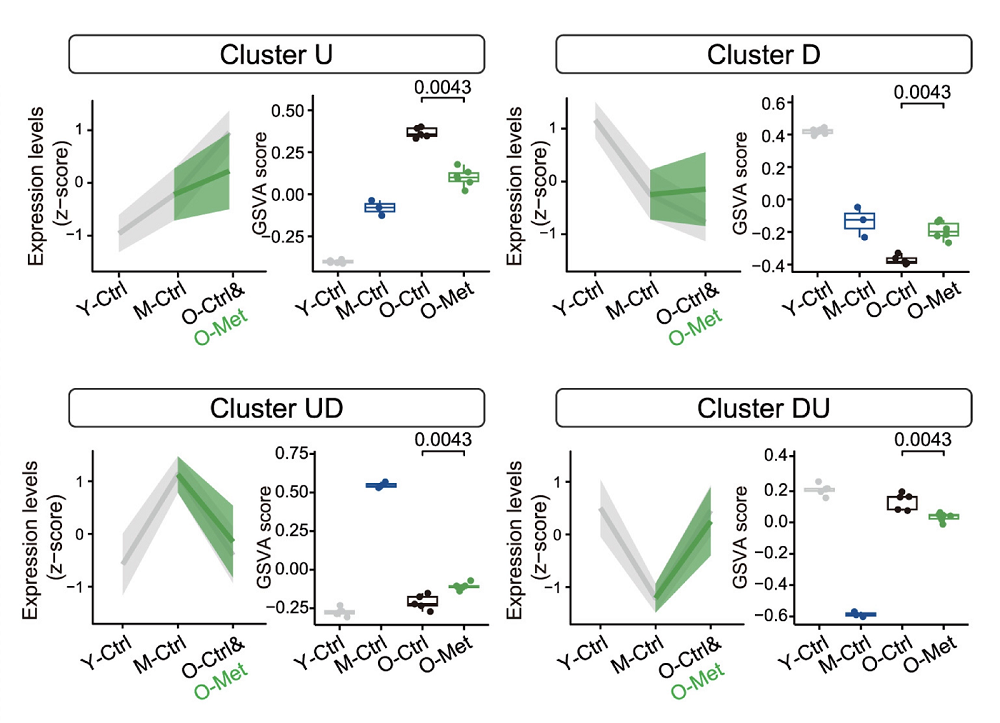
Literature

[1] Panchin, A. Y., Ogmen, A., Blagodatski, A. S., Egorova, A., Batin, M., & Glinin, T. (2024). Targeting multiple hallmarks of mammalian aging with combinations of interventions. Aging, 16(16), 12073–12100.

[2] Lewis, C. J., & De Grey, A. D. (2024). Combining rejuvenation interventions in rodents: a milestone in biomedical gerontology whose time has come. Expert Opinion on Therapeutic Targets.

Light pollution

Light Pollution Linked to Alzheimer’s Disease Prevalence

Scientists have found a correlation between the intensity of nighttime outdoor lighting, which can disrupt sleep, and Alzheimer’s disease [1].

Light pollution – heavy consequences

Outdoor lights help us with a lot of things, such as illuminating our streets and highways, discouraging crime, and so on. City nightlines and views of Earth at night from the orbit are among the most iconic images of our civilization. However, bright lights during nighttime are also quite unnatural for our biology, which is built around circadian rhythms.

Excessive levels of artificial outdoor light are called “light pollution” and have been linked to sleep disruption, obesity, depression, anxiety, memory dysfunction, atherosclerosis, and cancer [2]. Indoor light was found to be a problem as well [3]. Laws exist in certain states and countries that limit light pollution levels.

Some of those conditions, especially sleep disruption and depression, are known comorbidities for Alzheimer’s disease. In a new study, researchers from Rush University Medical Center in Chicago set out to investigate a direct link between light pollution and Alzheimer’s.

One of the strongest factors

The scientists assigned a light pollution score to each US state and retrieved data on Alzheimer’s prevalence in those states, controlling for several known factors that contribute to Alzheimer’s: alcohol abuse, atrial fibrillation, chronic kidney disease, depression, diabetes, heart failure, hyperlipidemia, hypertension, obesity, and stroke.

In their analysis, average nighttime light intensity was significantly associated with Alzheimer’s prevalence. This correlation remained strong in both people under and over 65, males and females, and across all races except Asian Pacific islanders.

Average nighttime light intensity was associated with Alzheimer’s prevalence even when accounting for alcohol abuse, chronic kidney disease, depression, heart failure, and obesity. According to the researchers, this suggests that nighttime light intensity has a stronger influence on Alzheimer’s than any of these conditions.

However, other covariates had a stronger association with Alzheimer’s than light intensity. Those included atrial fibrillation, diabetes, hyperlipidemia, hypertension, and stroke, “indicating that nighttime light exposure had a more subtle effect than these disease covariates.” Interestingly, for people under the age of 65, average light intensity was associated with Alzheimer’s even when accounting for all the covariates.

There is, of course, a lot of heterogeneity inside states. Some areas are more populated and some less, which results in corresponding differences in light pollution. For a more fine-grained outlook, the researchers picked 45 counties from across the country and threw in the District of Columbia. Nighttime light intensity was determined for the counties that contain the largest city in each state, and this data was compared to Medicare Chronic Conditions’ county-level data on Alzheimer’s.

The correlation held strong on a county level, too. In fact, it was even stronger than on a state level:

Alzheimer's Light Pollution 1

Interestingly, a county’s population size did not seem to define its levels of light pollution:

Alzheimer's Light Pollution 2

Possible lifestyle changes

“We show that in the US there is a positive association between AD prevalence and exposure to light at night, particularly in those under the age of 65,” said the first author of the study, Dr. Robin Voigt-Zuwala, an associate professor at Rush University Medical Center. “Nightly light pollution, a modifiable environmental factor, may be an important risk factor for AD.”

Discussing the seemingly stronger correlation between light pollution and Alzheimer’s in the younger population, Voigt-Zuwala suggested that “younger people are more likely to live in urban areas and have lifestyles that may increase exposure to light at night.”

How can this risk factor be mitigated? “Awareness of the association should empower people, particularly those with risk factors for AD, to make easy lifestyle changes,” said Voigt-Zuwala. “Easy to implement changes include using blackout curtains or sleeping with eye masks. This is useful especially for those living in areas with high light pollution.”

Like any populational study, this one does not prove a causal relationship but only shows correlation. It also had several limitations; for instance, it didn’t account for people migrating during their lives. Still, the study highlights the importance of light pollution as part of the exposome, the set of environmental conditions that affect human health.

The analyses reveal that greater average nighttime light intensity (i.e., light pollution) was associated with higher AD prevalence. This was true for 2012–2018 average and each year examined individually, and in those over and under the age of 65 (i.e., 65+, <65), in both sexes, and in each race (except Asian Pacific Island which may be related to power). This finding was observed when examining data on the state level as well as on the county level.
We would like to ask you a small favor. We are a non-profit foundation, and unlike some other organizations, we have no shareholders and no products to sell you. All our news and educational content is free for everyone to read, but it does mean that we rely on the help of people like you. Every contribution, no matter if it’s big or small, supports independent journalism and sustains our future.

Literature

[1] Voigt, R. M., Ouyang, B., & Keshavarzian, A. (2024). Outdoor nighttime light exposure (light pollution) is associated with Alzheimer’s disease. Frontiers in Neuroscience, 18, 1378498.

[2] Bożejko, M., Tarski, I., & Małodobra-Mazur, M. (2023). Outdoor artificial light at night and human health: a review of epidemiological studies. Environmental Research, 218, 115049.

[3] Sweeney, M. R., Nichols, H. B., Jones, R. R., Olshan, A. F., Keil, A. P., Engel, L. S., … & Jackson, C. L. (2024). Exposure to indoor light at night in relation to multiple dimensions of sleep health: findings from the Sister Study. Sleep, 47(2), zsad100.

Extracellular Vesicles

Extracellular Vesicles to Fight Liver Fibrosis

Researchers have filled extracellular vesicles (EVs) with micro-RNA that is effective against liver fibrosis in mice and published their breakthrough in Aging Cell.

The cellular postal service

EVs, which cells use to send chemical messages and packages to one another, are significantly affected by aging to the point that they have been used as biomarkers [1] and even considered as a hallmark of aging themselves. Directly affecting these vesicles and using them as a therapeutic vector isn’t new to the research world; previous work has focused on using them to transmit NAMPT, which is part of the NAD+ synthesis process [2], and there is evidence that some stem cell therapies work predominantly through EVs, which have been well-documented as containing microRNAs (miRNAs) [3].

These researchers have previously documented potential benefits of certain miRNAs, including in human beings [4]. A previous experiment examining miRNAs carried in EVs found that they fought against senescence and significantly improved the mitochondrial function of mice, leading to improvements in metabolism [5].

These researchers, therefore, decided to create an experiment in which they would artificially add microRNAs to EVs to determine their effectiveness. As their target, they chose liver cells, as these cells’ senescence is strongly linked to a failure of liver function [6] as their mitochondria decline [7]. Mitochondrial dysfunction is also linked to insulin resistance [8].

Exercising has an effect on EVs

Initially, the researchers treated aged mice, which they confirmed to have increasing obesity and insulin resistance, with EVs derived from the serum of young mice. They noticed that it is difficult to purify EVs, as albumin is difficult to remove, and its apolipoproteins can carry microRNAs as well. Interestingly, if the younger mice were exercised beforehand, their EVs (EV-EX) were actually less effective in increasing insulin sensitivity when administered to older animals.

However, EV-EX stimulated different gene expression in a way that encourages better mitochondrial function, glucose handling, and fat burning, including improved triglyceride levels. Most importantly for this study, EV-EX stimulated a gene associated with better insulin handling in the liver, and they did not have negative effects on liver fibrosis in the way that EVs derived from sedentary young mice (EV-C) or EVs derived from aged mice (EV-A) did. These findings were confirmed by gene expression analysis showing that EV-A caused the upregulation of multiple fibrosis-related proteins that EVs from younger animals did not.

Taken together, while both EV-C and EV-EX can induce liver fibrosis regression, they might trigger different mechanisms.

A signal in the noise

The researchers found that six miRNAs were upregulated, and three were downregulated, in EV-EX compared to EV-A. Some differences in EV-C compared to EV-A were found, but they did not reach statistical significance. One specific miRNA, miR-30c-5p, was found to have a substantial number of downstream pathway targets that are known to have beneficial effects against fibrosis; EV-C and EV-EX were found to trend towards having more of this miRNA than EV-A.

The researchers then altered EV-A by replacing its contents with miR-30c-5p or a control (EV-SCR) and injected it once a week for four weeks. This treatment did not affect insulin sensitivity, glucose, body weight, or body composition. However, it had a significant and dramatic effect on liver fibrosis.

EV miR-30c-5p Fibrosis

This effect was linked to a dramatic and direct decrease in Foxo3; other proteins associated with Foxo3‘s transcription and regulation were not affected.

While many of the other parts of this study had questionable and murky results, it has clearly demonstrated the potential of EVs as a treatment. As always, trials in humans need to be conducted before such modified EVs could be administered in the clinic.

We would like to ask you a small favor. We are a non-profit foundation, and unlike some other organizations, we have no shareholders and no products to sell you. All our news and educational content is free for everyone to read, but it does mean that we rely on the help of people like you. Every contribution, no matter if it’s big or small, supports independent journalism and sustains our future.
Literature

[1] Kern, F., Kuhn, T., Ludwig, N., Simon, M., Gröger, L., Fabis, N., … & Keller, A. (2023). Ageing-associated small RNA cargo of extracellular vesicles. RNA biology, 20(1), 482-494.

[2] Yoshida, M., Satoh, A., Lin, J. B., Mills, K. F., Sasaki, Y. O., Rensing, N., … & Imai, S. I. (2019). Extracellular vesicle-contained eNAMPT delays aging and extends lifespan in mice. Cell metabolism, 30(2), 329-342.

[3] Chitti, S. V., Gummadi, S., Kang, T., Shahi, S., Marzan, A. L., Nedeva, C., … & Mathivanan, S. (2024). Vesiclepedia 2024: an extracellular vesicles and extracellular particles repository. Nucleic Acids Research, 52(D1), D1694-D1698.

[4] Smith-Vikos, T., Liu, Z., Parsons, C., Gorospe, M., Ferrucci, L., Gill, T. M., & Slack, F. J. (2016). A serum miRNA profile of human longevity: findings from the Baltimore Longitudinal Study of Aging (BLSA). Aging (Albany NY), 8(11), 2971.

[5] Chen, X., Luo, Y., Zhu, Q., Zhang, J., Huang, H., Kan, Y., … & Chen, X. (2024). Small extracellular vesicles from young plasma reverse age-related functional declines by improving mitochondrial energy metabolism. Nature Aging, 1-25.

[6] Aravinthan, A. D., & Alexander, G. J. (2016). Senescence in chronic liver disease: Is the future in aging?. Journal of hepatology, 65(4), 825-834.

[7] Ogrodnik, M., Miwa, S., Tchkonia, T., Tiniakos, D., Wilson, C. L., Lahat, A., … & Jurk, D. (2017). Cellular senescence drives age-dependent hepatic steatosis. Nat Commun 8: 15691.

[8] Kubota, T., Kubota, N., & Kadowaki, T. (2017). Imbalanced insulin actions in obesity and type 2 diabetes: key mouse models of insulin signaling pathway. Cell metabolism, 25(4), 797-810.

LBF 2024

Less Talk, More Work: Foresight/LBF Longevity Workshop 2024

When Foresight Institute and Longevity Biotech Fellowship joined forces, a one-of-a-kind longevity event emerged.

Something different

There’s a time-tested recipe for a scientific conference: people come on stage one by one, give talks, and receive tepid-to-warm applause, and then there’s a rush to the hall, where everyone grabs a snack and engages in the Brownian motion known as networking. From time to time, four to five people gather on stage and have a rather contorted conversation: that’s a panel.

Don’t get me wrong: I love conferences and recognize their value. You get to hear about new research, including unpublished data, forge new connections, and nurture old ones, and there’s always a chance for a karaoke night. Jokes aside, conferences are important.

Yet, there’s also this nagging feeling of more of the same that many conference-goers can relate to. Conferences can feel like a testament to both the longevity field’s growing prowess and to its slow advance.

One organization worried about the rate of progress is the Longevity Biotech Fellowship (I recently interviewed its founders, Mark Hamalainen and Nathan Cheng). LBF has been pushing boundaries, advocating for the boldest possible approach to life extension as well as for major changes in regulation and public perception of longevity. Accelerating progress in the longevity field is LBF’s overarching goal, and the organization is constantly looking for new forms of collaboration and ideation.

Then, there’s Foresight Institute. Unlike LBF, which has been around for only a couple of years, Foresight Institute was established in 1986 to accelerate advances in nanotechnology. With time, it expanded into other areas, including longevity.

Foresight Institute has been perfecting the workshop formula for years. According to Foresight CEO Allison Duettmann, it’s been quite successful, with numerous ideas, which were originally thrown around at workshops, becoming projects and getting funded. For instance, a molecular machines project eventually got millions in funding from the Department of Defense and turned into a company.

Longevity-oriented workshops started in 2022. This year, the two organizations joined forces to create the LBF/Foresight Longevity Workshop 2024.

How did the collaboration with LBF come about? “I have been a big fan of LBF since its foundation and know the founders well,” says Allison. “LBF’s Roadmap and Foresight’s Longevity Tech Tree highlight the same topics as high-impact, so we thought we would collaborate on a workshop to bring our communities together and accelerate progress.”

Framing the problem

The two-day event was held at Stanford University, the source of some of the finest research in longevity. It was modest both in attendance and duration, but it just didn’t feel that way.

From the get-go, something was different. The co-working place near Stanford was buzzing with good energy emanating from a bunch of smiling, over-caffeinated people. It took some time for the organizers to calm everyone down and start the proceedings.

After opening remarks by Allison and Sonia Arrison, head of 100 Plus Capital, it was the turn of Mark and Nathan to present this year’s focus areas: Acceleration (tools to increase the rate of progress in biotech), Replacement (bypassing aging complexity by swapping old for young tissue), Bioengineering (measuring, modeling and gene delivery to solve aging ), Biostasis (saving lives with reversible stasis for organs and full humans), and Healthcare 3.0 (affordable health and lifespan extension for all of humanity).

LBF 2024 1

Mark Hamalainen states the obvious in his opening keynote talk.

In his keynote talk, Mark explained LBF’s Roadmap to Solving Aging. Among other things, he presented a simple diagram of “multiple bets”, which means that we should attack aging from every possible angle.

LBF 2024 2

The pharmacological approach is heavily favored today, but it has its limitations. While it requires certain understanding of aging, it can probably add just 5-10 years to human lifespan (“buying time”). Biostasis (which mostly means cryopreservation) is another way to buy time – an indefinite amount of it, in fact, and that’s without understanding aging.

Organ and tissue replacement is another way to “hack” or bypass aging without really understanding how it works. It’s probably the most cost-effective route right now (Mark suggested measuring costs in “Apollo programs”). Finally, advanced bioengineering has few limitations and can potentially solve aging completely, but it requires a much deeper understanding of biology than we currently have and immense amounts of money.

Keep it short!

After the keynote, it was time for the themed sessions. Each one began with a string of flash presentations of just seven minutes each. This would be considered an insult at a regular conference, but here, the speakers seemed to enjoy the rules of the game, rushing to make their point and a joke or two.

In the spirit of the workshop, let me make a very rushed presentation of some of the speakers. One of the first on day 1, Michael Antonov, co-founder of Oculus, talked about his company, DeepOrigin, which builds AI models of biology and tools for lab automation.

Jean Hebert is one of the very few people who work on radically tackling brain aging using progressive brain tissue replacement. Combined with innate neocortical plasticity, he said, this can reverse brain aging without discontinuity of self.

Omri Amirav of Renewal Bio reported on his company’s unique success in creating embryo-like structures (“embryoids”) from human stem cells. Such structures can be valuable research models, without ethical problems attached, and open opportunities for creating various anti-aging treatments.

Christopher Bradley represented Matter Bio, one of the most interesting companies in the longevity space. Matter is going after somatic mutations, a hallmark of aging that, until recently, was considered untargetable. Now, with the novel methods of identifying mutations and repairing DNA, this problem is starting to budge, and it’s a huge deal.

Emil Kendziorra heads TomorrowBio, a relatively new player in the field of human cryopreservation. Founded in Europe, TomorrowBio is already expanding to the US with state-of-the-art cryopreservation technology. This “insurance policy” might be a smart bet, given all the uncertainties of human life and the less-than-satisfactory current rate of progress in the longevity field.

Day 2 started with a keynote talk by a local: Michael Snyder, professor at Stanford University. The talk revolved around using multi-omic analysis to understand aging. Michael’s central premise was that everyone ages differently, as multi-omics show convincingly (many researchers say that this suggests that aging is not a program).

Michael then talked about “Amazoning healthcare” using the ever-expanding universe of wearables, such as smart watches and constant glucose monitors. Apparently, wearables can already be used for diagnostic tasks, such as early detection of Lyme disease and COVID infection just by measuring simple parameters like heart rate.

LBF 2024 3

Continuous glucose monitoring (CGM) highlights the amazing heterogeneity in response to various foods. Some people see the highest glucose spikes from bread, while others don’t. For some, it’s potatoes, and for others, it’s grapes. Michael implored the audience to ditch sweetened breakfast cereals as the most common denominator.

Michael’s talk was a perfect segue to Day 2’s topic: Healthcare 3.0. The overarching theme was that healthcare will have to become much more personalized, providing bespoke solutions to the highly heterogeneous aging trajectories that people develop.

One prerequisite for it, as well as for anti-aging research in general, is having reliable biomarkers of aging. A whole session was devoted to them. Vadim Gladyshev of Harvard provided a great overview of where the field is standing on biomarkers, and Nikola Markov of Buck Institute gave a talk on the need for a “consumer-accessible measuring platform for biomarkers of health.”

Several talks were dedicated to building a longevity ecosystem. Nathan Cheng wore a different hat and told the audience about Vitalism, the pro-longevity movement he co-founded with Adam Gries.

NIklas Anzinger talked about Vitalia, a “longevity city” which exists since the last year in Prospera, a special economic zone located on Roatan, a Carribean island that belongs to Honduras. Vitalia, co-founded by Niklas, began as a pop-up city, but now, it sports a continuous presence of several dozen longevity enthusiasts and offers enticing conditions to longevity biotech companies.

Stefanie Dainow, lifespan.io CEO, took the stage to tell the crowd about the upcoming merger of lifespan.io with another important non-profit in the longevity field, SENS Research Foundation. The merger is creating an organization with an even wider reach and range of activities, which now include state-of-the-art research projects run out of SENS’ Bay Area headquarters (where you can rent quality lab space).

Stephanie also discussed ways to talk about longevity to the general public and decision makers. “Marketing longevity” is not simple considering that most people view meaningful life extension as science fiction. People involved in the field know that achieving this is going to be hard but also that it is possible, maybe in the not-so-distant future. This understanding drives them forward, and they must be able to communicate it to the outside world – something that lifespan.io has excelled at for years.

Big ideas on big Post-it notes

Seven minutes per talk might not be enough to seriously educate the audience on a given topic, but that wasn’t the point. The talks, fascinating and informative as they were, were there first and foremost to set the mood for working in breakout groups.

After each session, the attendees were divided into groups by means of a plausible replica of the Hogwarts sorting hat. Over the course of 40 minutes, each group had to come up with three ideas on the given topic, concise enough to be put on a giant Post-it note.

Sometimes, it felt like a fun game, an exercise in creativity, or an unwanted chore, depending on the group’s mood and dynamics. There were also a lot of profound moments when we excitedly thought we were on to something, but it was for the audience to decide. After each session, the Post-it notes were hung on a wall for everyone to see and judge, and at the end of each day, people were given a bunch of tiny stickers to vote on the projects. The best project of the day was awarded 1,500 dollars.

Scribbling on giant Post-it notes might seem unserious, but I firmly believe that even non-realized ideas make an imprint by engendering new ones. Also, email me if you want to fund any of my workshop ideas, haphazardly sketched at the very last moment, such as replacing atherosclerotic arteries with lab-grown ones!

LBF 2024 4

Workshop attendees judge each other’s half-baked ideas.

All this buzz created a lot of healthy appetite which we quenched with the food inspired by Bryan Johnson’s Blueprint. Bryan was there in person, apparently content with the dishes’ quality. However, if you want to know what a real Don’t Die Dinner at Bryan’s house looks like, read this.

I can’t speak for all the attendees, but for me, the workshop created a lasting feeling of optimism and camaraderie. Importantly, it also reflected the fact that many ideas that, just recently, were considered outlandish and fringe are now discussed with much more seriousness and respect alongside more conventional ones.

Nathan Cheng agrees: “It was refreshing to be able to freely discuss ideas beyond the mainstream longevity Overton window, everything from whole-body replacement to biostasis and radical genetic engineering.”

“The unique power of the LBF + Foresight workshop”, he added, “was bringing together highly intelligent and rational scientists, entrepreneurs, engineers, and investors all aligned on the explicit goal of solving aging completely — not merely studying or partially ameliorating it.“

We would like to ask you a small favor. We are a non-profit foundation, and unlike some other organizations, we have no shareholders and no products to sell you. All our news and educational content is free for everyone to read, but it does mean that we rely on the help of people like you. Every contribution, no matter if it’s big or small, supports independent journalism and sustains our future.

Connection database

A New Atlas for Cellular Rejuvenation

In Aging, researchers from Spain and Luxembourg have described the creation of Single-cell RNA-seq Investigation of Rejuvenation Agents and Longevity (SINGULAR), an atlas for cellular rejuvenation that describes how interventions affect individual cells.

Computational biology might light up a better path

These researchers begin this paper by describing the problems with current interventions against the processes of aging. They hold that parabiosis is not feasible for human beings, partial reprogramming to bring cells back to a youthful state is still too dangerous to carry out in the clinic, and caloric restriction and exercise regimes, despite their vaunted effectiveness, are not things that people normally comply with for extended periods of time.

Additionally, they note that there is no transcriptomic standard for assessing the impact of interventions. Previous papers on parabiosis [1], caloric restriction [2], and exercise [3] have all investigated what is happening to the cellular transcriptome under those conditions, but these papers did not all select their cells in the same way.

However, these researchers also note that strides in computation, specifically computational network biology, have allowed for a more thorough understanding of the transcriptome along with intercellular communication, which allows the research community to better create and test hypotheses [4]. Therefore, they have created SINGULAR as a unified framework for analyzing cells, defining aging as a “metastable transcriptional state associated with loss of regular physiological function”. Rejuvenation, therefore, is accomplished by any intervention that reverses this loss.

A broad effort to restore function

This team used SINGULAR to analyze nine studies on six interventions (parabiosis, caloric restriction, exercise, metformin, rapamycin, and partial reprogramming), work that encompassed 74 distinct cell types in 18 organs, even though these studies were conducted at different levels of sequencing depth. In this process, low quality cells were filtered out, changes relating to cell cycle were normalized [5], and cells were clustered using an artificial intelligence algorithm. Further algorithms analyzed intercellular communication [6] and signaling molecules [7].

This initial examination found some surprising effects. The effects of these interventions were strongly heterogenous, although metformin was found to have few effects on any organs. While exercise diverts blood to the lungs, the strongest effects of exercise were found in liver, arterial, and spinal cord cells.

The researchers further found that there are two main ways that rejuvenation interventions affect gene expression: through transcriptional regulators (TRNs), of which the researchers found 317, along with signaling molecules. While these TRNs appeared to be hierarchical in nature, with a few of them able to affect many different genes, the heterogenous cells did not share these master TRNs. Additionally, the effects of some of these regulators only appeared in specific interventions.

While three of the four Yamanaka partial reprogramming factors were rediscovered in this process, this analysis found little overlap with previous work linking gene expression to natural aging [8]. The researchers, therefore, believe that the genes associated with aging and the ones associated with rejuvenation phenotypes have little to do with each other. Additionally, many of these genes have been found in previous work to have many other effects, such as proliferation and differentiation.

The researchers found signaling cascades that had not been previously documented in heterochronic parabiosis and in exercise, finding that parabiosis upregulates macrophage responsiveness (in addition to neutrophil inflammation) and that exercise’s downstream effects appear to upregulate a known factor in neuroprotection.

Only 17 of the master regulators, however, were considered to be druggable targets according to the DrugBank database. Cross-referencing them with the DrugAge database, which documents drugs known to have rejuvenative effects in model organisms [9], revealed that some of these drugs also have effects on the genes identified by SINGULAR.

This work is, of course, preliminary, and it may be that more interventions can be found to restore cellular function according to SINGULAR’s metrics. Whether or not this will translate into real rejuvenation for living organisms, including human beings, will require significant amounts of drug discovery and clinical work to determine.

We would like to ask you a small favor. We are a non-profit foundation, and unlike some other organizations, we have no shareholders and no products to sell you. All our news and educational content is free for everyone to read, but it does mean that we rely on the help of people like you. Every contribution, no matter if it’s big or small, supports independent journalism and sustains our future.

Literature

[1] Ma, S., Wang, S., Ye, Y., Ren, J., Chen, R., Li, W., … & Liu, G. H. (2022). Heterochronic parabiosis induces stem cell revitalization and systemic rejuvenation across aged tissues. Cell Stem Cell, 29(6), 990-1005.

[2] Ma, S., Sun, S., Geng, L., Song, M., Wang, W., Ye, Y., … & Liu, G. H. (2020). Caloric restriction reprograms the single-cell transcriptional landscape of Rattus norvegicus aging. Cell, 180(5), 984-1001.

[3] Sun, S., Ma, S., Cai, Y., Wang, S., Ren, J., Yang, Y., … & Liu, G. H. (2023). A single-cell transcriptomic atlas of exercise-induced anti-inflammatory and geroprotective effects across the body. The Innovation, 4(1).

[4] Del Sol, A., & Jung, S. (2021). The importance of computational modeling in stem cell research. Trends in Biotechnology, 39(2), 126-136.

[5] Hafemeister, C., & Satija, R. (2019). Normalization and variance stabilization of single-cell RNA-seq data using regularized negative binomial regression. Genome biology, 20(1), 296.

[6] Gonçalves, C. A., Larsen, M., Jung, S., Stratmann, J., Nakamura, A., Leuschner, M., … & Grapin-Botton, A. (2021). A 3D system to model human pancreas development and its reference single-cell transcriptome atlas identify signaling pathways required for progenitor expansion. Nature communications, 12(1), 3144.

[7] Ravichandran, S., Hartmann, A., & Del Sol, A. (2020). SigHotSpotter: scRNA-seq-based computational tool to control cell subpopulation phenotypes for cellular rejuvenation strategies.

[8] Maity, A. K., Hu, X., Zhu, T., & Teschendorff, A. E. (2022). Inference of age-associated transcription factor regulatory activity changes in single cells. Nature Aging, 2(6), 548-561.

[9] Barardo, D., Thornton, D., Thoppil, H., Walsh, M., Sharifi, S., Ferreira, S., … & de Magalhães, J. P. (2017). The DrugAge database of aging‐related drugs. Aging cell, 16(3), 594-597.