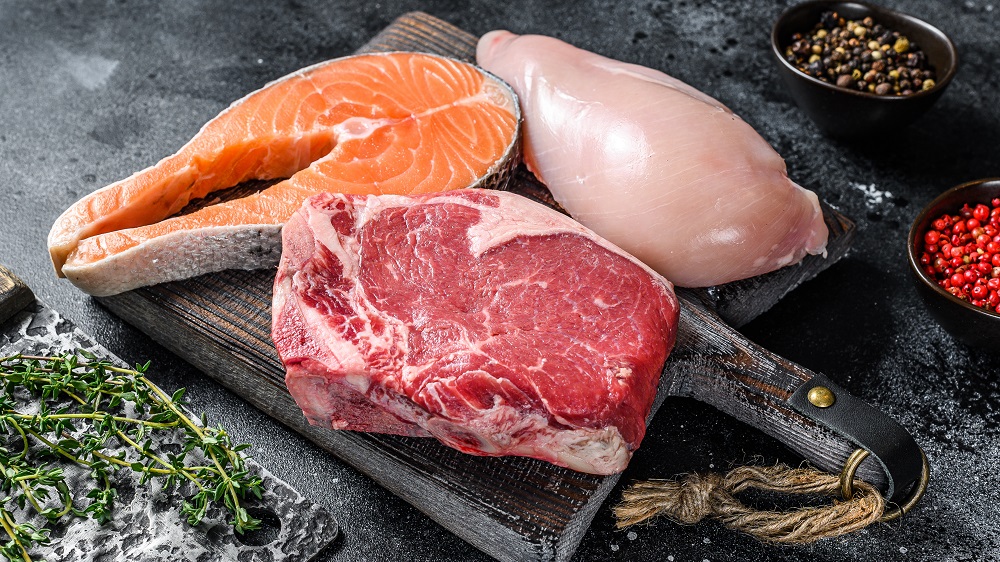
A new study has found a negative association between unprocessed meat consumption and cognitive decline in carriers of the “pro-Alzheimer’s” APOE ε4 allele. This counterintuitive connection might have something to do with human evolution [1].
The meat connection
The APOE gene, which produces apolipoprotein E, a protein central to lipid transport in the brain and body, comes in three variants (alleles): ε2, ε3, and ε4. APOE genotypes are a massive risk factor for Alzheimer’s disease, with ε3 being the most common and “neutral,” ε2 the rarest and protective, and ε4 significantly increasing the risk, especially in homozygous (ε4/ε4) individuals.
Interestingly, ε4 is the ancestral human allele, emerging perhaps 1-6 million years ago; ε3 appeared about 200,000 years ago, and ε2 even later. Several hypotheses explain this by shifts in human diet, since APOE probably modifies responses to dietary factors. One such hypothesis proposes that early humans went through a “hypercarnivorous” phase millions of years ago, followed by a gradual return toward more plant-based eating [2]. The timing of ε4’s emergence may overlap with that meat-heavy period, while ε3 appeared as diets became more omnivorous again.
This hypothesis is supported by the fact that ε4’s modern distribution is most common in populations with historically meat-heavy diets [3]. Moreover, in some populations still leading traditional subsistence lifestyles, ε4 does not appear to carry the same cognitive penalties seen in Western populations and may even confer cognitive benefits [4].
In a new study from Karolinska Institutet in Sweden, the researchers looked at the 2,100-strong human cohort in the Swedish National Study on Aging and Care and matched the incidence of dementia and cognitive decline with the APOE genotype and meat consumption. Interestingly, Northern Europe has a relatively high ε4 frequency, whereas Southern Europe has the lowest. This gradient tracks well with the historical reliance on animal-based foods compared to grain-based agriculture.
Less cognitive decline and dementia for ε4 meat eaters
Participants in the study were followed for up to 15 years. Diet was assessed via a food-frequency questionnaire at baseline and at follow-ups. The cohort was predominantly Northern European and had a mean age of 71 years. The researchers divided the cohort into two subgroups: people with or without the ε4 allele. Since ε4 and ε2 alleles are rare, about 80% of the non-ε4 group consisted of people with the ε3/ε3 genotype, and about 90% of the ε4 group consisted of people with the ε3/ε4 genotype.
The primary model was adjusted for age, sex, education, APOE status, living arrangements (alone vs. not alone), occupation, physical activity, smoking, alcohol intake, total energy intake, Alternative Healthy Eating Index score, number of chronic diseases, and baseline cognition. The primary outcome was cognitive trajectory: the rate of change over 10 years of a global cognition score composed of episodic memory, semantic memory, verbal fluency, and perceptual speed. The secondary outcome was a dementia diagnosis.
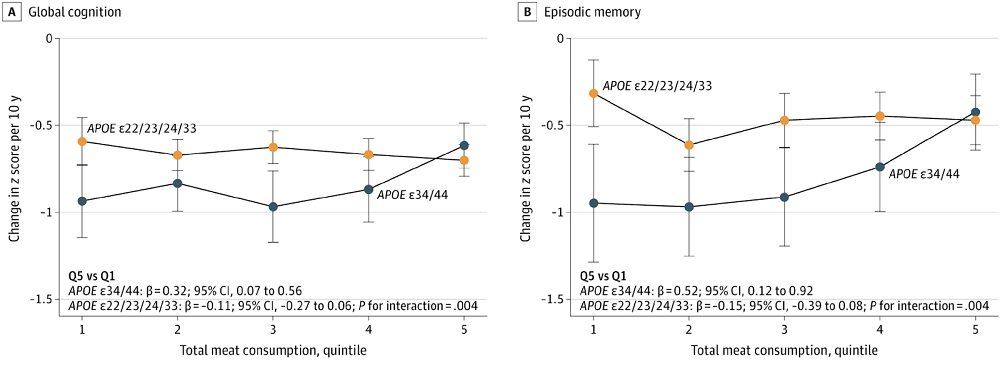
Higher total meat consumption was associated with significantly better cognitive trajectories in the ε4 group but not in non-carriers. In quintile-based analyses, Q5 ε4 carriers performed similarly to non-carriers, meaning that the well-established genotype-associated cognition penalty was effectively erased at high meat consumption.
The effect was strongest for episodic memory, which notably declines in Alzheimer’s. Semantic memory, verbal fluency, and perceptual speed showed directionally consistent but weaker and non-significant interactions.
The red-meat-to-poultry ratio was unrelated to outcomes, meaning that it didn’t matter whether the unprocessed meat was red or white. A higher processed-to-total meat ratio was unfavorably associated with cognitive trajectory in ε4 carriers. While total and unprocessed meat appeared beneficial specifically for ε4 carriers, processed meat was either neutral or harmful regardless of genotype.
Among ε4 carriers, Q5 vs Q1 of total meat consumption was associated with a 55% lower dementia risk. However, the APOE interaction for dementia did not reach statistical significance, so it cannot be ruled out that the effect of meat consumption on dementia incidence is not specific to ε4 carriers (although the data trended that way). Processed meat appeared unfavorable for dementia regardless of the genotype.
Higher unprocessed meat consumption was also associated with 15% lower all-cause mortality specifically in ε4 carriers. If meat simply reduced survival in ε4 carriers in ways unrelated to dementia, hence causing them to die before developing the disease, this would provide false evidence that meat protects from dementia. The mortality finding rules this artifact out. In good news for pescatarians, further analyses suggested that the cognitive benefit for ε4 carriers was preserved when meat was replaced with fish.
Reinforcement from two large cohorts
The authors identified concordant patterns in two large previously published studies. In the UK Biobank, unprocessed red meat was inversely associated with dementia overall, but this was driven by ε4 carriers [5]. In the Nurses’ Health Study and Health Professionals Follow-up Study, supplementary analyses revealed a significant ε4 interaction for unprocessed red meat, with favorable trends among carriers and adverse trends among non-carriers [6].
“Those who ate more meat overall had significantly slower cognitive decline and a lower risk of dementia, but only if they had the APOE 3/4 or 4/4 gene variants,” said first author Jakob Norgren, researcher at the Department of Neurobiology, Care Sciences and Society, Karolinska Institutet. “There is a lack of dietary research into brain health, and our findings suggest that conventional dietary advice may be unfavorable to a genetically defined subgroup of the population. Since the prevalence of APOE4 is about twice as high in the Nordic countries as in the Mediterranean countries, we are particularly well suited to conduct research on tailored dietary recommendations for this risk group.”
Literature
[1] Norgren J, Carballo-Casla A, Grande G, et al. (2026). Meat Consumption and Cognitive Health by APOE Genotype. JAMA Netw Open, 9(3):e266489.
[2] Ben‐Dor, M., Sirtoli, R., & Barkai, R. (2021). The evolution of the human trophic level during the Pleistocene. American journal of physical anthropology, 175, 27-56.
[3] Singh, P. P., Singh, M., & Mastana, S. S. (2006). APOE distribution in world populations with new data from India and the UK. Annals of human biology, 33(3), 279-308.
[4] Trumble, B. C., Stieglitz, J., Blackwell, A. D., Allayee, H., Beheim, B., Finch, C. E., … & Kaplan, H. (2016). Apolipoprotein E4 is associated with improved cognitive function in Amazonian forager-horticulturalists with a high parasite burden. The FASEB journal, 31(4), 1508.
[5] Zhang, H., Greenwood, D. C., Risch, H. A., Bunce, D., Hardie, L. J., & Cade, J. E. (2021). Meat consumption and risk of incident dementia: cohort study of 493,888 UK Biobank participants. The American journal of clinical nutrition, 114(1), 175-184.
[6] Li, Y., Li, Y., Gu, X., Liu, Y., Dong, D., Kang, J. H., … & Wang, D. (2025). Long-term intake of red meat in relation to dementia risk and cognitive function in US adults. Neurology, 104(3), e210286.