A perspective published in Aging and Disease has recommended the use of underground laboratory space in order to remove the effects of surface radiation on biological clocks.
A question of entropy
The cascading failure of bodily systems, leading to the loss of organ function, sits downstream of fundamental damage to genomics and epigenomics. However, how much of this damage is due to random, outside sources, such as unavoidable radiation, has been repeatedly questioned. Depending on the clock used, the stochastic portion of epigenomic damage ranges anywhere from two-thirds to nine-tenths [1], with the rest being attributed to deterministic processes.
The most well-known and well-established source of this sort of damage is radiation, which is impossible to completely avoid under ordinary conditions. Even if a sample or organism is kept safe from such well-known damage sources as ultraviolet radiation, fundamental particles known as muons, which originate from cosmic ray collisions with the atmosphere, will inevitably strike.
Where the muons aren’t
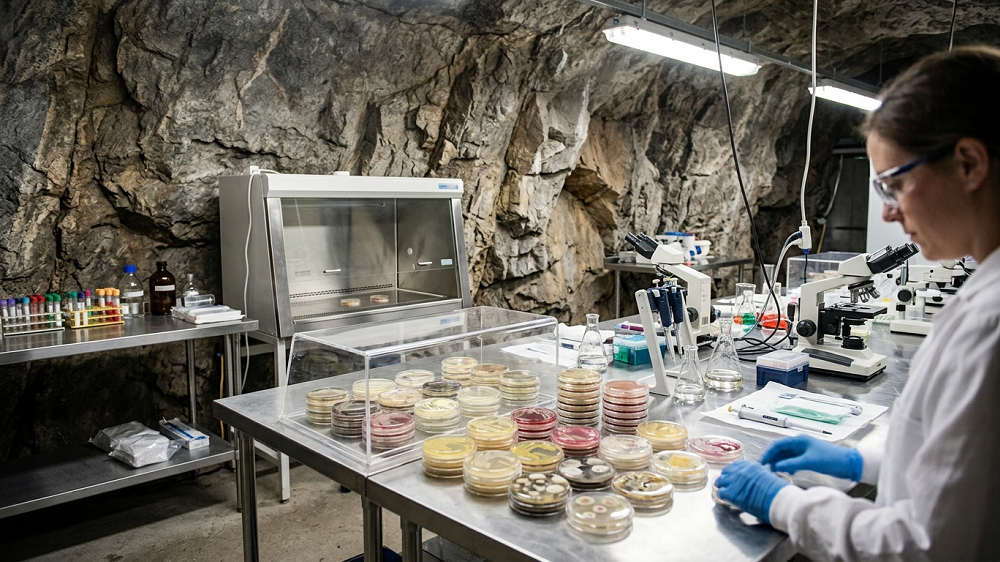
To prevent these particles from disrupting sensitive experiments, physics researchers have made use of deep underground laboratories (DULs), which take advantage of the fact that far fewer muons get through a substantial barrier of solid rock. This perspective paper holds that the same technique can and should be used for fundamental aging research in order to determine what happens when tissues are grown in an environment insulated from muon radiation.
Some work has already been done in this area, and the results were surprising. A population of Drosophila fruit flies grown in a DUL was found to have its natural repair mechanisms severely impaired without regular use [2].
This paper proposes an experiment with a different aim: to determine how much age-related epigenetic damage is caused by muon radiation. Specifically, the authors wish to use the Laboratorio Subterráneo de Canfranc (LSC) in Spain, which is the second-largest in Europe and one of only 14 DULs that exist around the world.
In such an experiment, the LSC would be used with one set of cells, while an above-ground lab would be used with the same type of cells grown in otherwise identical conditions to serve as a control group. Of course, as the authors note, this cannot possibly eliminate all random sources of damage; internal enzymes and oxidative stress would still exist, along with other chemistry-related issues and internal radiation, such as from imperfectly stable atoms of carbon and potassium. However, the purpose is simply to remove one source in order to determine its effects on the clock. While they do not expect its contribution to be large, they note that “this framework enables us to quantitatively test the muon-depletion hypothesis instead of presuming its mechanism.”
Many variables to measure
The authors also note that epigenetic clocks measure more than just genomic damage and that muon exposure may be having effects on both the epigenome and the genome, which must both be measured to gauge the effects of muon depletion. They intend to measure a great many factors of epigenetic aging, including repair signaling, senescence, inflammation, and cellular division. Similarly, they intend to measure radiation in all its forms, including radiation derived from objects around the samples, in order to have a background value to compare the effects of muon flux against.
Two competing hypotheses are entertained in this paper. The first is that epigenetic clocks will have more stability outside the effects of muon radiation and that variance will be decreased. However, the second is that, as the fruit fly experiments suggested, a certain level of background radiation is required for maintenance. Additionally, under this hypothesis, deviant, metastable cell lineages that would normally be obliterated by background muon radiation would proliferate. The results of an epigenetic clock under these conditions would be “increasingly governed by residual internal biases and long-lived states rather than by a simple narrowing of diffusion around an unchanged programmed drift”.
This is a perspective paper that recommends a direction of research, so these experiments have yet to be carried out. If they are, they could teach the research community valuable information about the relationship between background muon radiation and epigenetic aging. It would also be particularly valuable for astronauts, who are constantly beset by cosmic radiation, and anyone seriously considering long-term occupation of the Moon or Mars.

Literature
[1] Tong, H., Dwaraka, V. B., Chen, Q., Luo, Q., Lasky-Su, J. A., Smith, R., & Teschendorff, A. E. (2024). Quantifying the stochastic component of epigenetic aging. Nature Aging, 4(6), 886-901.
[2] Morciano, P., Iorio, R., Iovino, D., Cipressa, F., Esposito, G., Porrazzo, A., … & Cenci, G. (2018). Effects of reduced natural background radiation on Drosophila melanogaster growth and development as revealed by the FLYINGLOW program. Journal of cellular physiology, 233(1), 23-29.