CRISPR-Based System Targets RNA and Kills Cells on Demand
- This approach kills only cells with the selected RNA.

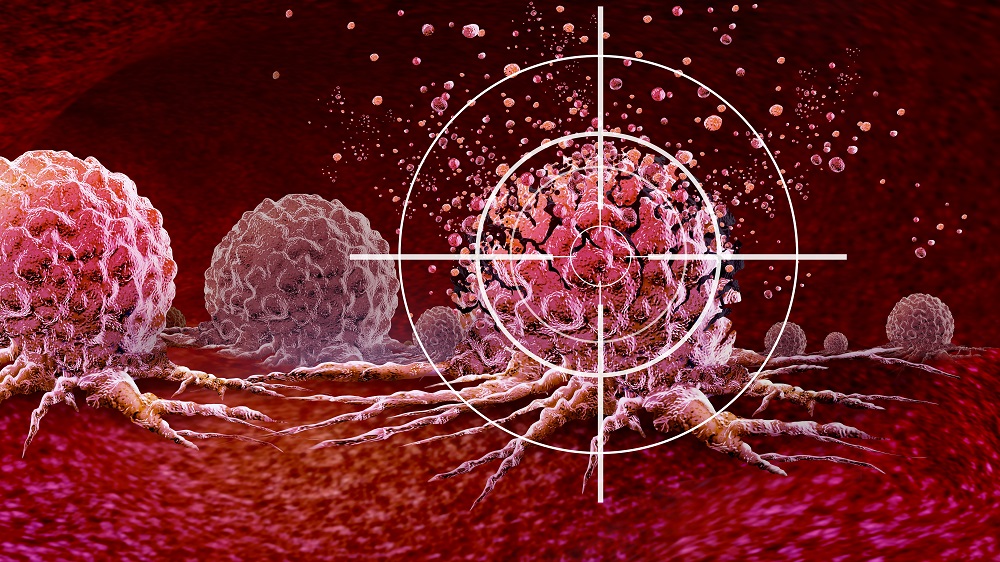
- When exposed to the correct target, this CRISPR variant begins tearing apart cellular DNA.
- While it does not work perfectly, this system is effective in killing kill cancerous cells and reducing the size of tumors.
Scientists have devised a CRISPR-based tool that can kill cells carrying a specific strand of RNA. The tested targets include cancerous and virus-infected cells [1].
Targeted assassination of cells
CRISPR-based systems work by cutting or changing DNA at a particular spot, an ability that can be used to fix dangerous mutations, such as in the famous case of Baby KJ [2]. However, sometimes you need to kill cells with specific features instead of fixing them. Current tools can target proteins inside and on the cell, but they often struggle when the relevant feature is a non-coding RNA, a spot mutation, or a viral transcript in an infected cell [3]. A method that reads a cell’s RNA and decides whether to kill it would unlock interventions not presently possible.
Can CRISPR-based systems help? They can recognize a particular DNA or RNA sequence and cut the molecule, but in itself, this won’t do much: destroying a single RNA transcript would have little effect, and cutting DNA at one spot would only make the cell repair the cut. But hope is not lost: in a new study, published in Nature, scientists from Utah State University offer an elegant solution.
The enzyme that goes wild
The authors had previously discovered a new enzyme called Cas12a2 that behaves unusually in bacteria. When its guide RNA finds a matching RNA target, Cas12a2 doesn’t just cut that one molecule. Instead, it “goes berserk,” indiscriminately chopping up any double-stranded DNA it can find, including the cell’s own. In bacteria, this works spectacularly, leading to cellular death. However, eukaryotic cells have much more robust DNA repair mechanisms. Going into this new study, the researchers wanted to know whether their invention could stay ahead of these mechanisms and kill the cell before it can patch itself up.
First, the team delivered Cas12a2 plus a guide RNA targeting the ADE2 gene transcript into baker’s yeast, Saccharomyces cerevisiae. ADE2 is a non-essential gene whose disruption turns yeast colonies red. Cas12a2 reduced surviving yeast colonies by 134-fold.
As a control, the researchers used FnCas12a, a conventional DNA-cutting nuclease that targets the same site but only that site, without going berserk on all the cell’s DNA. The team provided the yeast cells with a “repair template” that they could use to repair the break at the price of silencing the gene. The control enzyme only reduced colonies four-fold, and the remaining colonies turned red, showing that the yeast indeed had successfully deployed its DNA repair mechanisms to recover.
Next, the authors tested whether Cas12a2’s cell-killing abilities would translate into human cells, which have even more elaborate repair machinery than yeast, by targeting HeLa cells (a human cervical cancer cell line). Cells that had received the construct via electroporation, in which electric impulses cause the cells in the dish to open pores in their membranes, failed to proliferate and shrank in number.
The authors then broadened the test to six different transcripts (KRAS, EGFR, TP53, CD8A, MALAT1, GAPDH) across four cancer cell lines (melanoma, lung, head-and-neck cancers). Killing worked across cell types and even on poorly expressed transcripts. This time, they delivered the system via lipid nanoparticles (LNPs), the same delivery platform used for mRNA vaccines, which may make future therapeutic administration easier.
After confirming that DNA shredding and cell death indeed happens, the team tackled the important question of off-target activation: does the enzyme ever get activated by an RNA that wasn’t the intended target? If yes, it would kill cells that shouldn’t be killed. They found that Cas12a2 targeting transcripts that don’t exist in human cells does not cause DNA shredding or cell death, and that their tool is very sensitive to mismatches; even if cells carry RNA fragments that only slightly differ from the template, Cas12a2 does not mistake them for its target.
The possible applications are many
Finally, it was time to try three possible applications. First, the team targeted high-risk human papillomavirus (HPV), which drives cervical and head-and-neck cancer. HPV-positive head-and-neck cancer tissue from a real patient was grafted into immunodeficient mice. Once tumors reached about 150 mm³, the authors delivered Cas12a2 directly into the tumors, significantly reducing tumor growth.
The second application involved gene editing, which is often inefficient; a million cells can be transfected but only a small fraction actually gets the desired edit. What if we could kill the unedited cells, leaving an enriched population of edited ones? Apparently, Cas12a2 targeting the unedited sequence did just that.
The third application was the most challenging. Many cancers are driven by single-base mutations, such as KRAS G12C, which triggers unbridled cell growth. About 13% of lung adenocarcinomas carry this mutation. An FDA-approved drug, sotorasib, targets KRAS G12C, but tumors often evolve resistance to it. The authors designed three guiding templates, but only one was able to target the mutation and not the wild-type gene.
The killing rate was not perfect, especially in cells heterozygous for the mutation (when one chromosome carries the mutation, and the other one carries the wild-type gene). Cas12a2 depleted these cells by 50%, while sotorasib killed 65%. However, the combination of the two therapies produced a synergistic effect, killing more than 85% of the cells. In cancer, scientists strive to get the perfect result, since a few surviving cells can “rebuild” the tumor, but even these results are highly encouraging as a proof of concept.
“Because Cas12a2 can be programmed with a guide RNA to target any RNA sequence, and it shows little to no off-targeting, we believe we have discovered a way to selectively kill cells across all of biology,” said Utah State University biochemist Ryan Jackso, a leading author. “We show it can be used to enrich for gene editing, and to selectively kill cells harboring virus genes, and to kill cells with acquired mutations. We envision this technology will transform science, agriculture and medicine in ways previously unavailable.”
Literature
[1] Scholz, P., Thompson, J., Crosby, K. T., Fauth, T., Krah, N. M., Schlauderaff, G., … & Liu, Y. (2026). RNA-triggered cell killing with CRISPR–Cas12a2. Nature, 1-10.
[2] Musunuru, K., Grandinette, S. A., Wang, X., Hudson, T. R., Briseno, K., Berry, A. M., … & Ahrens-Nicklas, R. C. (2025). Patient-specific in vivo gene editing to treat a rare genetic disease. New England Journal of Medicine, 392(22), 2235-2243.
[3] Coan, M., Haefliger, S., Ounzain, S., & Johnson, R. (2024). Targeting and engineering long non-coding RNAs for cancer therapy Nature Reviews Genetics, 25(8), 578-595.
About the author

Arkadi Mazin