In a recent paper, researchers have proposed that the immune system and immune surveillance play a central role in maintaining microbial composition throughout life by suppressing microbial proliferation and that aging weakens these processes [1].
Lifelong companions
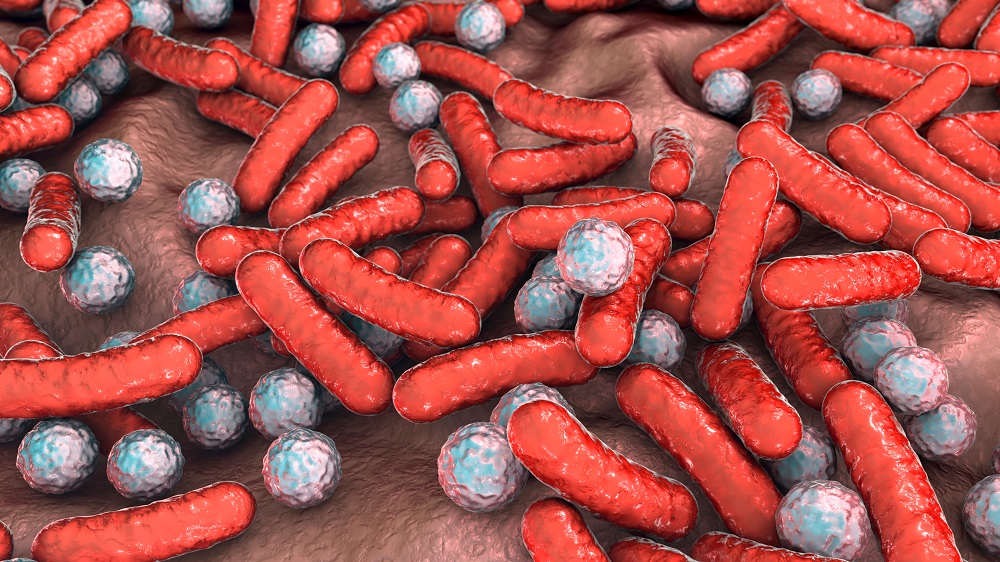
Aging leads to the deterioration of the organs and systems in the human body, while also altering the composition of our lifelong companions: microbes that live in and on the human body (the microbiota). Throughout life, these microbes play essential roles in the proper functioning of their hosts’ biology [2]; thus, unsurprisingly, alterations in their composition, known as dysbiosis, are associated with metabolic dysfunction and disease and can affect lifespan [2, 3].
The authors of a recent paper published in PLOS Biology as part of the “Unsolved Mystery” series delve into the drivers of aging-related dysbiosis.
Active control of the microbiome
Following the initial assembly of the adult microbial community and its stabilization, it is maintained faithfully through adulthood until it begins to deteriorate in old age. However, the mechanisms behind this maintenance and later deterioration have remained poorly understood.
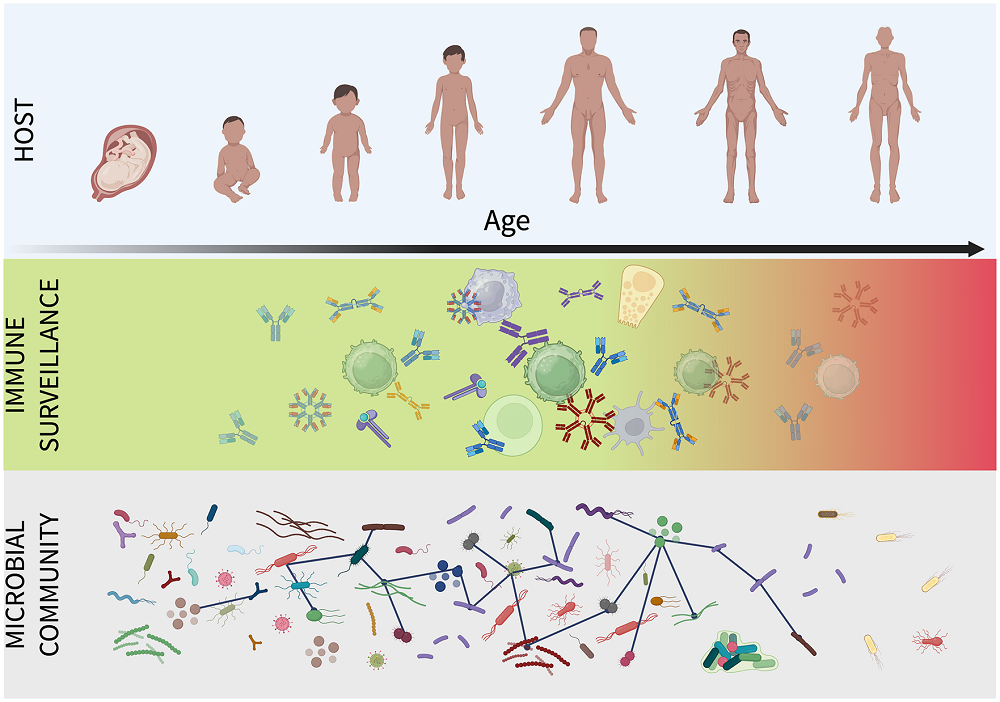
The authors of this paper propose that the process that keeps the microbial ecosystem on a “leash” is immune surveillance, which actively controls, rather than passively tolerates, microbial communities. They discuss how, as we age, this control is weakened by the decline in immune defenses (immunosenescence).
This concept is not new; it has been described in cancer biology, where it refers to the immune system’s continuous scanning of cells and tissues for aberrant cells that can be eliminated immediately before a tumor develops [4]. However, in the case of host-microbiota interactions, a modification to this idea is necessary, since applying this concept in the same way would imply that the gut is sterile (all bacteria would be killed by the immune system), which is not true. Therefore, these researchers propose that immune surveillance of the microbiome is based on activity rather than cell identity. That means the immune system primarily checks not whether the organism is a pathogen, but whether it is increasing in number.
They propose that the immune system’s response is activated by an increase in microbial load. When a bacterial subtype begins to proliferate and threatens to disproportionately dominate the ecosystem, resulting in the loss of the current balance and diversity of microbes, it triggers immune suppression mechanisms. The immune system’s suppression doesn’t eliminate the microbe but calibrates its numbers to maintain balance. In the authors’ model, when such a suppression rule is removed, one or two bacterial species begin to dominate the ecosystem, leading to a loss of diversity.
“We argue that the immune system does not primarily distinguish between ‘good’ and ‘bad’ microbes, but rather continuously monitors which organisms are beginning to dominate the community,” explained Prof. Dr. Dario Riccardo Valenzano, head of the Evolutionary Biology / Microbiome-Host Interactions in Aging research group at the Fritz Lipmann Institute. “This creates a dynamic equilibrium that ensures the long-term stability of the microbiome.”
A different point of view
The authors point out that their model shows microbiome diversity not as a fixed property but as a dynamic balance resulting from constant immune surveillance. This has implications for the age-related changes in microbiome composition. According to the authors, the observed changes to the microbial community result from immunosenescence.
As the aging immune system loses some of its functionality, the resulting changes often lead to constitutive, low-grade inflammation, known as ‘inflammaging,’ which reduces precision and responsiveness. Under this model, such reduced immune surveillance leads a failure to balance microbial species, so certain microbial subtypes, often pathogenic, divide more than others and dominate the community. However, further experimental testing is necessary to confirm this hypothesis.

This immune surveillance failure reveals an underlying weakness in the microbial ecosystem. Microbial diversity is beneficial for the host when surveillance works properly; a diverse microbial community ensures broad metabolic capacity for synthesizing vitamins, producing short-chain fatty acids, and other metabolites across a broad range of conditions and from various substrates. However, those benefits come with a price: the risk of harboring microbes that can become pathogenic under certain conditions, such as when immune surveillance is reduced.
“In our model, the immune system keeps the microbiome in balance by continuously limiting particularly dominant microorganisms,” explains Valenzano. “With age, this control function loses precision. As a result, more persistent bacteria can spread more widely and reduce the diversity of the community. Age-related dysbiosis would then not mean that the microbes turn against their host—rather, the host increasingly loses control over its microbial ecosystem. This is a hypothesis that research must now test.”
A different therapeutic approach
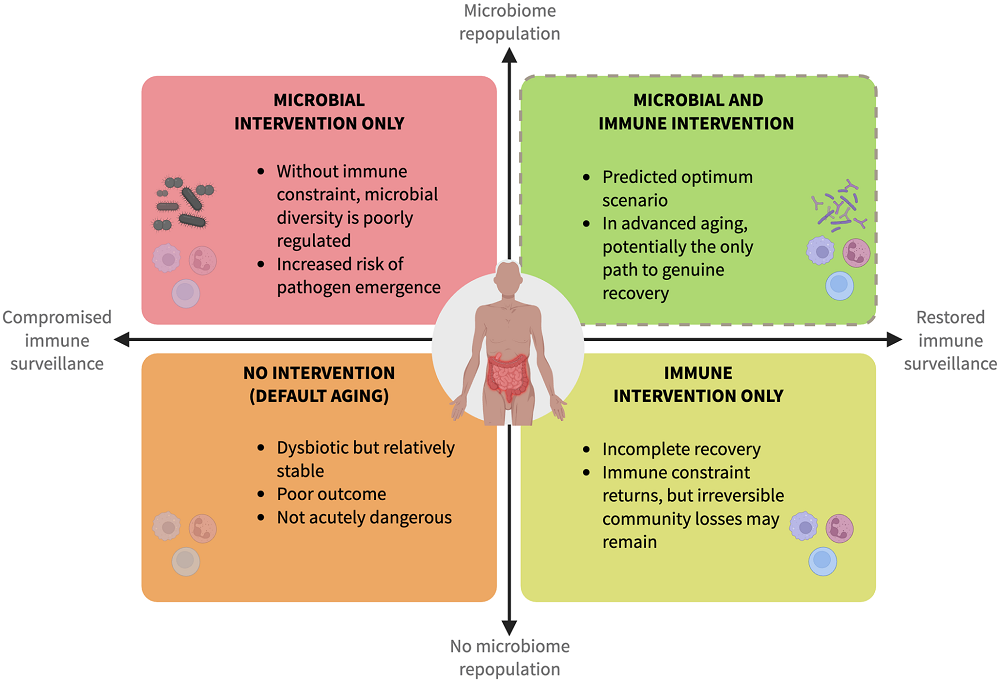
Overall, this framework changes a common interpretation of how aging impacts gut microbial composition. The authors suggest that the aging immune system and loss of immune surveillance might be the upstream processes that precede changes in microbial composition. Such a hypothesis has further implications. It suggests that aging-related changes in microbial composition are not passive but rather “a failure of active host-mediated control.” It also suggests a different view of interventions meant to restore microbial composition. Such interventions should include both restoration of immune system surveillance and microbiome management rather than isolated attempts to replenish beneficial microbes.
“The study points to a potentially important principle for future microbiome therapies: a stable and resilient gut ecosystem likely requires cooperation between microbial communities and the aging immune system. Understanding that interaction could help improve interventions aimed at promoting healthy aging,” explained Dr. Flávio Silva Costa, co-author of the study.
The authors also discussed several unresolved questions, such as which immune processes are most impactful in causing the decline in immune surveillance and whether there is a window of opportunity for intervention to restore immune surveillance and reverse or slow down microbial imbalance. They suggest that experiments in short-lived model organisms with defined microbiomes can help to answer some of those questions.
Literature
[1] Liu, S., Costa, F. S., & Valenzano, D. R. (2026). Immune surveillance and microbial escape in the aging host: Why does the microbiome lose its balance?. PLoS biology, 24(5), e3003815.
[2] Popkes, M., & Valenzano, D. R. (2020). Microbiota-host interactions shape ageing dynamics. Philosophical transactions of the Royal Society of London. Series B, Biological sciences, 375(1808), 20190596.
[3] Tseng, C. H., & Wu, C. Y. (2025). From dysbiosis to longevity: a narrative review into the gut microbiome’s impact on aging. Journal of biomedical science, 32(1), 93.
[4] Dunn, G. P., Bruce, A. T., Ikeda, H., Old, L. J., & Schreiber, R. D. (2002). Cancer immunoediting: from immunosurveillance to tumor escape. Nature immunology, 3(11), 991–998.