Intermittent Fasting Increases Lifespan in Male Mice
- Both sexes benefited on a composite healthspan index.

- Time-restricted feeding slowed frailty in all groups.
- However, lifespan was only significantly affected in male mice.
- Inflammatory biomarkers were not significantly affected.
Restricting food access to an 8-hour window increased median lifespan in male mice by 12%. However, that might be due to voluntary caloric restriction induced by the regimen [1].
You are when you eat
Time-restricted eating (TRE), also known as intermittent fasting, has become a popular health practice due to a slew of animal studies showing its benefits for healthspan and lifespan. Its record in humans, however, has been uneven [2]. One of the central questions that remain in both animal and human studies is whether TRE, known as time-restricted feeding (TRF) in animal research, provides benefits beyond simply inducing mild caloric restriction (CR), which is one of the most potent extenders of lifespan in animal models.
A new study from the University of Texas, published in Nature Aging, addresses this and several other questions, including whether TRF acts differently in male and female mice. While many previous studies have focused on obese mice (where almost anything that curbs overeating looks beneficial), this one involved lean, healthy animals on a normal chow. This is the long-term follow-up to the same group’s 2022 Science study, which showed that circadian-aligned CR extends lifespan in male mice [3].
Is it just CR?
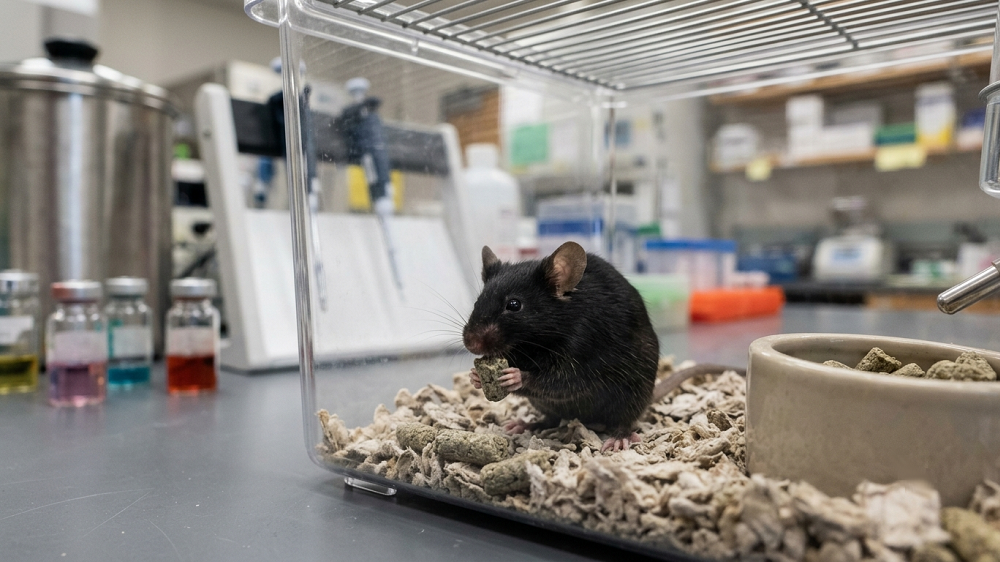
The researchers individually housed 264 male and 264 female mice in cages with running wheels and automated feeders, starting at two months of age. Feeders dispensed purified-diet pellets and logged the timing and quantity of every pellet taken.
After an eight-week baseline on ad libitum (AL) feeding, at four months, each sex was split into three lifelong groups: 12-hour TRF, which has food available during a 12-hour nighttime window; 8-hour TRF, which uses a shorter nighttime feeding window; and AL controls. Mice are active at night, so nighttime feeding fits their circadian rhythms and corresponds to daytime eating in humans. Hoarding of food was quantified and subtracted and did not substantially affect the results. Crucially, the daily food allotment always exceeded what any group ate, so no CR was imposed by design; any caloric reduction had to be voluntary.
TRF indeed caused mild CR in every group except in 12-h females. 12-h males had mild, transient CR (8-14% over time, mid-life only), and both 8-h TRF groups had deeper and sustained CR (10-22% in females, 9-23% in males). This makes it hard to decouple the effects of TRF and CR, except in 12-h females, who did show significant improvements in some metrics. For instance, a 12-h window was enough to improve body weight and composition in both sexes.
In this respect, 8-h TRF gave females no extra benefit over 12-h despite their added CR, whereas males clearly benefitted more from the 8-hour regimen (up to 16% less weight gain, larger fat/lean mass improvement). Apparently, females max out the body-composition benefit in the milder window, while males keep gaining as restriction tightens.
TRF slowed the rise in frailty, with effects depending on dose and sex. Using a 31-item mouse frailty index that combines coat, eyes, hearing, musculoskeletal and other deficits, the researchers found that both TRF windows reduced frailty at specific ages, with 8-h TRF producing the largest and longest-lasting reductions in both sexes. 8-h TRF delayed the median onset of health problems in males, and no other group showed this effect. Additionally, only 8-h males showed elevated activity from mid-life onward.
Interestingly, systemic metabolic, inflammatory, and blood markers were largely unchanged by the intervention. Fasting glucose and glucose tolerance showed only modest, mostly early improvements, and mostly in males. A panel of blood markers, including leptin, BDNF, and cytokines such as TNFα, IL-1β, IL-6, IL-10, and MCP-1, showed no sustained effects of TRF. The authors hypothesize that TRF’s health benefits, however obvious, do not depend on large shifts in systemic endocrine or inflammatory signaling.
Lifespan gains for males only
12-h TRF did not affect lifespan, while 8-h TRF extended, in males only, median lifespan by 12% and maximal lifespan by 3%. However, a composite healthspan index (frailty plus activity, feeding, body composition, etc.) showed benefits in both sexes and in both regimens, proportionally greater in females and on 8-h TRF. This was not uniform; the males fared better on some individual metrics such as physical activity.
The study had several noteworthy limitations. For instance, only early-onset, lifelong TRF was tested, while late-life initiation, a more clinically relevant scenario, was not. More importantly, females had shorter lifespans than males, which is the opposite of what you usually see in mice. The authors attribute this partly to cold stress in singly-housed females without nesting material. If the female cohort was chronically thermally stressed, that could mask a lifespan benefit from TRF that might emerge under better housing. Another major issue with mouse TRF studies is that due to their higher metabolic rate, an 8-hour feeding window actually represents a harsher TRF regimen for them than for humans, which limits translation.
Literature
[1] Iiams, S. E., Skinner, N. J., Wight-Carter, M., Acosta-Rodríguez, V. A., Green, C. B., & Takahashi, J. S. (2026). Time-restricted feeding extends healthspan in both sexes and lifespan in male C57BL/6 J mice. Nature Aging, 1-17.
[2] Lowe, D. A., Wu, N., Rohdin-Bibby, L., Moore, A. H., Kelly, N., Liu, Y. E., … & Weiss, E. J. (2020). Effects of time-restricted eating on weight loss and other metabolic parameters in women and men with overweight and obesity: the TREAT randomized clinical trial. JAMA internal medicine, 180(11), 1491-1499.
[3] Acosta-Rodríguez, V., Rijo-Ferreira, F., Izumo, M., Xu, P., Wight-Carter, M., Green, C. B., & Takahashi, J. S. (2022). Circadian alignment of early onset caloric restriction promotes longevity in male C57BL/6J mice. Science, 376(6598), 1192-1202.
About the author

Arkadi Mazin