
A team of researchers has concluded that while methylation-based epigenetic clocks generally give reliable outputs when given the same inputs, short-term biological fluctuations can drastically change their results.
Technical and biological reliability

The authors make a clear distinction between technical and biological reliability. A technically reliable clock is one that consistently gives the same outputs when presented with the same input. A dozen researchers at a dozen different labs could present portions of the same blood sample to a technically reliable clock, and, as they are using identical material, it would give the same answer to all of them.
In the context of biological research, this is far from a trivial problem. The authors list a great many issues that may affect technical reliability, including differences between array platforms, differences in sample probing procedures including the chemistry of the probes used, and differences involving the handling, extraction, and storage of DNA. While no clock can fully account for the various ways that its input may be mishandled, some clocks that use principal components (PCs) have been designed to fight back against technical noise [1].
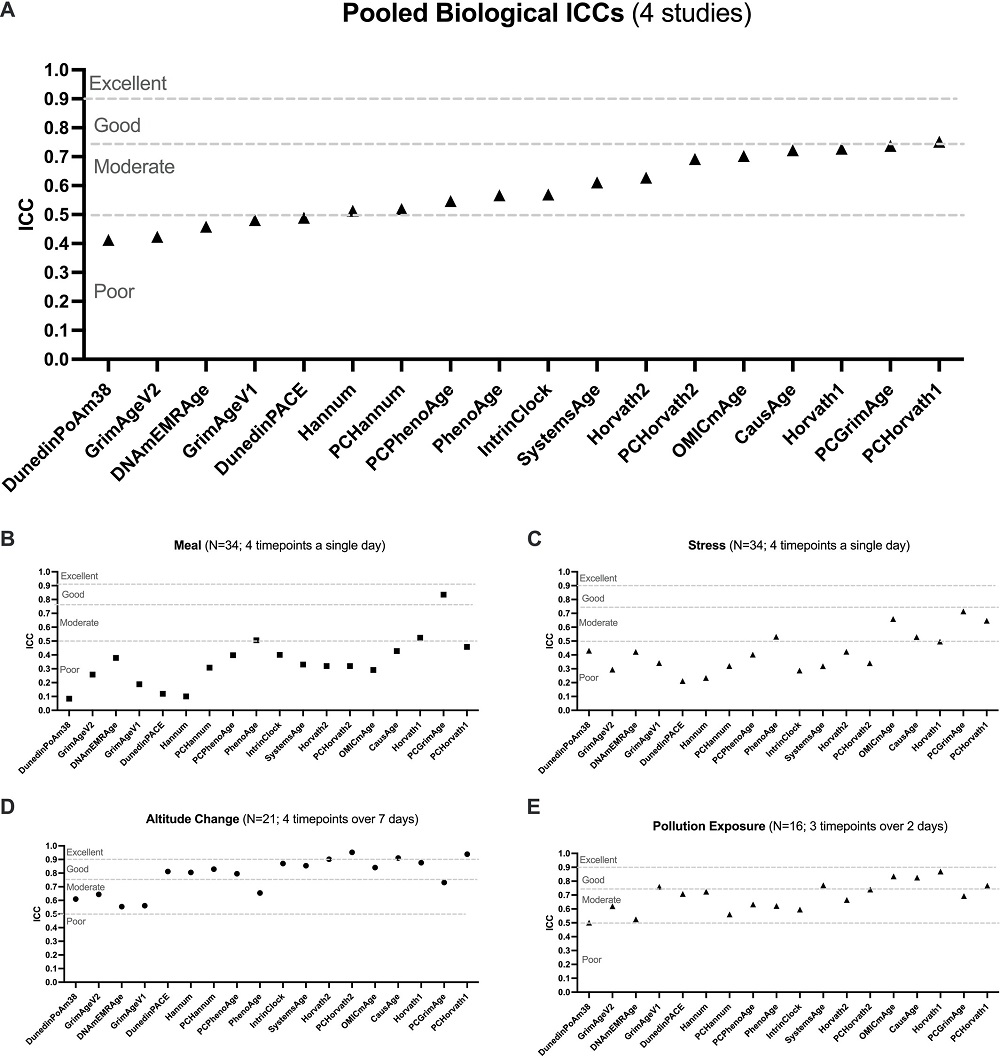
In general, all of the clocks that the researchers tested remained technically reliable under various laboratory conditions; While still in the ‘good’ range, CausAge was found to be the most vulnerable to such perturbations; SystemsAge and the PC versions of various clocks remained robust in the ‘excellent’ range. Certain disruptions in handling, such as slide placement, led to completely degraded technical reliability in many cases, and DNA extraction differences reduced reliability in three clocks. However, assuming proper and consistent handling, technical reliability appears to only be a mild concern.
A long-term clock can capture short-term effects instead
Biological reliability, however, is different. Aging clocks are supposed to measure long-term biological changes and remain unaffected by short-term perturbations in living conditions. However, the researchers’ findings, and the main thrust of their paper, are that they have significant problems with this and that their biological reliability is unrelated to their technical reliability.
For example, samples taken before and after eating yielded very different results in the vast majority of clocks. Only the PC version of the original GrimAge remained within the ‘good’ range of test/re-test reliability in this case; version 2 of GrimAge was very poorly reliable, as were the majority of other clocks. PhenoAge and the original Horvath clock remained in the ‘moderate’ zone after a meal.
Short-term stress yielded similar results; while many of the clocks were in the ‘moderate’ zone under stressful conditions, not a single one was considered ‘good’. Pollution exposure significantly degraded many clocks to the ‘good’ and ‘moderate’ ranges, and even a simple altitude change caused some unreliability, including in the PC version of GrimAge.
Ensuring reliability is difficult
The authors hypothesized that controlling for immune cell counts, which fluctuate under these conditions, may be a way of mitigating biological unreliability. This proved to be completely counterproductive; in nearly all of the clocks and nearly all of the conditions tested, this additional control led to a massive decrease in reliability instead. This led the authors to conclude that “changes in immune cell composition appear to reflect meaningful biological processes that are reproducibly detected by DNA methylation aging biomarkers.”
Of course, unreliable clocks cannot be used to yield reliable results. The authors claim that some of these clocks are so unreliable that their variation in z-scores fluctuates “across the full significance spectrum”, rendering their use completely untrustworthy regardless of the results generated using them.
Biological unreliability is in no way unique to methylation-based clocks [2], and the authors urge these results to be interpreted in that context. More traditional biomarkers, such as inflammatory compounds, are highly sensitive to perturbations such as exercise, markers such as hematocrit are very sensitive to hydration, and proteomic biomarkers fluctuate after meal consumption.
Additionally, the authors listed potential flaws in their own work; many of their findings were generated using cohorts of young adults, and there were no separate control groups to determine if specific perturbations or the simple passage of hours or days caused the variation in the clocks’ results. Further work should be done to ascertain more details about popular clocks’ reliability and any constraints, such as a fasting period, that should be adhered to in their use. If at all possible, future clocks should be developed to be insensitive to short-term alterations in epigenetic biomarkers.
Literature
[1] Higgins-Chen, A. T., Thrush, K. L., Wang, Y., Minteer, C. J., Kuo, P. L., Wang, M., … & Boks, M. P. (2022). A computational solution for bolstering reliability of epigenetic clocks: implications for clinical trials and longitudinal tracking. Nature aging, 2(7), 644-661.
[2] Della Monica, C., Revell, V., Atzori, G., Laban, R., Skene, S. S., Heslegrave, A., … & Dijk, D. J. (2024). P-tau217 and other blood biomarkers of dementia: variation with time of day. Translational psychiatry, 14(1), 373.