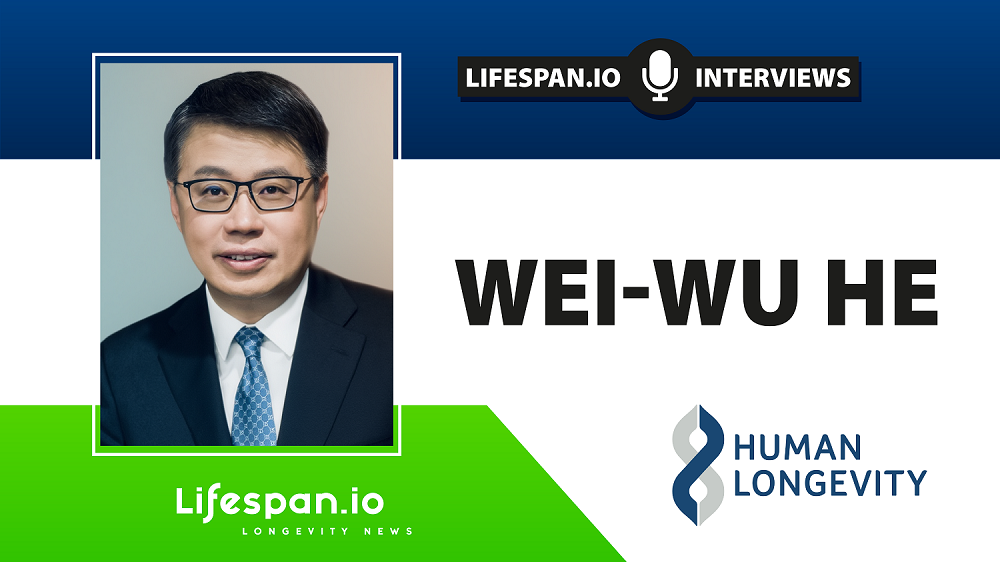
Human Longevity Inc., a company founded in 2013 by a trio of visionaries – Craig Venter, Peter Diamandis, and Robert Hariri – initially inspired high hopes. Several years and several hundred million dollars later, however, the company entered what many people saw as a period of turmoil. Dr. Wei-Wu He, an early investor in HLI, took the helm in 2019 and has led the company ever since.
Wei-Wu He is an unusual combination of scientist and businessman, with a PhD in molecular biology from Baylor College of Medicine and a record of founding and leading several successful companies. As HLI’s chairman and CEO, Dr. He guided it through a difficult period, stabilizing the business while preserving its scientific vision. That vision is now moving back to the foreground, with two major collaborations announced recently. We thought it was a great time to sit down with Dr. He and talk about the company’s past, present – and future, which he believes could change the longevity field and the way we tend to our bodies.
When Human Longevity launched, it was a major event. The company has since had an interesting history, with rapid expansion, several pivots, and changes in its business model. How do you see that story?
The company was founded by Craig Venter, Peter Diamandis, and Robert Hariri, and the original vision came largely from Craig’s work in genomics. He helped decode the first human genome, so he was always thinking about the genome’s impact. Eight billion people each have a genome, and humans have been on Earth for roughly 300,000 years, but this is the first time we can actually read it.
Craig’s vision was to create a precision medicine platform built on genomic information, combined with phenotypic information such as whole-body MRI, proteomics, metabolomics, and other measurements of health. The goal was to prevent or delay major diseases such as heart attack, stroke, cancer, and dementia. If you can delay those diseases by 20 or 30 years, you may end up living much longer.
That has always been the company’s thesis: a data-driven system. When HLI started, today’s AI tools didn’t even exist. The execution and business model have changed, but I don’t think the underlying vision has. Human Longevity was meant to serve humanity at scale, not just a small group of people.
We want to use precision medicine, starting with the genome, to add 10, 20, or potentially more healthy years to people’s lives. It’s a scientific endeavor, and that’s what distinguishes us from companies that are mainly selling luxury retreats or pampering. We publish research and remain a science-driven platform.
My impression was that HLI began as an extremely ambitious scientific and commercial project, with rapid growth, acquisitions, and a great deal of funding. Then, for several years, it seemed to become primarily a direct clinical service, perhaps putting some of the larger scientific ambitions on hold. Now, with technology catching up and collaborations such as those with Insilico Medicine and the LEV Foundation, it looks like HLI may be returning to its original vision. Is that a fair reconstruction?
I don’t think we ever paused the scientific work. One of the biggest barriers in this field is the lack of longitudinal datasets, and we now have 13 years of follow-up data from more than 10,000 people. That’s what allows us to build more accurate algorithms today.
The mistake in the early years was that we raised around $500 million and tried to work on everything. Scientists see that much funding and think of it as a very large NIH grant: they want to pursue every interesting question. But even the NIH, with tens of billions of dollars a year, cannot do everything. Trying to cover the entire field was a business mistake.
I’ve known Craig for more than 30 years. We helped build Human Genome Sciences after I left Harvard, doing large-scale DNA sequencing in the early 1990s. Craig later founded Celera to sequence the human genome, while I built OriGene and also ran a venture fund. When I heard in 2015 that Craig was building Human Longevity, I flew to San Diego and invested $40 million in the Series B round. Celgene (Bristol Myers Squibb), Illumina, GE, and others also invested.
The board agreed on the broad idea that data, AI, and science could help people live longer and healthier lives, but the company was going in too many directions at once, including cancer vaccines and projects such as predicting a person’s face from DNA. That work was publishable and technologically interesting, but in my view it wasn’t a good use of $5 million or $10 million.

By 2019, the company was burning roughly $100 million a year. I invested another $30 million, restructured it, and have been running it since then. I don’t take a salary, and I have probably invested around $70 million of my own money altogether. The company is very different today, but the vision of eventually democratizing this form of medicine for a billion people or more hasn’t changed.
For the past several years, though, HLI has mainly served high-net-worth clients and charged substantial annual fees. On the surface, that seems almost contrary to democratization.
All new technologies are expensive at the beginning. The first Tesla Roadster cost around $200,000, and only a small number were produced. Whole-genome sequencing cost us about $10,000 when HLI started. Today, the cost has fallen below $500, which is why we can offer clinical-grade whole-genome sequencing for $599.
You have to begin somewhere, learn how the system works, and bring the cost down over time. Mayo Clinic wasn’t built in three years with venture capital. It became Mayo Clinic by delivering high-quality healthcare for more than a century and operating sustainably. Silicon Valley often wants nine women to deliver a baby in one month, but biology and medicine have their own pace. You can’t build the Mayo Clinic of precision medicine in three years, no matter how much money you have.
So, your clinical business wasn’t a retreat from science. Instead, it gave HLI a sustainable model while allowing you to continue building a deeply phenotyped longitudinal dataset?
Exactly. Every period in medical history has had a major revolution. In the twentieth century, antibiotics and vaccines transformed infectious disease. Today, most deaths are caused by cardiovascular disease, cancer, dementia, diabetes, and other metabolic diseases. These are largely age-related diseases, and genetics plays an important role.
The two great revolutions now are that the human genome can be decoded for a few hundred dollars and that AI gives us the ability to analyze tens of terabytes of data. But, people often pigeonhole HLI as a genomics company because Craig Venter helped sequence the first genome. From day one, we’ve described ourselves as a genotype-and-phenotype company. That’s why we use whole-body MRI, extensive blood testing, proteomics, metabolomics, and other measurements.
We published a PNAS paper using data from our first roughly 1,200 participants to show why genotype and phenotype must be linked. One case involved a person with compound heterozygous variants associated with cystic fibrosis. The person had spent years being treated for symptoms such as nasal congestion and food allergies, but combining genomic information with lung imaging led to the underlying diagnosis very quickly.
The same principle applies to common disease. We’re developing an algorithm to predict future heart attacks by combining genetics with conventional biomarkers such as LDL cholesterol, Lp(a), high-sensitivity CRP, blood pressure, and homocysteine, as well as data such as continuous glucose monitoring and visceral fat. If an organization gives me data on 10,000 people, the goal is to identify the 500 who will contribute disproportionately to its future cardiovascular events.
Do we have evidence that this kind of early diagnosis and deep phenotyping actually reduces morbidity or mortality?
Our internal outcomes are very encouraging. In 13 years, we haven’t had a single prostate cancer case first detected at stage four. We’ve found them at stage one or stage two. Statistically, we would have expected a meaningful number of deaths, but we’ve had none. We haven’t yet published the full outcome dataset, so this is still internal evidence.
We’re confident enough that we offer a million-dollar pledge: if a member develops stage four prostate cancer that we failed to detect earlier, we commit up to $1 million to their care. We believe it would be extremely difficult for someone under regular surveillance to progress to stage four without our knowing about it.
There’s a common argument that eliminating cancer entirely would add only a few years to average life expectancy, but for the person whose cancer is prevented or cured, the benefit could be decades.
Yes, that’s an important distinction. Adding even one year to global average life expectancy is really hard, but population averages also conceal the benefit to people at particularly high risk. If you cure Steve Jobs’ pancreatic cancer and he lives another 20 years, that isn’t a two- or three-year benefit for him.
A subset of the population is genetically much more prone to cancer. For those people, preventing or successfully treating cancer may add five, ten, or many more years. When you average that benefit across eight billion people, the population-wide number looks smaller. Precision medicine is about identifying who is at high risk rather than treating everyone as an average person.
Let’s turn to the Insilico Medicine collaboration. What are you trying to build together?
We need a foundation model for longevity, but it won’t simply be a large language model. It’ll be a multimodal world model because humans are three-dimensional organisms and much of the relevant information is visual. Think of Tesla’s self-driving system: it isn’t based primarily on language; it learns from imaging and other sensor data.
In medicine, facial data may contain information about stress or emotional state. Retinal imaging can reveal signs associated with diabetes and other diseases. MRI, CT, pathology, and many other forms of imaging will also be part of the model. The collaboration with Insilico is aimed at building this broader world model for longevity. We may also work with large AI companies. Geoffrey Hinton and Michael Levitt have joined us as advisers.
We’re also working with the Framingham Heart Study. We’re sequencing several thousand people from a cohort with decades of longitudinal phenotypic data. Linking their genotypes to that history is very valuable. The more longitudinal data you have, the stronger the foundation model can become.
Framingham is one of the most important cohorts in medical history, but it was built primarily around phenotypic and clinical information. And now, you’re adding genomic data.
Exactly. What Craig envisioned 13 years ago is finally becoming practical. A recent UK Biobank cardiovascular algorithm suggests that genetics accounts for a very large share of heart attack risk. For $599, we can obtain information that remains relevant for the rest of your life.
We’re using UK Biobank data and our own cohort of more than 10,000 people to validate and improve these algorithms. One important finding is that an algorithm developed mainly in people of European ancestry may work well for Caucasian populations but much less well for Chinese or Indian populations.
HLI’s clinical cohort is also self-selected and includes many affluent clients. Doesn’t that create its own limitations?
It does, but our dataset is more diverse than people assume. We provided services to San Diego firefighters, many of them through a donated program. We also operated a clinic in Beijing, giving us data from thousands of Chinese clients. Silicon Valley itself has a diverse population.
But the problem is real. For example, the lack of Asian representation is a major weakness in many existing datasets. If an algorithm doesn’t work for Asian populations, it doesn’t work for a very large part of humanity.
Biology is now in a race to collect enough high-quality data to train useful foundation models. Where does HLI fit into that race?
It’s not enough to collect isolated measurements. You need to follow people over time, observe interventions, and record outcomes. Data scientists often simplify biology because they want a black-and-white problem. Healthcare is never black and white. There are tens of thousands of named human diseases, and the same genome can mean very low risk for one disease and very high risk for another.
Technology companies also often lack direct relationships with patients. Silicon Valley’s slogan is ‘fake it until you make it,’ but in medicine, if you fake data, you can harm people and go to jail. The consequences are completely different from releasing software with a bug.
We’ve spent 13 years building a dataset that begins with the genome, adds multi-omics and imaging, and includes physicians who care for the participants. That produces feedback and outcome data. Our dataset may be much deeper than a biobank because thousands of people are followed regularly by our physicians. A hospital system may have enormous amounts of data, but patients often go there because they are already ill. We repeatedly assess people before they develop disease, which is a different type of information.
Do you expect large health systems, including single-payer systems, to eventually adopt this model and offer regular genomic testing, imaging, and longitudinal surveillance?
Absolutely. The hardware is relatively easy to copy; the algorithm is harder. Anyone can buy scanners, just as anyone can buy servers. The real value is in how the data are integrated and interpreted. If genome sequencing eventually costs only a few dollars a year and helps identify the people at highest risk of heart attack, stroke, or cancer, why wouldn’t a health system use it? The economics could be compelling.
The economics depend on incentives, and US healthcare incentives are often poorly aligned. Have you worked with insurers? They would seem to benefit from prevention.
Almost 10 years ago, the CEOs of the largest insurance companies spent a full day in San Diego with Craig. They all said they wanted to do it, but none actually did. Large insurers are profitable and bureaucratic. The problem is a basic misalignment: an insurer may pay to reduce your long-term risk, but you may switch insurers before the benefit appears. The next company gets the savings.
We’ve also spoken with self-insured corporations. They have a more direct incentive because healthcare is a budget item for them, but even they say that employees often leave after a few years. Why should they pay today to reduce someone’s dementia risk if that person will be working for a different company by the time the benefit arrives?
Who, then, has the strongest incentive to pay for long-term prevention?
Life insurers are potentially very interested because their business directly depends on lifespan. If I can predict that someone is likely to live to 99, that changes how I would price a policy. Accurate longevity prediction gives you a real information advantage.
That brings us nicely to HLI’s collaboration with the LEV Foundation and its work on centenarians and supercentenarians. What do you hope to learn?
Genetics clearly influences lifespan. Some studies have put the heritable contribution to longevity at around 15%, while a recent Science paper argued for something closer to 50% or 55%. I don’t know the true number, but I believe it’s more than 15%.
One scientific strategy is to study the extremes. At one end are supercentenarians who live beyond 110. At the other are children and teenagers who develop cancer very early; I’m funding a Harvard project in that area. Their genetics may reveal opposite ends of genome stability and DNA repair. Bowhead whales can live for more than 200 years and rarely develop cancer, and elephants also have unusual cancer resistance. Understanding those mechanisms could eventually benefit billions of people.
Centenarians and supercentenarians have been studied and sequenced before, without yielding a simple set of “longevity genes.” What makes you think the next effort will succeed?
The tools may not have been good enough. AlphaGenome, from Google DeepMind, is potentially a major advance. When two people differ at a single nucleotide, historically we’ve had very limited ability to tell whether that difference matters, especially outside protein-coding regions. AlphaGenome can help predict the functional consequences of variants in regulatory DNA.
Much of what used to be called junk DNA contains important regulatory elements. Longevity may not come from one or two genes. It could reflect the combined effect of hundreds of thousands or even millions of variants across the genome. The same may be true at the other extreme for a child who develops colon cancer at 14.
At very old ages, chance must also matter. A person who reaches 110 may simply have been lucky to survive a series of risks that killed other people with similar biology.
Chance matters for an individual, but it becomes a lazy answer if we use it to avoid studying populations. It’s true that in the past, people who reached 100 were probably extraordinarily lucky, but the number of centenarians has been rising quickly.
Science asks whether we can move the entire distribution. Can we increase the number of centenarians from perhaps 10 per 100,000 people to 100 per 100,000? That’s not a story about one lucky person. It’s a measurable population-level project. Our goal is to increase the number of healthy centenarians dramatically over the next 20 years.
What is HLI’s practical roadmap for doing that?
Our algorithms are designed to delay the major diseases that cause most deaths. If I’m otherwise destined to have a heart attack at 55, I want to prevent it before 55. Maybe I’ll have one at 105, but I’ve gained 50 years. The same applies to cancer: if we identify an aggressive prostate cancer at stage on and remove a one-centimeter tumor before it metastasizes, we’ve delayed or prevented the disease that would have killed that person. Eventually, everyone dies of something. The goal is to keep moving the major threats farther into the future.
My initial instinct was to separate the collaborations into simple categories: Insilico for future therapies and LEV for longevity variants, but I can see now that your strategy is more integrated than that.
Medicine is much more complex than those categories. It’s a symphony – think of Beethoven’s Ninth. To live to 110, you need diagnostics, interventions, monitoring, and many other components working together. It may be the most complex symphony in the world, yet people constantly try to simplify it.
Medical schools divide medicine into specialties because no human brain can remember tens of thousands of diseases. A patient may have one rare disease that a general physician has never encountered. AI can change all that. Geoffrey Hinton told me, “Don’t worry about specialization. Collect as much data as humanly possible, and eventually AI will figure it out.”
We’re following that advice. We collect microbiome data, GlycanAge data, imaging, and potentially facial and retinal data, but the critical element is outcome data. AlphaGo learned from games in which there was a clear outcome: somebody won. A longevity model also needs to know what happened to the person. Did the intervention work? Did the disease occur? Did the person remain healthy? Without outcomes, you can’t validate the model.
How would that model change an individual’s care?
My own risks provide a simple example. An AI model looking at my genome, PSA history, and prostate imaging might tell me not to worry much about prostate cancer because my genetic risk is in the lowest percentile and my markers have been stable for 10 years. But my coronary calcium score rose from three to 80 in five years. The model should tell me: don’t focus on your prostate; focus on your cardiovascular risk.
That kind of prioritization can be smarter than the fragmented advice people often get from multiple specialists. Your main risk may be completely different from mine.
You have said that people should become the CEOs of their own health. Is this what you mean?
Yes. Everyone should have something like a personal ChatGPT with all of their own data behind it: genome, proteomics, imaging, annual examinations, and 10 or 20 years of history. That system could coach you to become the CEO of your own body.
But, the physician remains important. The AI should also help identify the right human expert. If you have a very rare autoimmune or genetic disease, it may direct you to the one physician who has spent 40 years studying it. Deep human expertise can contain a kind of pattern recognition that is difficult to explain. Malcolm Gladwell’s Blink describes an art expert who immediately recognized a museum acquisition as fake even though technical testing had suggested it was genuine. He couldn’t explain his reasoning; it was intuition based on decades of expertise. Medicine will combine that human expertise with AI rather than simply replacing it.
Genome sequencing has fallen dramatically in price, but other components of deep phenotyping, such as whole-body MRI, remain expensive. How can those be democratized?
Imaging will also become cheaper. Siemens, for example, has developed the Magnetom Free.Max, a 0.55-tesla MRI system that uses much less helium and can be installed more easily than a conventional high-field scanner. It may not replace every advanced MRI application, but it can be very useful for many forms of screening.
Never underestimate technology. Something that costs a million dollars today may cost $5,000 in 30 years. Craig has said that the computing hardware used for the first human genome cost around $80 million at the time; years later, comparable computational power cost almost nothing. We’ll see the same kind of decline in imaging and other diagnostics.
Beyond genomics and imaging, are you adding biological-age tests or other longevity-oriented modalities?
We have tried many of them. At the moment, we’re particularly interested in GlycanAge. It has a substantial scientific literature and measures a specific dimension of aging: glycosylation patterns on IgG. I think it may be saying something about inflammatory and immune aging. If that measure looks unusually old, it may be worth considering interventions to reduce inflammation.
We also offer therapeutic plasma exchange in our clinic. More broadly, we keep evaluating new modalities and interventions. We work with a large network of clinicians at Mass General Brigham and Brigham and Women’s Hospital on difficult cases. Deep sequencing inevitably identifies rare variants and unusual diseases. Brugada syndrome, for example, can involve variants in cardiac ion channels and a risk of sudden death. A specialist who has studied a particular variant or syndrome for decades may know exactly how to manage it.
So, HLI is not just accumulating data. The clinical work is still generating scientific questions and interventions.
I’m doing this for the science. Basic lifestyle is still important: sleep well, exercise, eat well, and don’t overeat. Chinese medicine and philosophy have emphasized those principles for thousands of years. But lifestyle alone won’t solve everyone’s genetic or medical risks. Science is what can add another 20 years.
I think most people are biologically capable of living much longer than they do. The body is like a ship designed to last for decades, but it can sink on its first voyage if it hits an iceberg. A century ago, the iceberg was often infection. Today, it’s often cardiovascular disease or cancer. If we protect the blood vessels and prevent a heart attack, we may add decades. If we also prevent cancer, we may add more.
In other words, HLI’s role within the broader longevity field is to help people realize more of their inherent biological potential.
Yes. I call that class-one technology: using prediction, prevention, and current medicine to help the body reach its inherent potential. Class two is regenerative medicine – replacing a failing heart, kidney, retina, or another organ so the person can go beyond that original limit. Gene therapy and regenerative medicine are coming.
Somebody has to believe in the future. If people don’t believe a difficult technology can be built, it will never be built. HLI’s task is to keep collecting the data, proving what works, and moving precision medicine from a boutique service toward something that can benefit humanity at scale.