
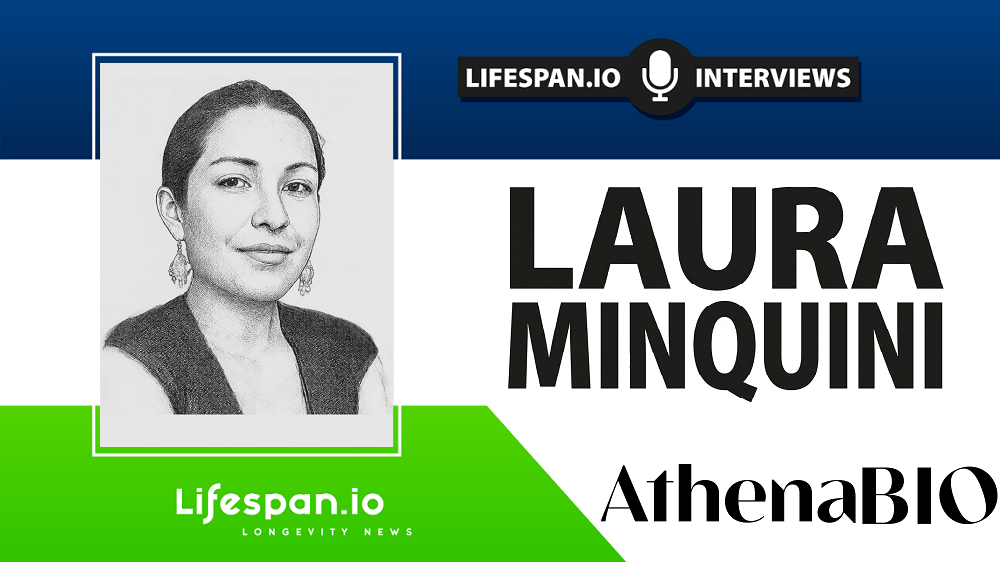
Laura Minquini is not a scientist, but that hasn’t stopped her from joining the front lines of the war on aging: specifically, female reproductive aging. Several years ago, after a successful stint in consumer technology, Laura discovered the longevity field when decentralized science was all the rage. Inspired by VitaDAO’s success, she founded AthenaDAO, a decentralized autonomous organization devoted to female health and longevity. Now comes the next step: AthenaBio, a more conventional 501(c)(3) nonprofit with the same broad focus. We talked with Laura about her journey and why female longevity requires special attention (and more female billionaires).
Tell me about your journey into longevity and your personal connection to the field.
First, I’m not a scientist. I got into longevity after we sold my other company. I was looking for a mission, and by pure fluke, while volunteering with my dog, who was still a puppy, at retirement homes, I discovered how we age. I wanted to do something about that.
Let’s take a step back. What was the company?
I started as a fashion editor. When I moved from Canada to Paris, I went into the business side, doing trend forecasting and qualitative research for companies like LVMH. This was before everything was available on Instagram and Google. You had to be part of the industry to have access.
Then I had an opportunity to start a consumer tech company. My business partner and I were the first to do licensed accessories for Apple in Europe. We did design, manufacturing, distribution, everything in between. I call it my MBA in business. We were in Apple stores, Amazon, and fashion distribution, selling across the globe.
It was super interesting and super fun, but it wasn’t what I thought my life would be. My partner wanted to focus on his other business, and I didn’t want to keep doing this. We said, “Let’s call it a day.” Because of how the market was, it was okay to do that, but then you have this moment of, “What do I want to do next?” I looked for a while before I found it.
After we sold it, I wanted to do something interesting that had impact and would make some money. Volunteering with my dog at retirement homes made me think, “Oh my God, this needs help.”
I did a market study and went to Aging 2.0 in San Francisco, thinking, “Tech and aging, that’s how we’ll figure it out.” I hated it. We were talking about diapers and data systems. I thought, “This is not how we’re going to change how we age.”
Then I met my first longevity biotech founder and started reading about the biology of longevity. I thought, “Okay, this is it. Rejuvenation and stopping aging.” Not everybody wants to live forever, but everybody would love to age better and be healthy, whether their goal is 80, 100, or 150.
People should have a choice.
Yes. If you want to call it a day at 80, call it a day at 80. If you want to live forever, live forever. The big question is having health or not having health. For that, we need to figure out the biology.
I got very passionate about it around the pandemic. You probably remember this app called Clubhouse, where you could talk to people you would never otherwise reach. Nathan Cheng and I started panels called The Future of Longevity. We had George Church, David Sinclair, Matt Kaeberlein – everybody who is someone in longevity. We never would’ve had access to these people if not for that app. People were bored at home, so they joined. It was a crazy time, but that was the interesting thing about it: you could have conversations that wouldn’t otherwise happen.

A friend introduced me to Jennifer Garrison, who was working on ovarian aging. Meeting her changed everything. I realized what a huge change menopause is for women, and that became my focus.
I don’t think women are going to have longevity unless we figure out that part of the equation. Women live longer, but they live longer postmenopausal, which is in many ways a compromised state of health.
Four years ago, we started AthenaDAO to fund translational research for women’s health. As a non-scientist, my mission is to bring more capital and attention to scientific research.
I don’t have the temperament to be an influencer. I don’t want to sell supplements. I get that humans want to know what to buy and do today, and that’s why all this placebo works so well, but to live to a thousand years, or whatever people want – or, more basically, for women not to spend a third of their lives in a compromised state – we need to understand biology and stop some of its processes.
That means science and research. Not supplements, meditation, red light, or protocols. Literally therapies.
I agree. Those are Band-Aids.
Think of it: for how many years did Americans battle with weight gain?
Until the GLP-1 drugs came.
Yes. One drug, and everything changed. You can take all the supplements and do all the protocols you want. The only thing that will ever make a difference is when we start having therapies for these things.
I know you as the leader of AthenaDAO, which started during the DAO craze. I understand it’s now morphing into AthenaBio, a more traditional nonprofit.
AthenaDAO is still alive. We’re advancing the assets we funded and functioning as an advocacy resource and network for women and researchers interested in female health.
AthenaBio is about getting more capital allocated. When I started AthenaDAO, they asked, “Why don’t you make this a foundation?” I went against it, and I think we did the right thing then. Now is the right time for a foundation, a 501(c)(3) nonprofit.
These are separate entities with different mandates. AthenaBio is based on a thesis that took four years to form: what’s the biggest unlock in this space? I fully believe it’s data.
We’ll get to AthenaBio, but first, for people who are not familiar with this term, what is a DAO? Why did you choose it, what has AthenaDAO accomplished, and why create a more traditional structure?
Clubhouse plays a role again. During the pandemic, we had this huge crypto rally and the NFT craze. People were awash with cash, I guess because of those government checks. They were trading JPEGs of rocks for millions of dollars.
I’m curious about new technology, and I thought, “This is insane. These rocks are so useless.” I understood the people selling them and pitching them as the biggest game changer in the world. I could see how people were ascribing value to them, and it was interesting to watch that mania and hype. I got the sellers’ side. The consumer side was more interesting: “Wow, these people are totally going for it.”
Through longevity, I discovered VitaDAO – the first longevity DAO [decentralized autonomous organization] – as it was launching. The idea was to use blockchain to fund science. You create a token, and people buy it for governance rights, to vote on the science and join the community.
I joined early, stepped away for my own project, then came back. I got more involved because I was talking to Jennifer Garrison about funding research for her organization. I tried presenting the project within VitaDAO.
VitaDAO had a very successful launch. They had what I considered the god of longevity, Aubrey de Grey, and the god of crypto, Vitalik Buterin, together on YouTube. Everybody was at home watching.
All the stars aligned. Literal stars.
Oh my God, all the stars aligned. The token auction brought in millions and millions of dollars.
But no one was interested in funding women’s health or ovarian aging. Then I was asked to MC a DeSci conference. I met the team behind Molecule, who launched VitaDAO, who wanted to do other DAOs, and other women and technologists interested in the space.
Coming back to what a DAO is: you can say it’s a group with a shared mission. You form an organization, figure out how to run it, and go into the market with a governance token. We have an ATH token. Our mission was funding translational research in women’s health: something from a lab that could become a diagnostic, drug, or therapeutic.
We funded projects from $50,000 up to, I guess, $300,000. We ran four cohorts, all around ovarian and reproductive health. Eventually, we could address every kind of condition in women’s health, but those calls for submissions need to be focused.
We funded $1.5 million in research across seven labs, twenty fellowships, and five or six academic conferences, alongside initiatives bringing attention to female researchers and women in biotech. Our big validation moment came this year when we were featured in TIME’s longevity issue.
We supported a company spinning out of an academic lab. Three IP research projects we funded are moving through the regular biotech pipeline and have successfully proven their thesis and theory.
But science takes time and money, and crypto’s timelines don’t work with science’s timelines. With AI, there’s an overemphasis on engineering problems that can be proven fast. You can generate data quickly for those engineering problems. But researchers doing experiments can’t just produce results on demand. Hard scientific discovery for a new molecule or target validation takes time and a lot of capital.
So, what is AthenaBio all about?
Our five-year mandate is to model, measure, and aggregate ovarian aging data, creating robust datasets for the era of AI. It’s a specific end goal: what we’re going to achieve with this capital within a certain period, rather than, “Give me the money and let me figure out what to do.” That distinction matters to me.
AthenaDAO was great schooling: building a science and deal-flow team, doing due diligence, managing projects by milestones to get IP. AthenaBio, on the other hand, is a new type of research organization, closer to an Arc Institute or an FRO, a focused research organization.
The difference is that I don’t think moving labs into a centralized location makes sense here. Most focused research organizations want to build the structure themselves and bring researchers into one place. But when you imagine the capital allocation, moving labs, setting everything up, and only then getting the work done, we’re going to waste a lot of time and capital.
We’d work with labs across the US and the globe, developing protocols and ways to measure things. A big issue is batch integration and batch correction: figuring out what we can take from each lab and finding standardized endpoints to make the datasets valuable.
In five years, we would have new datasets for research and open science. So, again, t’s not, “Give me the money, and it’ll be fine whether we get something done or not.”
So, data collection that’s decentralized but standardized?
Yes, though I don’t want “decentralized” to make it sound like crypto. It’s open science.
Multiple labs working with the same standards and endpoints?
One thing I know is lacking – and here I’ll go back to my fashion life – is something like Pantone. It was our biggest license when we made cases and cables.
I met the founder’s daughter. Her father used to be a paint salesman, I think, and met people who had developed a way of coding colors. You didn’t have to say, “The red that’s a little more white.”
Imagine working with China, LA, New York, and Paris and saying, “Give me the red,” without a code. That’s how the world of paint and color was. Pantone was a genius idea. Now everybody in the creative field has these Pantone books so you can specify exactly what you mean.
We haven’t standardized data as well for our field. We need to know which decisions can’t be made today in ovarian biology, and what’s the failure point. There’s also a crucial lack of sex-specific information. We need to collect more of it and make it available for research.
How has female health been overlooked by medicine and healthcare systems, and where are we today?
It’s only been 30 years since women were mandated into clinical trials. We’re missing a lot of sex-specific information.
We have to look beyond discrimination, too. There are horrible drug development stories where information wasn’t taken into account, causing deaths or birth defects.
Because of female reproduction, clinical research in women became more expensive and difficult. Excluding women optimized the budgets. It starts with mice: female mice are more expensive because they have fertility cycles. With women, you have to be mindful of repercussions like infertility or birth defects.
That created a bias toward excluding females, but women are not men who are 25% smaller. Having ovaries changes everything. It’s also an organ that stops working within our lifetime.
And it orchestrates much of female biology. I don’t think men have anything comparable in its overall impact.
No. Women’s bodies are still a battlefield. Women don’t have full bodily autonomy, to different degrees across the globe. Our reproductive system is weirdly overregulated or not regulated. It’s taboo. People confuse the ovaries’ function with reproduction, when they regulate so much else.
Then there’s who makes decisions in academia. It’s only been maybe 30 or 40 years that academics have become more varied. I’m not saying men don’t study female health, but decision makers have mostly been men. If it’s not a problem you face, why think of it?
Your thesis describes the ovary as a uniquely high-leverage organ and one of the least understood. Could studying its earlier aging give us insights into aging in both sexes?
Five or six years ago, I think, Jennifer Garrison started the Global Consortium for Reproductive Longevity and Equality (GCRLE), which she’s since left. She was the first person I heard advocating so concretely for the ovary as a way to study aging. She did the rounds in longevity many years ago.
For certain aspects of human aging, a longitudinal study would take 70 or 80 years. With the ovary, you have a lifespan of 15, 25, 30, 35 years. It’s a great organ to study longitudinally. Maybe others said it before, but Jennifer was the first I heard really pushing this message.
Studying ovaries would have benefits beyond female health. It could also ultimately reveal things about males. That would be an unlock for the longevity space. Take cellular reprogramming: why don’t we try ovaries first? We could figure it out faster.
That’s a good candidate, I’d say.
In the last New York Times article about Altos Labs, the CEO, Hal Barron, mentioned ovaries. He didn’t say they’re doing it, but I posted the quote, thinking, “Oh my God, I hope they are.” Vittorio Sebastiano and I have talked a lot about this. I’m always trying to get funding so he can do the research.
Sexual dimorphism is the elephant in the room in longevity. Male and female aging are so different, including how geroprotectors work, yet that often gets swept under the rug. What’s your view?
Alzheimer’s is a clear example. More women have it than men, but we’re probably not studying it in women as much as we should.
Then, there are hormones. This factory works within you for years, shaping how your body works. When those hormones aren’t there, it causes havoc. Men have their own problems with testosterone and andropause, but there’s a bigger loss o the female side.
Women also metabolize many drugs differently. Clinical trials have to account for that. Not studying sex-specific differences is constantly to the detriment of bringing things to market.
Turning to AI and advocacy: your whitepaper leans heavily on AI. We probably need it to solve aging’s immense complexity. Given public attitudes ranging from legitimate concerns to demonization, could longevity do more to make that case?
I think AI will do great things. I also think we’re overestimating what it can do, both bad and good.
A lot is at play over who wins: the US versus China, new companies versus the two huge companies that already exist. I think AI is a net positive, and the train has left the station.
I like regulation within limits. This is why I don’t think the FDA sucks, by the way. Could it be better? Yes, but it isn’t solely responsible for where we are in drug discovery. With AI, if we regulate new companies coming in, how will we get innovation? There has to be give and take.
That’s why we’re building our thesis around AI. How will you cure ovarian cancer without researching the fundamental biology, or even having datasets to run models that could find treatments?
My point is that saying AI could develop drugs doesn’t sound convincing enough when the survival of the species is on the other side of the argument. Saying that probably only AI could cure aging might be more convincing. Should we be more vocal about it?
I don’t know if that will work. They say AI will cure cancer because people care about cancer. They don’t care about aging or ovaries.
I don’t make the rules. We need to be realistic. Cancer touches everyone: men, women, dogs. It’s multispecies, genderless. We’ve all lost friends or family to it; some of us have experienced it.
Dementia scares us too, but that’s later in life. Some of us have experienced cancer ourselves, some haven’t, but it touches all our lives. People know it can happen at any stage, from childhood onward. But when it comes to aging, many people say, “Oh my God, no, don’t cure aging.”
That’s basically longevity’s central PR problem.
You have to meet people where they are. Sometimes our field goes to a place people can’t relate to.
In my almost seven years in longevity advocacy, I don’t think we’ve moved the needle much on that.
If anything, it’s moved to wellness, which I find even more dangerous.
Working for a longevity nonprofit, I know how hard fundraising is. Any insights into doing it right? Has the situation improved or worsened?
Ask me in six months. I’ve worked in other fields. I feel like I’ve sold things my entire life. I’ve never found a more complicated, challenging area than women’s health.
The barriers to capital are fascinating. People throw money at other areas of biotech, including philanthropic money. Our job is figuring out what will make someone give you money. For me now, it’s more of a numbers game: trying to meet everyone and anyone who could help with this mission. Every day, we’re figuring out what those levers are.
For reasons that I don’t entirely understand, longevity in general is hard to fundraise for.
And yet, women’s health is a thousand times harder. Longevity has the Brian Armstrongs, people putting their capital or image into it. Vitalik gave a lot. Nobody in crypto has given that kind of money to female health.
You could say we keep hitting the glass ceiling. It illustrates the lack of women among the richest and most powerful people.
People always say, “There’s Melinda Gates.” That’s one woman. Longevity has Jeff Bezos with Altos, Peter Thiel, so many billionaires. Jeff Bezos’s ex-wife gave millions to many things, but nothing I could concretely point to in research.
My call to action is to please let people know we are doing concrete work to address the problem, we have a successful proof of concept on deploying capital and due diligence, we are not just writing or figuring out what is needed, we know and only need the partners and capital that can support this.