
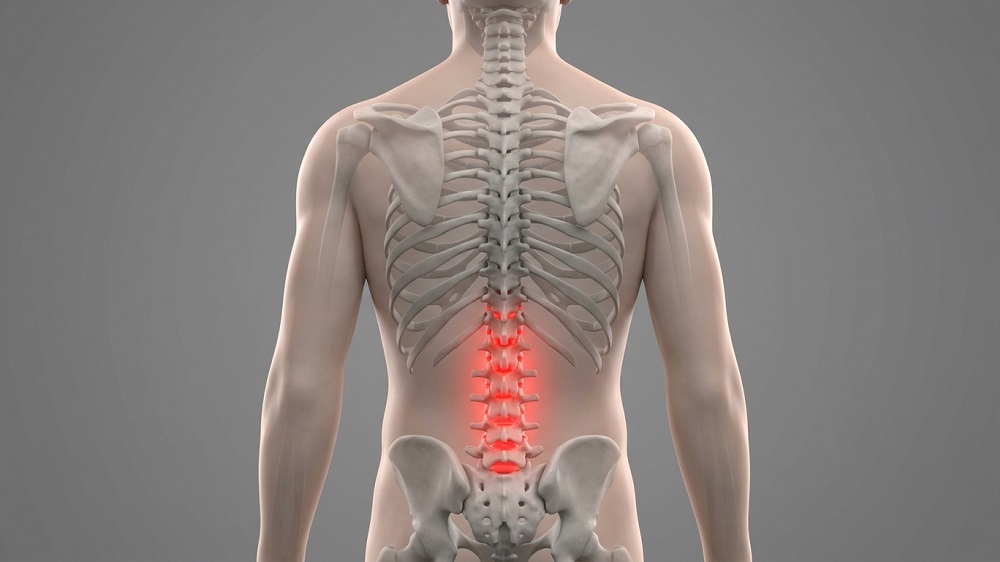
In Aging Cell, a team of researchers has described how a little-known gene, ZNF865, has a significant influence on back pain through the regulation of cellular senescence.
Lower back pain and senescence are related

The link between cellular senescence and back pain has been thoroughly documented, particularly in the context of intervertebral disc degeneration (IVDD) [1], and in both rats and people, senescence accumulates as discs deteriorate [2]. These cells and their SASP contribute to the pain both directly and indirectly, as they both inflame the area and cause the extracellular matrix to deteriorate [3]. Targeting these cells through senolytics has shown some results in animal models; giving 14- to 23-month-old mice the senolytic combination of dasatinib and quercetin was found to significantly reduce their IVDD [4].
Using CRISPR technology, this team has previously investigated ZNF865 in the context of bioengineered intervertebral disc cells, finding that it increases cartilage, maturation, and overall performance [5]. Little other work has been done on ZNF865, although one previous paper has noted that people with an ineffective version of this gene have unique problems with neurological development and other organs [6]. As this team’s previous RNA sequencing work has also linked ZNF865 to senescence [5], the researchers took another look, focusing on its effects in that context.
Little known but highly necessary
These researchers first performed another RNA sequencing analysis, using degenerative human nucleus pulposus cells (dhNPCs) along with cells derived from fat tissue and the well-known human embryonic kidney cell line HEK293. In all three cell types, ZNF865 was found to be related to cellular replication, DNA repair, mTOR, and senescence.
In dhNPCs, ZNF865 is substantially lower than in healthy human nucleus pulposus cells (hNPCs). However, in hNPCs, ZNF865 decreases with age. This was measured with samples taken from lower back pain patients and trauma patients. In mice, this was confirmed with analyses at 4, 12, and 24 months of naturally aged wild-type animals. Unsurprisingly, dhNPCs were found to have significantly more markers of DNA damage than hNPCs.
The researchers then used CRISPR technology to silence the ZNF865 gene in hNPCs. Compared to an unsilenced control group, the affected cells had roughly five times the markers of cellular senescence along with a significant increase in markers of DNA damage.
The opposite experiment was then performed: using CRISPR to boost ZNF865 in dhNPCs. The treated cells had more rapid cellular proliferation and had their markers of cellular senescence reduced nearly to those of hNPCs, including those of SASP expression and inflammation. DNA damage was also significantly reduced, and the treatment group expressed more collagen as well, suggesting benefits for the extracellular matrix.
Promising cellular and rat data
A chromatin accessibility analysis confirmed these benefits. Administering ZNF865 to dhNPCs restored their chromatin accessibility to be much more like that of hNPCs, reducing the number of differences in this area by 94% and giving them no upregulated pathways compared to hNPCs. RNA expression analysis bolstered these findings, showing that ZNF865 upregulation had given these cells a healthier overall gene expression phenotype.
The researchers then confirmed the effects of ZNF865 in living animals. Silencing its ortholog in rat NP cells using a CRISPR vector and injecting those cells directly into the rats’ vertebral discs, the team found that the animals developed signs of degenerative disc disease in less than two months, including increased pain sensitivity, along with increases in cellular senescence, SASP proteins, and genetic damage.
While these results are informative, they are limited to cells derived from a limited number of people and an experiment that demonstrated the results of depriving it from rats. The researchers note that the molecular mechanisms of ZNF865’s effectiveness are undetermined, and they lament that there are no treatments other than CRISPR that are known to directly affect ZNF865 in cells; there are no antibodies, inhibitors, or activators yet developed for it. For this research to be made into a therapy suitable for human use, a workable approach will first have to be developed and given to an animal model to demonstrate that ZNF865 can mitigate IVDD or another senescence-related disease in vivo.
Literature
[1] Wang, F., Cai, F., Shi, R., Wang, X. H., & Wu, X. T. (2016). Aging and age related stresses: a senescence mechanism of intervertebral disc degeneration. Osteoarthritis and cartilage, 24(3), 398-408.
[2] Gruber, H. E., Ingram, J. A., Norton, H. J., & Hanley Jr, E. N. (2007). Senescence in cells of the aging and degenerating intervertebral disc: Immunolocalization of senescence-associated β-galactosidase in human and sand rat discs. Spine, 32(3), 321-327.
[3] Zhang, G. Z., Liu, M. Q., Chen, H. W., Wu, Z. L., Gao, Y. C., Ma, Z. J., … & Kang, X. W. (2021). NF‐κB signalling pathways in nucleus pulposus cell function and intervertebral disc degeneration. Cell proliferation, 54(7), e13057.
[4] Novais, E. J., Tran, V. A., Johnston, S. N., Darris, K. R., Roupas, A. J., Sessions, G. A., … & Risbud, M. V. (2021). Long-term treatment with senolytic drugs Dasatinib and Quercetin ameliorates age-dependent intervertebral disc degeneration in mice. Nature communications, 12(1), 5213.
[5] Levis, H., Lewis, C., Fainor, M., Lawal, A., Stockham, E., Weston, J., … & Bowles, R. D. (2025). Targeted CRISPR regulation of ZNF865 enhances stem cell cartilage deposition, tissue maturation rates, and mechanical properties in engineered intervertebral discs. Acta biomaterialia, 191, 276-291.
[6] Bradbrook, S. M., Graham, G., Carter, M. T., Kibaek, M., Fagerberg, C., Larsen, M. J., … & Marcadier, J. (2026). De novo truncating variants in ZNF865 cause a novel neurodevelopmental disorder. American Journal of Medical Genetics Part A, 200(1), 244-252.