

Scientists have tested the delivery of a neuron-boosting molecule into mouse brains via a nasal route. The treatment reversed age-related cognitive decline and prevented Alzheimer’s symptoms [1].
On the nose
Memory depends in part on changing the strength of connections between neurons. These changes are facilitated by brain-derived neurotrophic factor (BDNF). It also supports neuronal survival and the development of immature neurons. BDNF levels tend to decline with age and are reduced in several brain regions in patients with Alzheimer’s disease. Raising BDNF has improved cognition in animal models [2], making it an attractive target for treating cognitive decline.
However, delivering BDNF into the brain is challenging, as very little of it crosses the blood-brain barrier [3]. Injecting it directly into the brain is invasive, especially for regular dosing. The nasal route is promising because of the close anatomical connection between the nasal cavity and the brain, but BDNF breaks down quickly in the nasal lining. A new study from the University of Sidney, published in Advanced Science, explores a different idea: turning nasal endothelial cells into BDNF factories by providing them with relevant RNA instructions.
The way to the brain
The researchers packed BDNF-encoding messenger RNA (mRNA) into lipid nanoparticles and injected them into the nasal cavities of mice. By labeling nanoparticles, they were able to confirm effective delivery into the nasal lining. Nanoparticles were not detected in the brain, lungs, or other peripheral organs.
The team then confirmed that at least some cells in the nasal lining used these instructions to start producing BDNF. The secreted protein also produced the expected beneficial effects on neural cells. When grown in fluid collected from BDNF-producing cells, stem and progenitor cells from adult mouse hippocampi multiplied faster and, when replated, formed more new cell clusters, suggesting improved proliferation.
After two doses, total BDNF protein levels increased in brain tissue, especially in the hippocampus. To ensure that the treatment does not simply make the animals’ brains produce more BDNF but actually delivers BDNF produced in the nasal cavity into the brain, the researchers tagged BDNF molecules that originated from mRNA instructions. After one dose, the tagged protein was strongly present in the olfactory bulb and detectable at lower levels in the hippocampus. This directly demonstrated that some of the protein in the brain did come from the nanoparticles. However, where exactly it was made is still unresolved.
Cognition at youthful levels
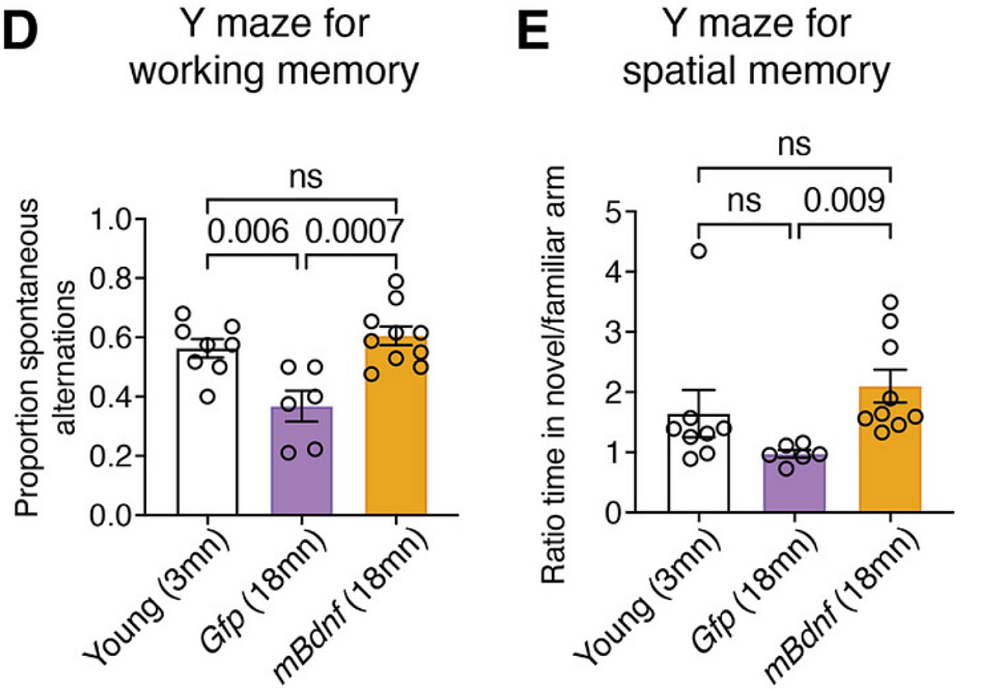
The researchers then gave BDNF mRNA to naturally aged 18-month-old mice once a week for four weeks. The team ran one different behavioral test each week, 24 hours after that week’s dose. This design’s drawback is that if the treatment’s effect accumulates, its impact would be weaker in earlier tests and stronger in later tests. On the novel object recognition, working memory, and spatial memory tests (administered at week 2, 3, and 4, respectively), the treated mice performed significantly better, on par with much younger, three-month-old controls.
“In aged mice, we saw learning and memory significantly increased, returning animal cognition to its youthful prime,” said Professor Gred Neely, the lead author. “What’s exciting is that this was achieved with a simple non-invasive nasal delivery system that builds on the same underlying mRNA-LNP technology platform many people became familiar with during the COVID-19 pandemic.”
The researchers stained hippocampal tissue for doublecortin (DCX), a protein expressed by immature neurons. After four doses, treated aged mice had 2.4 times as many DCX-positive cells per unit area as aged controls, a sign of increased neurogenesis. Those cells also had longer projections. However, both measures still fell short of youthful levels.
Stopping Alzheimer’s in its tracks
The researchers next used 5xFAD mice, which carry five mutations associated with inherited Alzheimer’s disease. These mice develop amyloid pathology by about two months of age and typically show cognitive deficits from around four months. Treatment began at two months, when brain pathology was emerging but before the expected memory deficits. Behavioral testing began after 16 doses, while the treatment continued.
BDNF-treated 5xFAD mice outperformed sham-treated 5xFAD mice on all three memory tasks, scoring similarly to healthy mice of the same age. The treatment’s timing is important as it suggests successful prevention, but the question of reversal after symptom onset remains open.
BDNF-treated mice had more immature neurons, and those had longer projections, echoing the findings in normally aged mice. However, the hippocampal amyloid plaque burden did not differ from untreated controls.
“Current Alzheimer’s treatments largely focus on clearing these amyloid plaques,” said Neely. “However, just under a third of Alzheimer’s patients have serious plaques but do not suffer from dementia, and these patients show naturally higher BDNF levels, suggesting if we raise BDNF, it’s possible to live with Alzheimer’s disease pathology.”
Literature
[1] Bergamasco, M., Scarborough, H., Ponta, A., Clark, T., Cohen, S. B., Loo, L., … & Neely, G. G. (2026). Bdnf mRNA‐LNP Drives Nasal Epithelial BDNF Production and Improves Cognition in Aged and Alzheimer’s Disease Mouse Models. Advanced Science, e78225.
[2] Nagahara, A. H., Merrill, D. A., Coppola, G., Tsukada, S., Schroeder, B. E., Shaked, G. M., … & Tuszynski, M. H. (2009). Neuroprotective effects of brain-derived neurotrophic factor in rodent and primate models of Alzheimer’s disease. Nature medicine, 15(3), 331-337.
[3] Pardridge, W. M., Kang, Y. S., & Buciak, J. L. (1994). Transport of human recombinant brain-derived neurotrophic factor (BDNF) through the rat blood− brain barrier in vivo using vector-mediated peptide drug delivery. Pharmaceutical research, 11(5), 738-746.