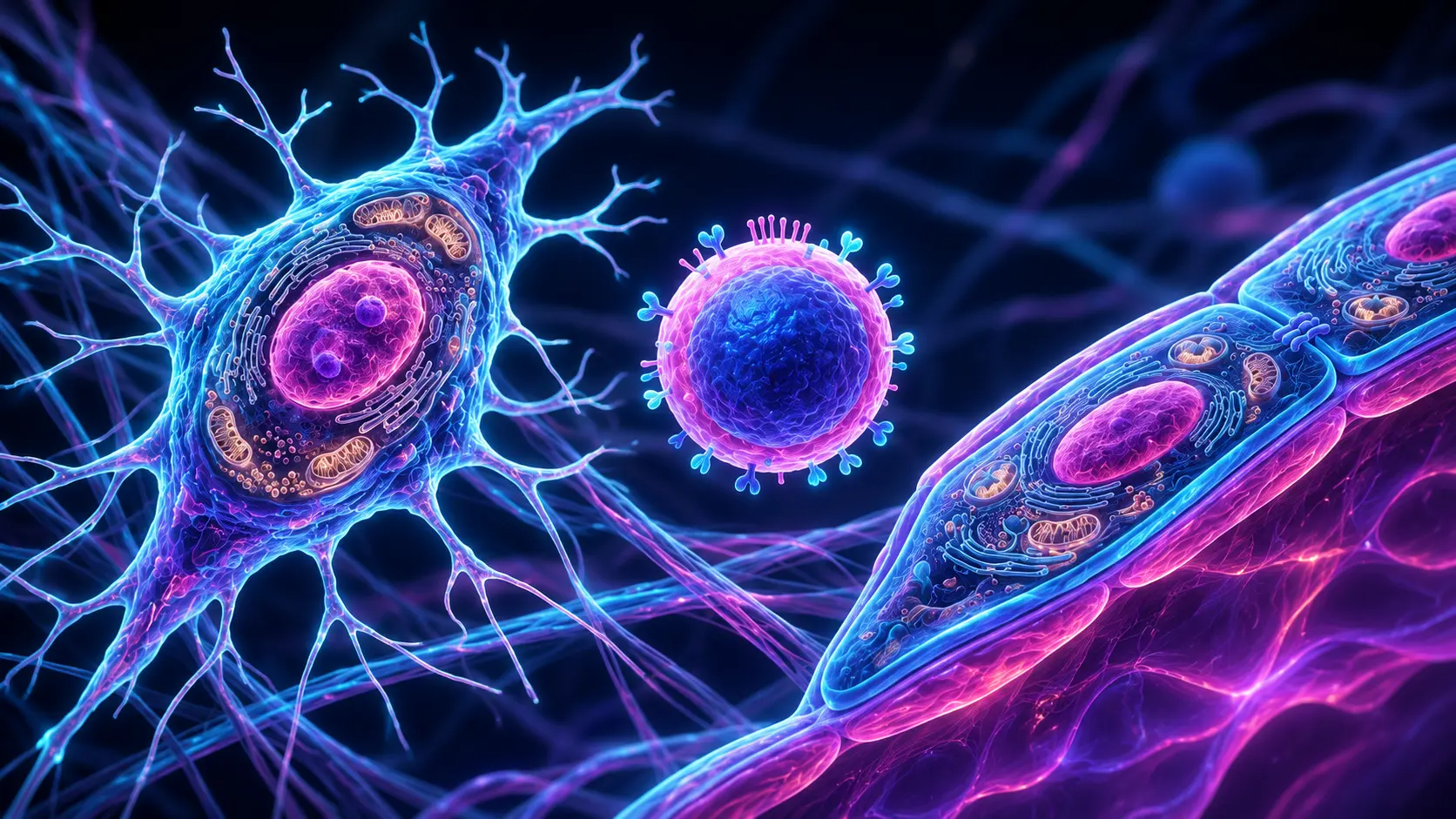


Researchers have discovered that Granzyme K, a compound predominantly emitted by older CD8+ T cells, accelerates aging in multiple organs.
Immune cells can drive aging
CD8+ T cells, cytotoxic cells that become primed to recognize and destroy threats, are particularly prone to rapid aging [1]. This leads to downstream aging in other organs and systems, and this is far from the first study to recognize that fact; previous work has found that a diminished immune response leads to senescent cell accumulation [2] and that excessive, sustained inflammatory signaling leads to inflammaging [3].

One molecule that has stood out in previous studies is Granzyme K, which is emitted by multiple immune cells but shows up most strongly in CD8+ T cells. One study referred to Granzyme K-producing cells as a “conserved hallmark of inflammaging” that induces cellular senescence [4], and other studies have found that it causes the release of inflammatory cytokines [5] and contributes to inflammation-related diseases [6]. This study built on that work by attempting to link Granzyme K to various hallmarks of aging.
Only some cells are responsible
The researchers initially investigated the presence of Granzyme K in the spleen, liver, and lungs of young and aged mice. As expected, more of this compound was found in older animals, with the source being CD8+ T cells; smaller amounts were found to be emitted by CD4+ T cells. Specifically, CD8+ memory T cells were responsible for the majority of this increase. While this team noted that previous work has found age-related increases in Granzyme K in other immune cells, they found no such increases here.
This study continued with a population of mice that do not produce Granzyme K, which were monitored throughout their lives. Interestingly, with aging, the immune system itself seemed to be unaffected in these mice compared to their wild-type counterparts; there were no differences in immunosenescence, there were no differences in how memory cell fate changes with aging, there was no difference in the shift towards M1 inflammatory macrophage polarization, and there were no differences in how hematopoietic stem cells become more biased towards producing myeloid rather than lymphoid cells with age.
The absence of Granzyme K appeared to have little effect on how the immune systems of mice conducted themselves, at any age. While older mice without Granzyme K had more CD8+ cells that were capable of infiltrating tumors, this didn’t affect actual tumor control. In total, a lack of Granzyme K had no real effect, one way or the other, on how immune cells performed or how they aged.
Not inflammaging but overall proteomics
Surprisingly, the researchers also found that, despite previous research to the contrary, Granzyme K has no statistically significant effect on the levels of inflammatory compounds in the blood. In the mouse populations that these researchers used, they found only age-related increases in MCP-1 and IL-6, and they found no significant decreases due to a lack of Granzyme K.
However, there were statistically significant differences in proteins that are unrelated to inflammaging but related to aging more generally. Compared to young mice and aged mice that do not produce Granzyme K, aged wild-type mice produce greater amounts of several proteins that are connected to age-related diseases. Among them are SOD2, which responds to oxidative stress, along with several proteins that signify cellular damage and mitochondrial dysfunction. Similarly, the aged mice that do not produce Granzyme K were found to produce more proteins associated with youthful function, such as angiopoietin-1, which inhibits senescence in mice [7].
These benefits for the proteome were accompanied by many functional benefits. In aged Granzyme K-less mice, glomerular hypertrophy, a disease of the kidneys, was substantially decreased compared to their wild-type counterparts. Kidney fibrosis was not affected by this lack of Granzyme K, but liver and heart fibrosis both were, and the age-related increase of the heart’s left ventricular wall thickness was also attenuated. While the age-related declines in kidney function and muscle size were not significantly affected, the liver and heart both received functional benefits.
While Granzyme K is not connected to every aspect of functional decline, the authors of this paper have made it clear that it appears to be very detrimental for aged organisms. Using publicly available datasets, they have confirmed that it is present in fibrotic human diseases as well. Their research has led them to conclude that “acquisition of the GzmK+ phenotype requires the integration of antigen-driven differentiation with inflammatory cues provided by the aged tissue microenvironment”, suggesting a bidirectional relationship in which such aged tissue ultimately worsens tissue aging. They hold that targeting Granzyme K is a “compelling therapeutic avenue” that could be used to extend healthspan.
Literature
[1] Quinn, K. M., Fox, A., Harland, K. L., Russ, B. E., Li, J., Nguyen, T. H., … & La Gruta, N. L. (2018). Age-related decline in primary CD8+ T cell responses is associated with the development of senescence in virtual memory CD8+ T cells. Cell reports, 23(12), 3512-3524.
[2] Ovadya, Y., Landsberger, T., Leins, H., Vadai, E., Gal, H., Biran, A., … & Krizhanovsky, V. (2018). Impaired immune surveillance accelerates accumulation of senescent cells and aging. Nature communications, 9(1), 5435.
[3] Desdín-Micó, G., Soto-Heredero, G., Aranda, J. F., Oller, J., Carrasco, E., Gabandé-Rodríguez, E., … & Mittelbrunn, M. (2020). T cells with dysfunctional mitochondria induce multimorbidity and premature senescence. Science, 368(6497), 1371-1376.
[4] Mogilenko, D. A., Shpynov, O., Andhey, P. S., Arthur, L., Swain, A., Esaulova, E., … & Artyomov, M. N. (2021). Comprehensive profiling of an aging immune system reveals clonal GZMK+ CD8+ T cells as conserved hallmark of inflammaging. Immunity, 54(1), 99-115.
[5] Kaiserman, D., Zhao, P., Rowe, C. L., Leong, A., Barlow, N., Joeckel, L. T., … & Bird, P. I. (2022). Granzyme K initiates IL-6 and IL-8 release from epithelial cells by activating protease-activated receptor 2. PloS one, 17(7), e0270584.
[6] Xin, C., Liu, P., Zhan, Q., & Cao, W. (2025). Gzmk+ CD8 T cells in inflammatory diseases. Frontiers in Immunology, 16, 1661755.
[7] Yang, M., Zhang, M., Chen, J., Mukherjee, R., Zhang, L., Lin, S., & Gu, Y. (2010). Angiopoietin-1 inhibits mouse glomerular endothelial cell senescence via Tie2 receptor-modulated ERK1/2 signaling. American Journal of Nephrology, 31(6), 490-500.