
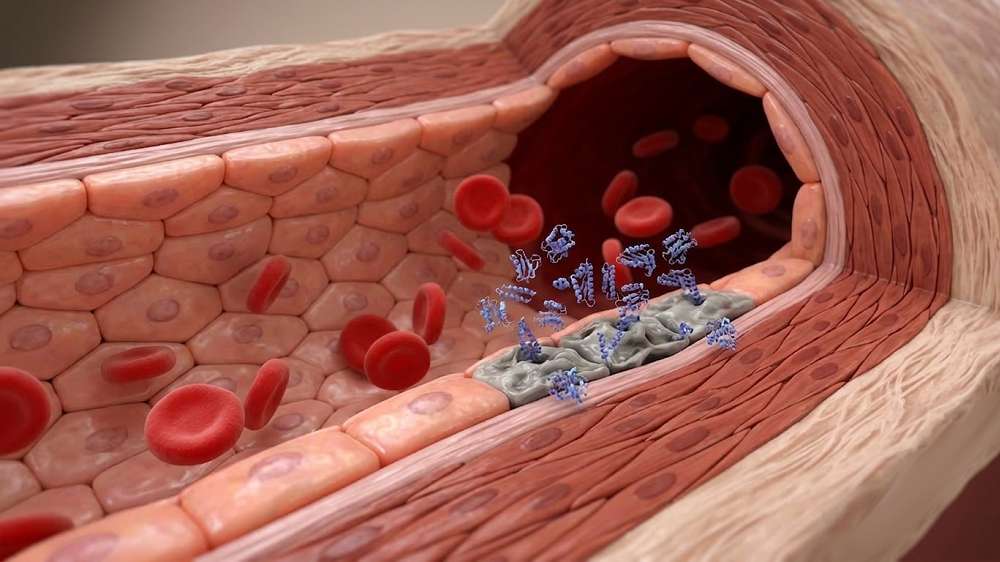
Researchers have created a deep learning-based biomarker, SASP Score, that evaluates the combined effects of the senescence-associated secretory phenotype (SASP) circulating in the bloodstream.
Measuring an overall burden

Gathering the data needed to evaluate a person’s circulating SASP is as simple as taking a blood draw. However, as bloodstream SASP is a combination of many different proteins secreted by many types of senescent cells located throughout the body, and as these proteins have nonlinear relationships to each other along with various aspects of health [1], measuring the entirety of the SASP as a single, combined biomarker that has any predictive utility is not an easy task.
This led the researchers to employ a deep learning algorithm to analyze this complex data, calling it SASP Score. They hold that their algorithm solves two key problems in SASP analysis: it accounts for these nonlinear relationships, and it can be used across multiple data-gathering platforms without the need for additional data transformation. This algorithm is based on Guided AutoEncoder with Transformer (GAET) architecture, which is particularly useful in determining nonlinear relationships and has been previously used in aging clock development [2].
To develop it, they used data from the well-used UK Biobank, specifically the UK Biobank Pharma Proteomics Project (UKB-PPP). Out of 54,219 participants, the team used data from 50,997. Only three proteins were discarded before initial analysis, as they were not present in most samples. After evaluating the literature, the researchers chose a total of 38 proteins with which to build their biomarker. Many of these selections, such as the CCL family, the CXCL family, and the IL family of inflammatory factors, are well-known as being related to senescence in a large variety of cells. The researchers randomly selected 85% of this data to use for development, reserving the other 15% for validation.
Not a complete aging clock
This paper’s authors note that in developing SASP Score, they used chronological age only to guide model development; chronological age is not part of SASP Score evaluations. They are also careful to say that, as it only measures cellular senescence, it is not a general biological aging clock and is not meant to be used as one. However, it was found to be closely correlated with chronological age when used with UK Biobank data, to roughly the same degree as PhenoAge, BioAge, and proteomic clocks measuring age and healthspan. Unsurprisingly, higher SASP Scores are correlated with markers of functional loss as well, including a composite frailty index, high blood pressure, a decline in lung and heart fitness, slower walking, and reduced grip strength.
A higher SASP Score is also correlated with a significantly greater risk of death and age-related disease after controlling for other health-related factors, including chronological age, smoking, drinking, blood pressure, and BMI. People with high SASP Scores were found to be roughly 1.4 times as likely to die for any reason as people with low SASP Scores. While some cancers were found to be not significantly correlated, or even inversely correlated, with a high SASP Score, conditions such as dementia, stroke, and particularly chronic kidney disease are all much more likely to be present alongside an increase in total SASP Score. SASP Score was found to have stronger predictive power in this regard than evaluations of any particular protein.
Exercise may put the brakes on SASP increase
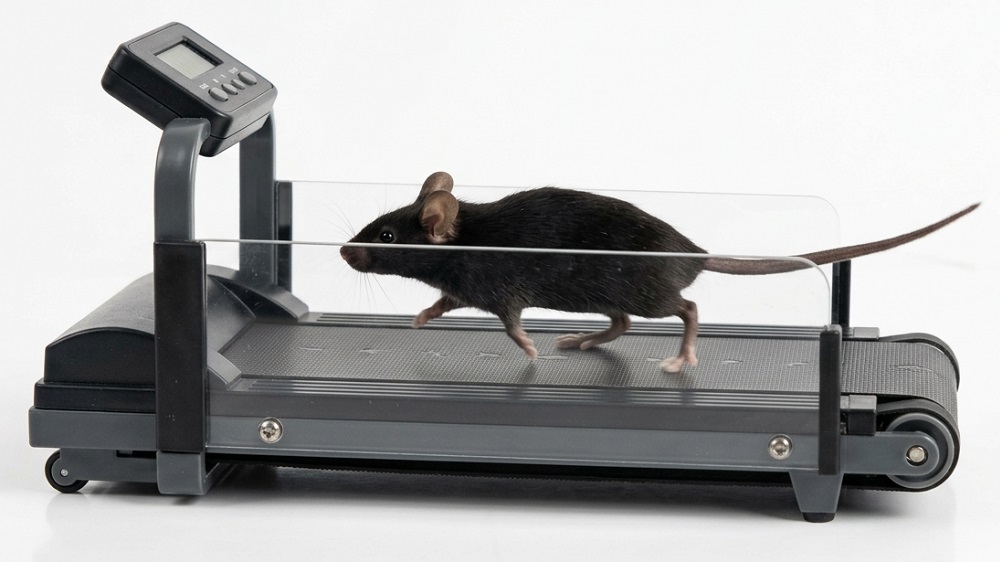
For further validation, the team used SASP Score on a different data set, this one derived from the MEDEX study, which was developed to gauge the effects of exercise. Because that study recruited healthy older people without specific age-related diseases, a higher SASP Score was not correlated as strongly with chronological age in MEDEX data. In the non-exercise group, the average SASP Score was found to significantly increase over the 18 months of that study. However, the scores of people who engaged in regular exercise for those 18 months were largely flat, suggesting a protective effect.
The creators of SASP Score note that as a blood-based marker, it is systemic and general in nature, and they intentionally chose SASP proteins that are common between highly heterogenous senescent cells. While a consistently elevated SASP Score is statistically likely to signify the presence of potentially deadly long-term conditions, it cannot be used to determine which of those conditions it is. This metric is intended to be used alongside biological aging clocks as a supplementary measurement, as it contains useful information about overall senescent cell burden and can be used to quickly estimate the effectiveness of lifestyle and pharmacological interventions.
Literature
[1] Fafián-Labora, J. A., & O’Loghlen, A. (2020). Classical and nonclassical intercellular communication in senescence and ageing. Trends in cell biology, 30(8), 628-639.
[2] Sayed, N., Huang, Y., Nguyen, K., Krejciova-Rajaniemi, Z., Grawe, A. P., Gao, T., … & Furman, D. (2021). An inflammatory aging clock (iAge) based on deep learning tracks multimorbidity, immunosenescence, frailty and cardiovascular aging. Nature aging, 1(7), 598-615.