


A new study that tracked over 1500 people who were at least 65 years old, and that lasted for almost 30 years, suggests that experiencing chronic loneliness increases the risk of developing dementia by 38%. The researchers didn’t observe this association among participants who reported only occasional loneliness [1].
A global health threat
Social connection is an important, and often underrated, component of living a healthy, long life. Previous studies have linked social isolation and loneliness to adverse health outcomes, including cardiovascular disease and mental health problems [2, 3]. We have also previously reported a study indicating that social isolation is associated with more rapid aging. According to some studies, experiencing loneliness has similar consequences in terms of mortality as smoking 15 cigarettes a day, excessive alcohol use, and physical inactivity. [4] The impact of loneliness on public health is increasing. The World Health Organization (WHO) refers to this problem as a ‘loneliness epidemic ’ and a ‘global health threat’.
One of the aging-related health problems linked to loneliness is dementia [5]. With the aging population, dementia is becoming a serious health issue worldwide. It is estimated that by 2050, approximately 150 million people will have dementia, making it urgent to identify modifiable factors that can delay or prevent the onset of the disease. Social connection is emerging as one of such modifiable lifestyle factors.
Chronic or occasional
In this study, the researchers assessed the participants’ loneliness at baseline and after 3, 5, and 8 years. At each visit, participants answered: “Have you felt lonely in the past week: never, occasionally (one-two days), fairly often (three-five days), frequently/all the time?”
The last loneliness assessment also served as the baseline assessment for dementia. To be included in the analysis, participants in this study had to be free of dementia at that time point. Then, the researchers followed them for 20 years to assess whether they would develop dementia.
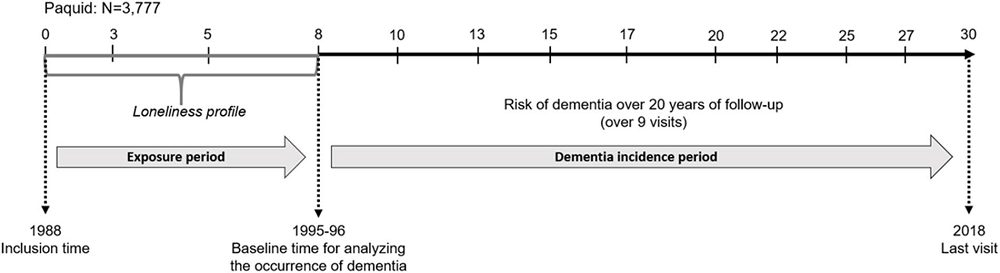
The goal of looking at how participants felt at different time points was to distinguish between occasional and chronic loneliness, since loneliness can fluctuate over time, but previous studies mostly assess it at a single time point and do not distinguish between occasional and chronic loneliness.
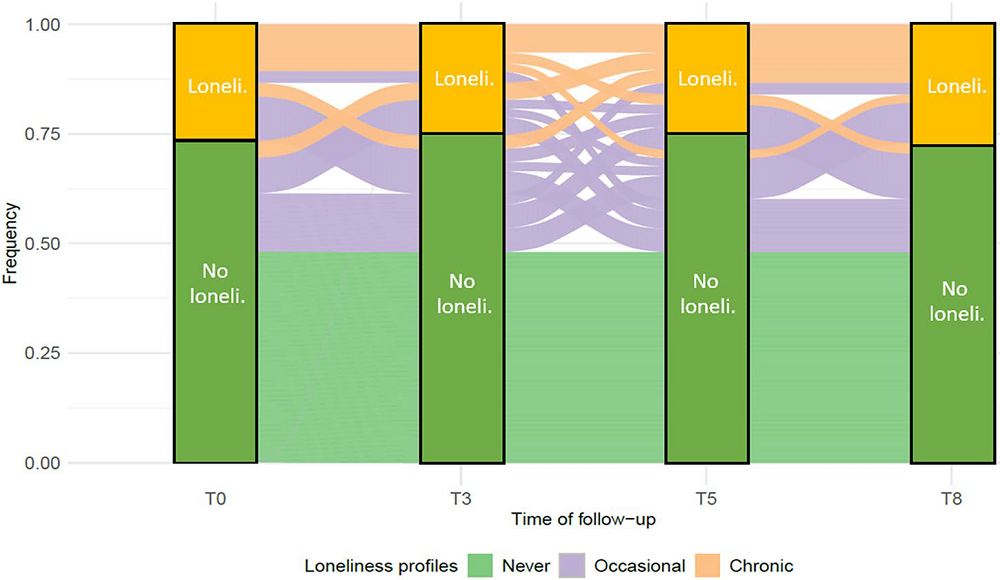
Based on the participants’ answers, the researchers distinguished between three groups. The first group consisted of participants who never reported loneliness (never lonely). The second group reported loneliness once or twice (occasional loneliness). The third group reported loneliness three or four times and was labeled as the chronic loneliness group.
Among the study participants, almost half have never reported feeling lonely, around one-third experienced occasional loneliness, and 17% reported chronic loneliness. This diagram represents how loneliness fluctuated among the participants over time.
The participants who experienced loneliness, compared to those who never experienced it, were more likely to be older, female, have lower education, be widowed, live alone, and have poorer health.
Higher dementia risk
560 participants developed dementia during the follow-up period; however, the incidence of dementia differed between the groups, with 33.1% of participants developing dementia in the never-lonely group, but 49.1% in the chronic loneliness group.

Statistical analysis indicated that there was a higher dementia risk in people who experienced chronic loneliness compared to the never-lonely group. A sensitivity analysis with more restrictive criteria suggested the same. There was no association between experiencing occasional loneliness and dementia risk after controlling for many confounding factors.
“This distinction is critical,” said co-author Karine Pérès, a Senior Researcher at the Bordeaux Population Health Centre. “While most people experience loneliness at some point in their lives, it is when loneliness becomes chronic and persistent that it may increase the risk of developing dementia.”
The probability of death did not differ between the groups.
Loneliness versus social isolation
The findings of this study agree with previous research, which suggests that chronic loneliness can be an independent risk factor for dementia [6] and that “not all forms of loneliness carry the same risk” [7]. While this study does not investigate the underlying neurobiological mechanisms linking loneliness and dementia, the authors discuss previous findings on this topic.
“The previous research suggests several mechanisms through which persistent loneliness may accelerate cognitive decline,” added Karine. “Chronic loneliness triggers sustained inflammation through prolonged activation of stress and immune pathways. It’s also associated with physical inactivity and poor diet, contributing to cardiovascular disease and diabetes—both dementia risk factors. Additionally, lack of social interactions limits cognitive stimulation, while unresolved social stress leads to an accumulation of biological wear and tear over time.”
The authors also point to an important distinction between two states: objective social isolation and perceived loneliness. Loneliness is defined as “the response to a perceived discrepancy between an individual’s desired and experienced social relation” [8], while social isolation is “an objective lack of social connections” [9].
Some studies suggest that the subjective feeling of loneliness, rather than the measurable number of social contacts, has a stronger association with adverse health outcomes and dementia [10]. This distinction is important when researching the impact of social connection on aging and age-related diseases. Social connection appears to have a positive impact, but only when it is desired, satisfying, and reciprocal [11]; being in company but still feeling lonely, such as in an unsatisfying relationship, can negatively affect cognition.
“It shows this vulnerability may also stem from unsatisfying relationships, caregiving burdens, or lack of meaningful activities,” explained lead author Yvanna Simon. “Healthcare professionals, social workers, and policymakers should not exclusively focus on living arrangements as a proxy for social risk, but should also incorporate subjective experiences of connection and loneliness.”
The paper concludes with a call to action: “As some situations of loneliness are a potentially preventable or reversible condition, it may represent critical an actionable target for interventions aimed at promoting healthy cognitive aging, preserving autonomy, and improving quality of life in later adulthood.”
Literature
[1] Simon, Y., Sendra, M., Faidherbe, V., Amieva, H., Dartigues, J. F., Ouvrard, C., & Pérès, K. (2026). Loneliness exposure groups and 20-year dementia risk: a longitudinal population-based study. Aging & mental health, 1–12. Advance online publication.
[2] Leigh-Hunt, N., Bagguley, D., Bash, K., Turner, V., Turnbull, S., Valtorta, N., & Caan, W. (2017). An overview of systematic reviews on the public health consequences of social isolation and loneliness. Public health, 152, 157–171.
[3] Dahlberg, L., McKee, K. J., Frank, A., & Naseer, M. (2022). A systematic review of longitudinal risk factors for loneliness in older adults. Aging & mental health, 26(2), 225–249.
[4] Holt-Lunstad, J., Smith, T. B., Baker, M., Harris, T., & Stephenson, D. (2015). Loneliness and social isolation as risk factors for mortality: a meta-analytic review. Perspectives on psychological science : a journal of the Association for Psychological Science, 10(2), 227–237.
[5] Luchetti, M., Aschwanden, D., Sesker, A. A., Zhu, X., O’Súilleabháin, P. S., Stephan, Y., Terracciano, A., & Sutin, A. R. (2024). A Meta-analysis of Loneliness and Risk of Dementia using Longitudinal Data from >600,000 Individuals. Nature. Mental health, 2(11), 1350–1361.
[6] Akhter-Khan, S. C., Tao, Q., Ang, T. F. A., Itchapurapu, I. S., Alosco, M. L., Mez, J., Piers, R. J., Steffens, D. C., Au, R., & Qiu, W. Q. (2021). Associations of loneliness with risk of Alzheimer’s disease dementia in the Framingham Heart Study. Alzheimer’s & dementia : the journal of the Alzheimer’s Association, 17(10), 1619–1627.
[7] Wnuk, H. K., Van Orden, K. A., & Wang, K. H. (2025). Bridging social isolation, loneliness, and brain aging: A narrative review of mechanisms and translational interventions. Neuroscience and biobehavioral reviews, 179, 106451.
[8] Perlman, D., & Peplau, L. A. (1981). Toward a social psychology of loneliness. In R. Gilmour & S. Duck (Eds.), Personal relationships 3: Relationships in disorder (pp. 31–56). Academic Press.
[9] Gerlach, L. B., Solway, E. S., & Malani, P. N. (2024). Social Isolation and Loneliness in Older Adults. JAMA, 331(23), 2058.
[10] Guarnera, J., Yuen, E., & Macpherson, H. (2023). The Impact of Loneliness and Social Isolation on Cognitive Aging: A Narrative Review. Journal of Alzheimer’s disease reports, 7(1), 699–714.
[11] Khondoker, M., Rafnsson, S. B., Morris, S., Orrell, M., & Steptoe, A. (2017). Positive and Negative Experiences of Social Support and Risk of Dementia in Later Life: An Investigation Using the English Longitudinal Study of Ageing. Journal of Alzheimer’s disease : JAD, 58(1), 99–108.