
After a review of substantial literature, scientists publishing in Aging Cell have concluded that poor sleep quality and inflammaging worsen each other in a vicious cycle, reducing quality of life and fueling other age-related diseases.
More than a peripheral link
This review begins with a brief discussion of inflammaging, including the seminal paper by Franceschi et al. that addressed the subject [1]. The reviewers describe inflammaging as an immune-metabolic disorder, noting its well-known contributions to other diseases.
The authors include various types of sleep disruption in this review. One of the most well-known is obstructive sleep apnea (OSA), which is defined as a failure to breathe during sleep. Insomnia, abnormal sleep durations, problems with circadian rhythms, and poor self-reported sleep quality, such as having problems with staying awake during the day, are also noted.
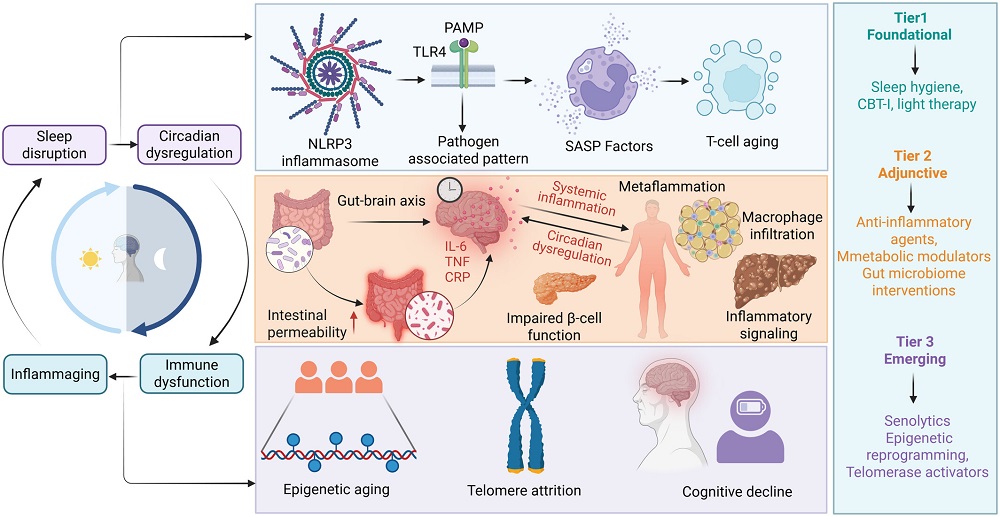
Previous work has strongly linked stress and brain disorders to systemic inflammation. One paper linked inflammaging to an overall energy shortage [2], and another noted the contribution of brain macrophages to inflammaging [3]. However, despite multiple papers linking circadian rhythm disruption to inflammaging and senescence [4, 5], these reviewers note that existing models “largely treat sleep and circadian disruption as downstream consequences or peripheral contributors” rather than core aspects of inflammaging. In contrast, they hold that there is a “sleep-immune-inflammaging axis” that links sleep disruption to systemic inflammation through identifiable biochemical interactions.
A master regulator goes awry
The reviewers point to research showing that sleep is biologically hierarchical [6], being regulated by a pacemaker located in the suprachiasmatic nucleus in the brain and governed by the production of melatonin, which decreases with age [7]. The immune system also has its own clocks, which are synchronized to the core circadian clock through multiple methods, such as leukocyte activities [8]. However, with aging, this leukocyte traffic is disrupted, leading to circadian rhythm dysregulation and subsequent immune dysregulation [9]. The researchers hypothesize that an extended period of poor sleep may lead to lifelong problems with the immune system, as it has been retrained to function under such conditions [10].
Mouse and human studies have bolstered these reviewers’ argument. In people, poor sleep has been found to directly boost levels of the inflammatory receptor TLR4 [11], and single-cell analysis has found its link to immune disruption [12]. Studies have found that people with OSA are more likely to suffer from systemic inflammation [13]. Even in young mice, insufficient sleep leads to senescence and inflammation [14]. Mouse studies have also found evidence in the other direction: increased TNFα is sufficient to cause young mice to exhibit the same disordered sleep patterns as old mice [15].
Additional factors
The gut-brain axis also appears to play a significant role. The gut flora are also affected by systemic clock signals, and disrupting these signals leads to gut dysbiosis [16] and subsequent immune issues, as the intestinal barrier becomes disrupted [1]. The glymphatic clearance system is responsible for migrating potentially dangerous aggregates, such as amyloid beta and tau, along with inflammatory cytokines, away from the brain. It is also impacted by poor sleep [17].
While this comprehensive review contains a substantial amount of high-quality evidence connecting poor sleep to systemic inflammaging and inflammatory conditions, the authors note that this evidence is associative in nature and that there have not been randomized controlled trials to properly evaluate the effects of good sleep. They believe that such trials should be conducted on adults between 50 and 75 years old; utilize sleep-promoting interventions such as OSA treatment, circadian reinforcement, and insomnia therapies; use established biomarkers of aging; and have long-term follow-up periods of 2 to 5 years in order to ascertain the true effects of sleep on inflammaging and vice versa.

Literature
[1] Franceschi, C., Garagnani, P., Parini, P., Giuliani, C., & Santoro, A. (2018). Inflammaging: a new immune–metabolic viewpoint for age-related diseases. Nature Reviews Endocrinology, 14(10), 576-590.
[2] Straub, R. H. (2017). The brain and immune system prompt energy shortage in chronic inflammation and ageing. Nature Reviews Rheumatology, 13(12), 743-751.
[3] Gonzalez-Hurtado, E., Leveau, C., Li, K., Mishra, M., Qu, R., Goldberg, E. L., … & Dixit, V. D. (2025). Nerve-associated macrophages control adipose homeostasis across lifespan and restrain age-related inflammation. Nature Aging, 5(9), 1828-1843.
[4] Irwin, M. R., & Opp, M. R. (2017). Sleep health: reciprocal regulation of sleep and innate immunity. Neuropsychopharmacology, 42(1), 129-155.
[5] Nie, T., Nepovimova, E., & Wu, Q. (2025). Circadian rhythm, hypoxia, and cellular senescence: From molecular mechanisms to targeted strategies. European Journal of Pharmacology, 990, 177290.
[6] Acuña-Castroviejo, D., Rahim, I., Acuña-Fernández, C., Fernández-Ortiz, M., Solera-Marín, J., Sayed, R. K., … & Escames, G. (2017). Melatonin, clock genes and mitochondria in sepsis. Cellular and molecular life sciences, 74(21), 3965-3987.
[7] Bocheva, G., Bakalov, D., Iliev, P., & Tafradjiiska-Hadjiolova, R. (2024). The vital role of melatonin and its metabolites in the neuroprotection and retardation of brain aging. International journal of molecular sciences, 25(10), 5122.
[8] Esquifino, A. I., Cano, P., Jiménez-Ortega, V., Fernández-Mateos, P., & Cardinali, D. P. (2007). Neuroendocrine-immune correlates of circadian physiology: studies in experimental models of arthritis, ethanol feeding, aging, social isolation, and calorie restriction. Endocrine, 32(1), 1-19.
[9] Nathan, P., Gibbs, J. E., Rainger, G. E., & Chimen, M. (2021). Changes in circadian rhythms dysregulate inflammation in ageing: focus on leukocyte trafficking. Frontiers in immunology, 12, 673405.
[10] Netea, M. G., Joosten, L. A., Latz, E., Mills, K. H., Natoli, G., Stunnenberg, H. G., … & Xavier, R. J. (2016). Trained immunity: a program of innate immune memory in health and disease. Science, 352(6284), aaf1098.
[11] Carroll, J. E., Carrillo, C., Olmstead, R., Witarama, T., Breen, E. C., Yokomizo, M., … & Irwin, M. R. (2015). Sleep deprivation and divergent toll-like receptor-4 activation of cellular inflammation in aging. Sleep, 38(2), 205-211.
[12] Liu, X., Chen, B., Huang, Z., Duan, R., Li, H., Xie, L., … & Su, W. (2021). Effects of poor sleep on the immune cell landscape as assessed by single-cell analysis. Communications biology, 4(1), 1325.
[13] Thompson, C., Legault, J., Moullec, G., Baltzan, M., Cross, N., Dang-Vu, T. T., … & Gosselin, N. (2022). A portrait of obstructive sleep apnea risk factors in 27,210 middle-aged and older adults in the Canadian Longitudinal Study on Aging. Scientific Reports, 12(1), 5127.
[14] Avilez-Avilez, J. J., García-Aviles, J. E., Ramírez-Carreto, R. J., Salas-Venegas, V., Guzmán-Ruiz, M. A., Medina-Flores, F., … & Gómez-González, B. (2025). Progressive Blood–Brain Barrier Disruption in Sleep-Restricted Young Mice: Cellular Senescence and Neuroinflammation Crosstalk. Neurochemical Research, 50(5), 269.
[15] Kostin, A., Alam, M. A., Saevskiy, A., & Alam, M. N. (2024). Chronic astrocytic TNFα production in the preoptic-basal forebrain causes aging-like sleep–wake disturbances in young mice. Cells, 13(11), 894.
[16] Müller, L., & Di Benedetto, S. (2025). Immunosenescence and inflammaging: Mechanisms and modulation through diet and lifestyle. Frontiers in Immunology, 16, 1708280.
[17] Xiong, Y., Yu, Q., Zhi, H., Peng, H., Xie, M., Li, R., … & Sun, P. (2024). Advances in the study of the glymphatic system and aging. CNS Neuroscience & Therapeutics, 30(6), e14803.