

A new study associated with Immorta Bio suggests that combining a senolytic vaccine with mesenchymal stem cells might create a synergistic impact. However, the findings rest on acute, artificially induced injury models rather than natural aging [1].
Clearing out senescent cells to help stem cells work
Mesenchymal stem cell (MSC) therapies have largely underperformed in the clinic. MSCs are connective-tissue stem cells that help mostly not by becoming new tissue but by secreting repair-promoting factors. Despite strong preclinical promise, clinical MSC trials in fibrosis, inflammation, and organ failure have shown only modest benefits [2].
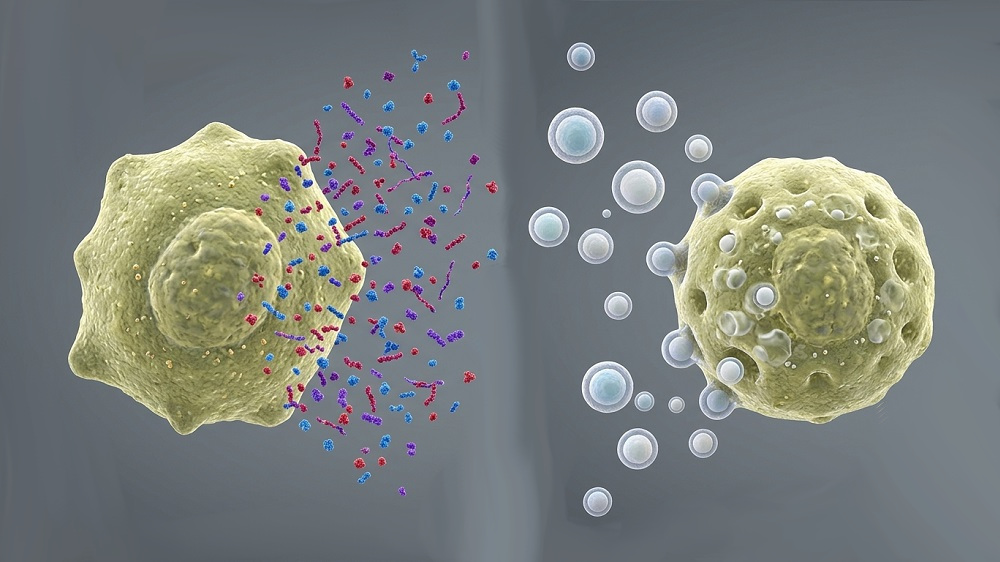
One of the reasons may be an unwelcoming environment full of senescent cells, which secrete a mix of inflammatory and tissue-degrading molecules called the senescence-associated secretory phenotype (SASP). Prior work suggests that SASP factors actively suppress stem cell proliferation, differentiation, and survival [3]. In a new study published in the Journal of Translational Medicine and associated with the biotech startup Immorta Bio, the authors suggest a solution: combining MSCs generated from pluripotent stem cells with the company’s proprietary senolytic agent SenoVax.
As evident from its name, SenoVax is a “senolytic vaccine” that primes the immune system against the body’s own senescent cells. Notably, Immorta describes SenoVax in two different ways. In its patent, IND, and press materials, SenoVax is presented as an autologous, personalized cellular immunotherapy: the patient’s own cells are taken via biopsy and driven into accelerated senescence, then used as an antigen source to pulse the patient’s dendritic cells generated ex vivo. The dendritic cells are then reinfused and prime T cells. This is a personalized, work-intensive, and expensive procedure. In the study, however, SenoVax is described as a simpler peptide-based vaccine: peptides derived from senescence-associated proteins and injected subcutaneously along with an immune-triggering adjuvant in the hope that resident dendritic cells will “learn the lesson” in vivo.
The combination wins every time
The researchers tested the combination in two mouse models of senescence-driven damage, asking whether the combination beats either therapy alone on inflammation, regeneration, organ function, physical performance, and survival. One model involved injecting carbon tetrachloride (CCl₄), a liver toxin, to emulate chronic liver injury and senescence-associated inflammation. The other one was based on injecting low-dose doxorubicin, a chemotherapy drug that drives cells into senescence. In each model, induced mice were split into four arms: untreated control, SenoVax alone, MSCs alone, or the combination.
The team then measured four inflammatory/SASP markers – IL-11, IL-23, IL-6, and YKL-40 – in the liver injury model. All four fell below the injured baseline in every treated arm, and the combination lowered each one the most, suggesting that both agents dampen SASP signaling and that combining them produces the largest effect. Importantly, these factors are less senescence-specific than p16, p21, or SA-β-gal, so the senolytic mechanism is rather inferred than shown. Conversely, the regeneration markers Klotho, FGF-2, VEGF, and GDF-11 rose above the injured baseline, while the liver-damage enzymes AST and ALT fell; both of these shifts pointed toward improvement. In each case, the combination moved furthest, supporting the idea that clearing SASP takes the brakes off regeneration.
To show the pattern isn’t specific to chemical liver injury, the researchers then repeated the SASP and the regenerative markers panels in the doxorubicin-induced “accelerated aging” model. The results were similar: most positive with the combination.
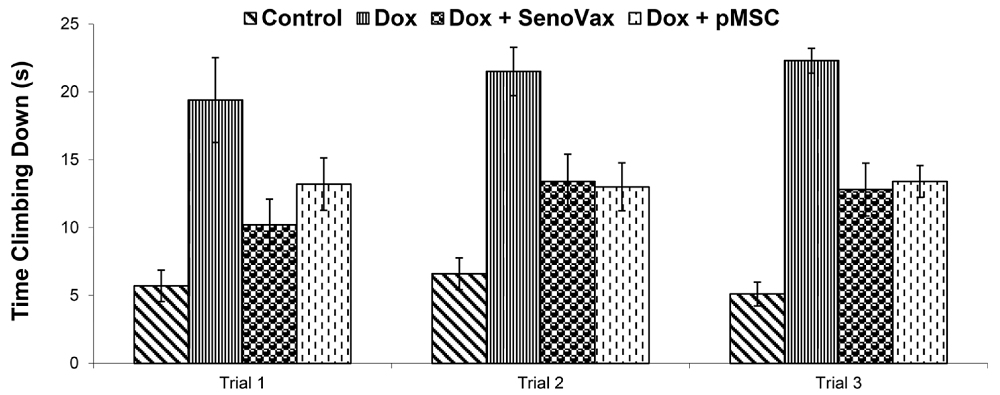
To test physical function in the “accelerated aging” model, the team used the “T-climbing” test, which times how long a mouse takes to climb down a vertical pole – a standard motor-coordination and strength assay. The combination improved climbing performance by roughly 65%. However, this claim, made in the Discussion session, is not supported by the correspondent figure, which only contains bars for single interventions, not for the combination. Numbers for monotherapies do not appear in the paper.
Large lifespan effects – but short lifespans
In the capstone experiment, which tested survival, mice received doxorubicin until death or a humane endpoint. The combination again gave the best results: about 50% of the animals were alive at Day 35 and 20% at Day 40, versus complete mortality by Day 30 in untreated doxorubicin controls. Monotherapies extended median survival only modestly, to about Day 35.
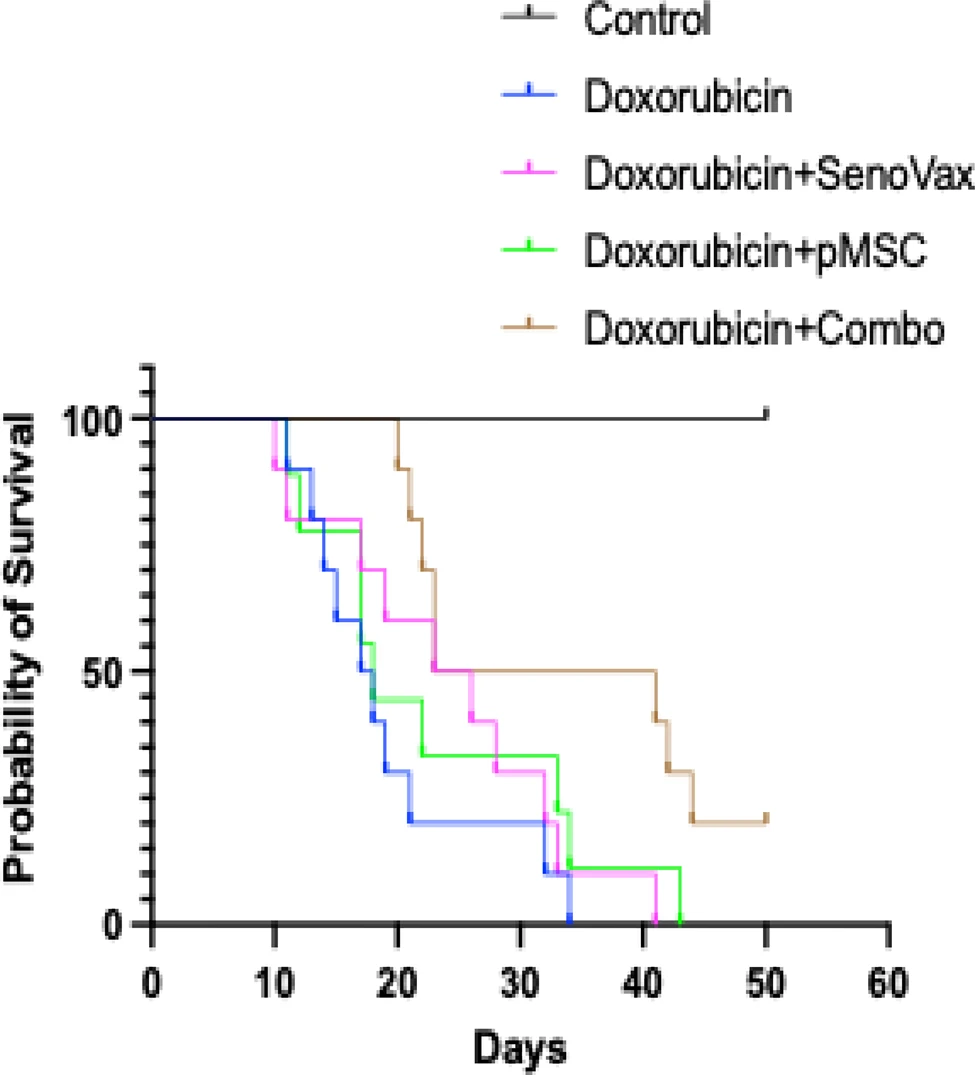
While the accompanying press release touts a 73% increase in mean survival and ~84% extension of median lifespan compared with untreated controls in validated murine aging models, the extremely short lifespan puts it more into the “acute toxin-related damage” territory, as opposed to accelerated aging, much less natural aging.
Despite the several drawbacks and quirks, the study lends certain support to the intriguing concept behind Immorta Bio: using senolytics to create an auspicious niche for MSCs to work their magic. Hopefully, the company will keep developing this concept further.
Literature
[1] Ichim, T. E., Markov, N., Lopes, G., Pascual, K. A., Evans, A., Reznik, R., … & Reznik, B. N. (2026). Synergistic senolytic–regenerative therapy significantly extends healthspan and lifespan Journal of Translational Medicine, 24(1), 745.
[2] Levy, O., Kuai, R., Siren, E. M., Bhere, D., Milton, Y., Nissar, N., … & Karp, J. M. (2020). Shattering barriers toward clinically meaningful MSC therapies. Science advances, 6(30), eaba6884.
[3] Moiseeva, V., Cisneros, A., Sica, V., Deryagin, O., Lai, Y., Jung, S., … & Muñoz-Cánoves, P. (2023). Senescence atlas reveals an aged-like inflamed niche that blunts muscle regeneration. Nature, 613(7942), 169-178.