
A team of researchers has written a paper with a surprising finding: that many of the benefits of caloric restriction and increased NAD+ may be due to their effects on the cilia of hypothalamic neurons.
Neuronal cilia have a relationship to overall health

To interact with their environment and maintain internal balance, many cells, including hypothalamic neurons, have primary cilia on their external surfaces [1]. Genetic disorders that lead to diabetes and other metabolic issues include ciliary dysfunction among their symptoms, and this dysfunction appears to play a causative role [2]. Impairing ciliary function in adult mice leads to similar metabolic disorders [3].
As cilia and the maintenance process of autophagy are connected [4], and long-lived neurons require functional autophagy to stay alive [5], ciliary health in these cells is critical. Unfortunately, the cilia of neurons shorten with age [6]. This research focuses on the previously undocumented relationship of cilia to NAD+, which has been linked to autophagy through its connection to SIRT1 [7].
SIRT1, NAD+, and cilia
This paper’s first finding was unsurprising: both cilia length and NAD+ decline in the hypothalamus between 3 and 24 months of age in mice. A further experiment found that there is a causative effect, as culturing hypothalamic neurons in vitro and depleting NAD+ from them using FK866 significantly shortened the length of these cells’ cilia, although it did not affect the generation of cilia. Increasing NAD+ in hypothalamic neurons in vitro directly through its precursors lengthened cilia, and suppressing the NAD+ consumer CD38 was even more effective in this. Further experiments found that this affects retinal pigment epithelial cells, and experiments with depleting and repleting NAD+ in 3-month-old mice confirmed its causative relationship to ciliary length in hypothalamic neurons in vivo.
The researchers then looked into the impact of SIRT1. Overexpressing normal SIRT1 in hypothalamic neurons had similar effects to suppressing CD38 in terms of lengthening cilia, and suppressing SIRT1 significantly decreased the effects of increased NAD+. This was found to be due to a specific deacetylase in SIRT1; abnormal SIRT1 that lacked this deacetylase had no effect, and suppressing SIRT1 deacetylase activity also neutralized the effects of increasing NAD+.
An RNA analysis provided more information about these effects. Upregulating SIRT1 also upregulated several genes that are related to ciliary length, and increasing NAD+ through NMN upregulated a few of these genes as well. Roughly a decade ago, this team found that leptin increases RFX1, which is linked to ciliary growth; in this study, the team found that SIRT1 increases the effectiveness on RFX1 through deacetylation. The team also found a connection to autophagy; knocking down a key autophagy-related gene blunted the effects of SIRT1 on ciliary length.
A core causative role
The researchers found that the cilia play a fundamental, causative role in this relationship. Directly suppressing genes that are related to ciliary growth through silencing RNA also suppressed the beneficial effects of NAD+ on autophagy. A protein that appears in the cilia, CHMP4B, was found to be a core part of this relationship; when NAD+ was depleted, this protein stopped appearing in the cilia where it normally does and instead travels to the lysosomes. Using a toxin to injure lysosomal membranes caused CHMP4B to appear there as well. Further work confirmed this conclusion: cilia contain CHMP4B, which returns to lysosomes to maintain their integrity, but NAD+ depletion harms lysosomes and depletes cilia of this protein.
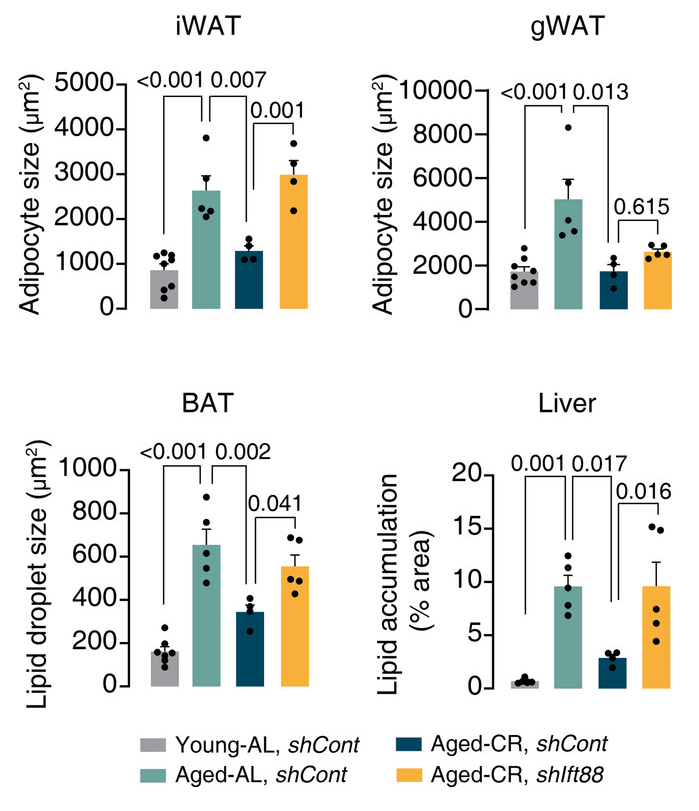
Caloric restriction, which increases NAD+, was found to have similar effects as direct NAD+ interventions in vivo. 24-month-old mice were put on a caloric restriction regimen, and some of them were given silencing RNA against a key ciliary growth gene in the hypothalamus. While calorically restricted aged mice without this silencing RNA had metabolic measurements that were more akin to those of young mice, aged mice with this silencing RNA had some adipose tissue measurements that suggested that they had never been given caloric restriction even though they were. This, therefore, demonstrates that “hypothalamic primary cilia are required for the CR–induced improvements in aging–associated metabolic phenotypes.”

This study’s findings are rather striking, as they point to very specific parts of very specific neurons as being fundamental, causative actors in a commonplace longevity intervention. Further work should be done to confirm these findings and determine whether or not there may be interventions that can directly engage the cilia in the hypothalamus in order to treat metabolic disorders.
Literature
[1] Singla, V., & Reiter, J. F. (2006). The primary cilium as the cell’s antenna: signaling at a sensory organelle. science, 313(5787), 629-633.
[2] Lee, C. H., Kang, G. M., & Kim, M. S. (2022). Mechanisms of weight control by primary cilia. Molecules and cells, 45(4), 169-176.
[3] Davenport, J. R., Watts, A. J., Roper, V. C., Croyle, M. J., van Groen, T., Wyss, J. M., … & Yoder, B. K. (2007). Disruption of intraflagellar transport in adult mice leads to obesity and slow-onset cystic kidney disease. Current Biology, 17(18), 1586-1594.
[4] Orhon, I., Dupont, N., Pampliega, O., Cuervo, A. M., & Codogno, P. (2015). Autophagy and regulation of cilia function and assembly. Cell Death & Differentiation, 22(3), 389-397.
[5] Rubinsztein, D. C., DiFiglia, M., Heintz, N., Nixon, R. A., Qin, Z. H., Ravikumar, B., … & Tolkovsky, A. (2005). Autophagy and its possible roles in nervous system diseases, damage and repair. Autophagy, 1(1), 11-22.
[6] Oya, M., Miyasaka, Y., Nakamura, Y., Tanaka, M., Suganami, T., Mashimo, T., & Nakamura, K. (2024). Age-related ciliopathy: Obesogenic shortening of melanocortin-4 receptor-bearing neuronal primary cilia. Cell Metabolism, 36(5), 1044-1058.
[7] Lee, I. H., Cao, L., Mostoslavsky, R., Lombard, D. B., Liu, J., Bruns, N. E., … & Finkel, T. (2008). A role for the NAD-dependent deacetylase Sirt1 in the regulation of autophagy. Proceedings of the National Academy of Sciences, 105(9), 3374-3379.
[8] Kang, G. M., Han, Y. M., Ko, H. W., Kim, J., Oh, B. C., Kwon, I., & Kim, M. S. (2015). Leptin elongates hypothalamic neuronal cilia via transcriptional regulation and actin destabilization. Journal of Biological Chemistry, 290(29), 18146-18155.